×Description:
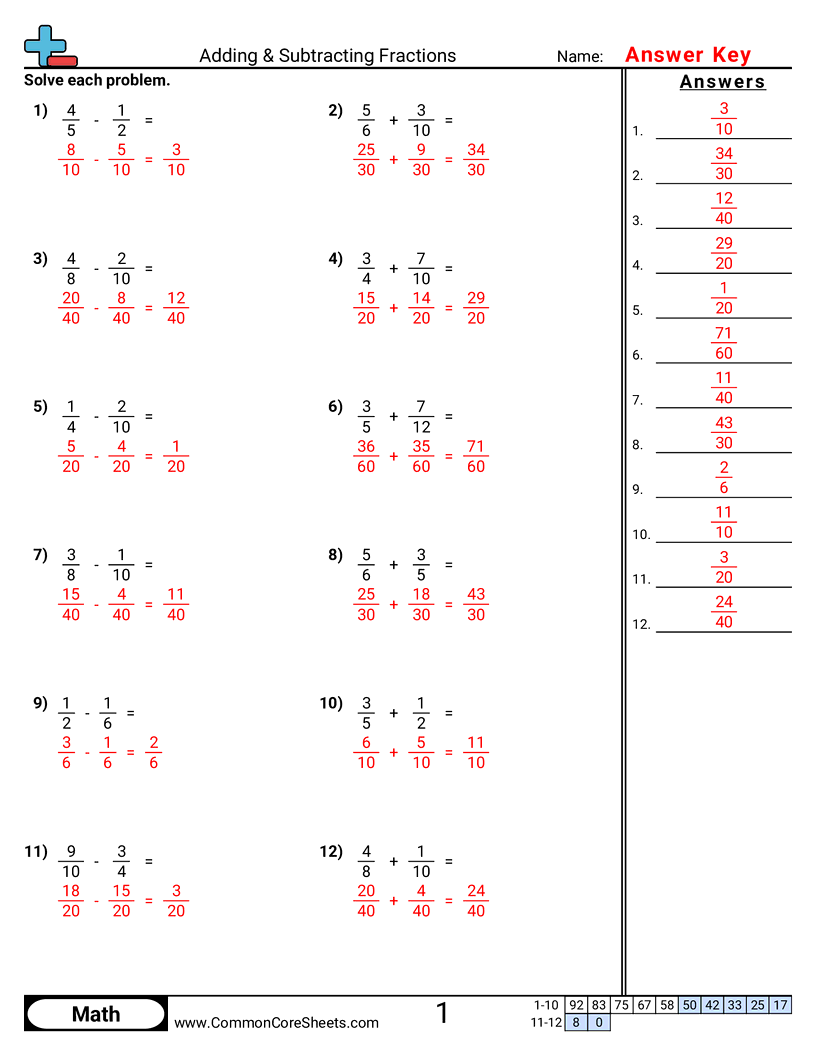
"This worksheet is designed for children to learn and practice adding and subtracting fractions, a key mathematical concept. Featuring 12 examples, it helps children grasp the process of fractional arithmetic, converting fractions, and simplifying results. Tailored to suit diverse needs, it can be customized, converted into interactive flash cards for individual study or used in distance learning platforms."
×Student Goals: Understanding of FractionsAfter completing the worksheet, students should gain a thorough understanding of the fundamental concepts of fractions. This includes recognising fractions as being composed of a numerator and a denominator, and understanding that fractions represent a part of a whole. Moreover, they would develop a deep familiarity with the notion of equivalent fractions and how to simplify fractions.Addition and Subtraction of FractionsStudents will acquire competencies in performing addition and subtraction of fractions with different or similar denominators. They should be able to use techniques such as finding the common denominator to add or subtract fractions efficiently. These activities will enhance students' arithmetic skills and help them understand the mechanics of fractional computation.Problem-solving SkillsAs students work through the problems presented in the worksheet, they will enhance their problem-solving skills. This involves applying mathematical principles, logical thinking, and analytical skills to solve the problems correctly. They would be able to approach fractions with flexibility and adaptability, benefiting them in various mathematical contexts.Critical Thinking DevelopmentBy engaging in the problems included in the worksheet, students will foster their critical thinking skills. They will be challenged to think methodically, reason logically, and make connections between different mathematical concepts. As a result of this practice, they will be more proficient in assessing, analysing, and solving mathematical problems.Academic ConfidenceSuccessfully navigating through the problems in the worksheet would imbue students with a sense of academic confidence. They will gain confidence in their ability to handle more complex mathematical problems involving fractions. Additionally, this self-confidence boost could inspire a greater interest in the subject of Mathematics in general.