×Description:
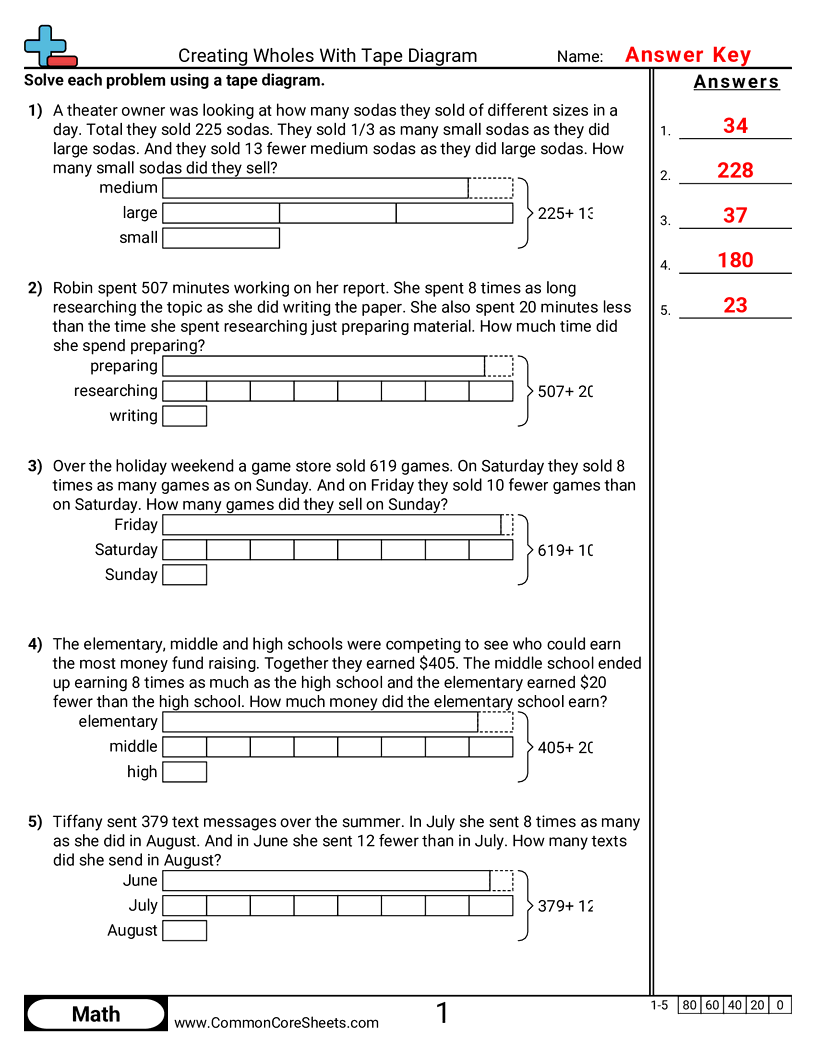
"This worksheet is designed to teach children the concept of mathematical problem-solving using tape diagrams, focusing on relationships between whole quantities. Students tackle five dynamic problems involving real life scenarios ranging from fundraising, time management, business operations, baking, and communication patterns. The worksheet can be customized, converted into flashcards for reinforced learning, or used in distance learning environments, ensuring versatile and engaging experiences."
×Student Goals: Enhanced Problem-Solving SkillsAfter completing this worksheet, students should have a strengthened ability to tackle complex problems using logical thinking. They should be able to interpret real-life situations and convert them into mathematical equations, and vice versa. Thereby, they'll sharpen their problem-solving skills, a universal asset applicable in diverse academic and daily life situations.Proficiency in Mathematical CalculationsStudents should be able to calculate math problems effectively, using a variety of mathematical operations such as addition, multiplication, and division. These foundational calculate skills are essential and will act as building blocks for more complex mathematical problems in later studies.Understanding of Proportional RelationshipsAfter engaging in these exercises, students will gain an improved understanding of the concept of proportional relationships. Through numerical examples, they'll gain the capacity to determine and compare proportions, fostering their ability to envision larger number relationships and trends.Improved Reading ComprehensionThe practice provided by the worksheet helps enhance the students' reading comprehension skills. They must carefully read and understand the word problems to determine the steps needed to solve each problem. This skill is useful not only in higher-level math, but also across various academic subjects.Development of Strategic ThinkingWith the given problems, students will develop strategic thinking. They will learn how to effectively use strategies such as tape diagrams to visualize the elements of a problem, organize information, and understand the relationships between different components. This skill, once developed, is transferable across other subjects and real-life scenarios.Enhanced Analytical SkillsFinally, students should be able to demonstrate improved analytical skills. They should be able to decide on the best methods for solving problems and justify their choices. They will be able to analyze the problem, apply the correct mathematical process, and draw valid conclusions based on their analyses. These are critical skills for future math work as well as a broad range of careers and life scenarios.