Robin Bird Worksheet Download
Free reading worksheets on Robin Bird. Each worksheet has 20 problems with an answer key and are ideal for teachers and homeschooling. You can download the PDF, create a set of flash cards or set it up for online learning.
Select a Different Activity
>


Sheet Information >
Available at 2nd grade, 3rd grade, 4th grade, 5th grade and 6th grade reading levels.
Read the passage
Robins are small, friendly birds that are fun to learn about. They have a bright red chest and a brownish-grey body, which makes them easy to spot. These charming birds live in North America, Europe, and parts of Asia, and usually make their nests in trees or bushes.
One of the coolest things about robins is their diet, as they eat a variety of things. They mainly munch on insects, worms, and berries, and sometimes you can see them hopping around on the ground looking for their next meal. Robins also have an interesting life cycle, as they lay small, blue eggs in their nests, and the baby birds hatch after about two weeks.
Robins have a special relationship with humans and other animals. They often live near people\'s houses, and some even build their nests in unusual places, like on top of a garden hose reel. While they are friendly with humans, they sometimes have to defend themselves against bigger birds and animals, like cats, by using their sharp beaks and strong wings.
Meet the robin, a small and colorful bird found in many parts of the world. Robins have a reddish-orange chest and belly, with gray and brown feathers on top. They are known to be friendly and sociable, often hopping around close to humans in search of food. Did you know that these little birds can sing beautifully, especially in the early morning?
Now let\'s talk about where robins live and what they eat. You can find them in gardens, parks, and woodlands, building their nests in trees or bushes. Robins are omnivores, which means they eat both plants and animals. Their diet mainly consists of insects, worms, fruits, and berries.
Finally, let\'s learn about the life cycle of a robin and their relationships with other animals. Robins typically lay 3-5 blue eggs in their nest, and after about two weeks, the baby robins hatch. As they grow, robins have to be careful of predators like cats, snakes, and larger birds who might try to eat them. However, humans and robins often have a friendly relationship, with many people enjoying the sight and sound of these charming birds in their yards.
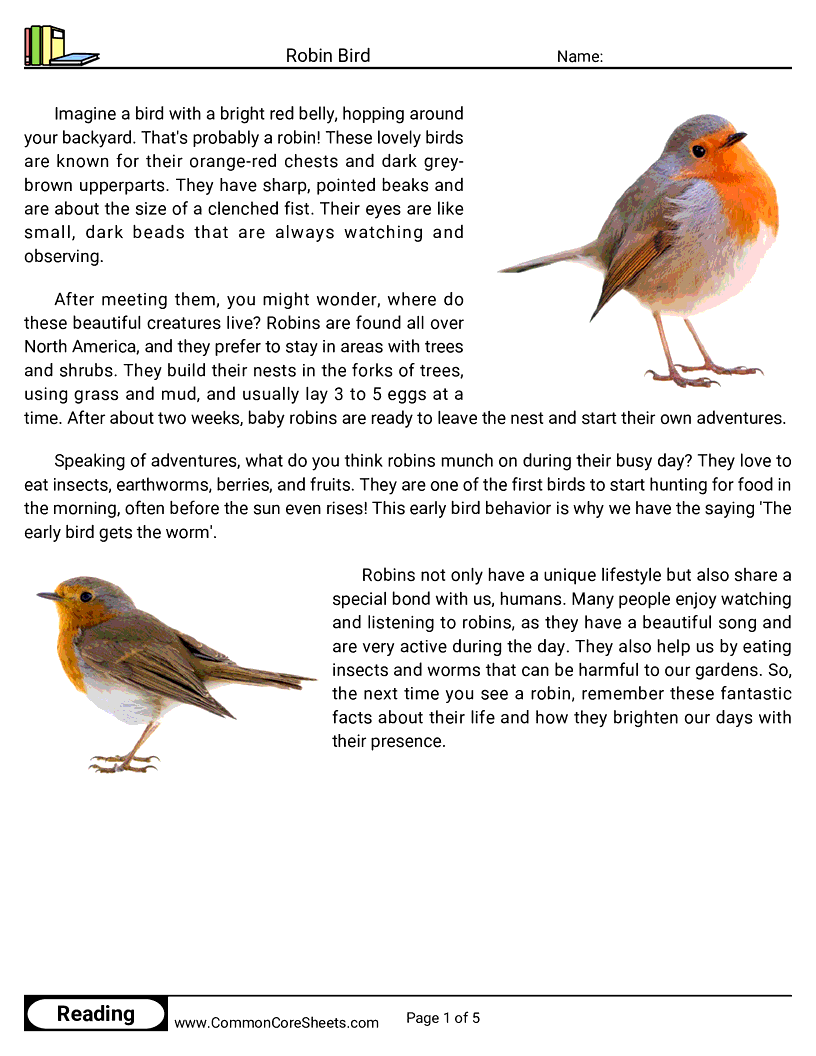
Imagine a bird with a bright red belly, hopping around your backyard. That's probably a robin! These lovely birds are known for their orange-red chests and dark grey-brown upperparts. They have sharp, pointed beaks and are about the size of a clenched fist. Their eyes are like small, dark beads that are always watching and observing.
After meeting them, you might wonder, where do these beautiful creatures live? Robins are found all over North America, and they prefer to stay in areas with trees and shrubs. They build their nests in the forks of trees, using grass and mud, and usually lay 3 to 5 eggs at a time. After about two weeks, baby robins are ready to leave the nest and start their own adventures.
Speaking of adventures, what do you think robins munch on during their busy day? They love to eat insects, earthworms, berries, and fruits. They are one of the first birds to start hunting for food in the morning, often before the sun even rises! This early bird behavior is why we have the saying 'The early bird gets the worm'.
Robins not only have a unique lifestyle but also share a special bond with us, humans. Many people enjoy watching and listening to robins, as they have a beautiful song and are very active during the day. They also help us by eating insects and worms that can be harmful to our gardens. So, the next time you see a robin, remember these fantastic facts about their life and how they brighten our days with their presence.
Have you ever seen a little bird with a red chest hopping around in your backyard? That\'s probably a robin! Robins are one of the most common birds you\'ll find in North America and Europe. In this article, we\'re going to learn all about these fascinating birds and what makes them special.
Let\'s start off by talking about what robins like to eat. These birds have a diverse diet, munching on insects, earthworms, and even fruit. You might have seen a robin tugging a worm out of the ground in the early morning – that\'s their favorite breakfast! But, during the winter months, they mostly rely on fruits and berries to keep their energy levels up.
Now, let\'s discuss where robins live and what their nests look like. Robins are known to build their nests in trees, bushes, and sometimes even on the ledges of buildings. Their nests are made of grass, twigs, and mud, with a soft lining of feathers and leaves on the inside. Usually, they lay 3-5 eggs, which are a beautiful shade of blue.
Do you know that robins have a unique relationship with humans and other animals? Humans often enjoy watching and listening to robins, as they have a beautiful song and are active during the day. Robins also help control insect populations, which can be beneficial for gardens. However, they can be territorial and might chase away other birds or small animals that come too close to their nests.
Finally, let\'s explore some differences between robins and other bird species and learn some interesting facts. One of the most noticeable differences is their red or orange chest, which sets them apart from other birds. Robins can also recognize their own reflection in mirrors or windows, which is unusual for birds. Did you know that robins are part of the thrush family, and their scientific name is 'Turdus migratorius'?
Now you know all about the charming robin bird! Keep an eye out for them in your backyard or local park, and enjoy their delightful presence.
Let\'s learn about the amazing robin bird, a fascinating creature that can be easily spotted with its bright red breast. Robins are small birds that are commonly found in gardens, parks, and woodlands. Their beautiful colors and melodious songs make them a favorite among birdwatchers and nature enthusiasts. In this article, we will explore the life of a robin, including its habitat, diet, and interesting facts about its behavior. So, let\'s dive into the wonderful world of robins!
Robins can be found in various habitats, from forests to backyards. They usually prefer areas with trees, shrubs, and grassy spaces where they can find food, nest, and hide from predators. Robins are migratory birds, which means they travel to different areas depending on the season. In the summer months, they can be found in North America, while in the winter, they travel to Central America to escape the cold. Their adaptability to different environments is one of the reasons they are so widespread.
A robin\'s diet mainly consists of insects, earthworms, and berries. They have a sharp beak that helps them catch insects like caterpillars, spiders, and beetles. Robins also love to eat earthworms, which they often pull out of the ground after heavy rainfall. Additionally, they eat a variety of fruits and berries, which provide them with energy during the cold winter months. Their diverse diet helps them stay healthy and strong throughout the year.
The life cycle of a robin is both interesting and complex. Robins usually start breeding in the spring, when they build a nest using grass, twigs, and mud. Female robins lay between three to five eggs, which are a beautiful shade of blue. Both parents take turns incubating the eggs, keeping them warm and safe until they hatch after about two weeks. The baby robins, or chicks, are born blind and helpless, relying on their parents for food and protection until they are ready to leave the nest and fend for themselves.
Robins have a unique relationship with humans and other animals. They are often seen in gardens, where they help control the insect population and eat unwanted pests. Robins are also known to be territorial, and they can become quite aggressive if they feel their nest is threatened. Although robins may look similar to other species of birds, they are easily distinguished by their red breast, which sets them apart from their relatives. In conclusion, the robin bird is a fascinating creature with a vibrant life, offering joy and beauty to those who observe them in their natural habitat.
About this worksheet
Students read a short passage about robins and answer comprehension questions about their appearance, habits, and habitat.
This worksheet is designed to educate children about Robins, increasing their reading and comprehension skills through 20 engaging problems. The content explores various aspects, including Robin's color, diet, nesting habits, and contribution to the ecosystem. It's adaptable for different educational settings, allowing conversion into flashcards or adjusting for distance learning purposes, offering versatility to every learning-style needs.
Student objectives
- Read a short informational passage about robins
- Answer questions using details from the text
- Learn basic facts about where robins live and what they eat
- Practice finding key information in a reading passage
Everyday practice
- Recognize a robin in your yard and recall what it eats
- Talk about the birds you see outside and describe them
- Explain to a friend why robins build nests in spring
- Point out a robin's red chest when birdwatching with family