Poison Dart Frog Worksheet Download
Free reading worksheets on Poison Dart Frog. Each worksheet has 20 problems with an answer key and are ideal for teachers and homeschooling. You can download the PDF, create a set of flash cards or set it up for online learning.
Select a Different Activity
>


Sheet Information >
Available at 2nd grade, 3rd grade, 4th grade, 5th grade and 6th grade reading levels.
Read the passage
Hey there, let\'s learn about the colorful and fascinating poison dart frogs! These tiny amphibians come in a variety of bright colors like blue, green, yellow, and red, which warn predators that they are toxic. They live mainly in the rainforests of Central and South America, where they spend most of their time close to the ground searching for food. Poison dart frogs love to eat small insects like ants, termites, and flies, using their long, sticky tongues to catch their prey.
Now let\'s hop into the life cycle of these amazing creatures. Poison dart frogs start as eggs laid by the female on land or leaves, which hatch into tadpoles after about two weeks. The father frog then carries his tadpole babies on his back to a safe water source, where they continue to grow and develop into froglets and eventually adult frogs.
Lastly, let\'s explore their relationship with humans and other animals. The name 'poison dart frog' comes from the fact that indigenous people in South America used their toxic secretions to make poison darts for hunting. Their bright colors and toxicity help protect them from predators, but they can still be prey for some animals like snakes and spiders that have developed resistance to their poison. While they may be dangerous in the wild, some species of poison dart frogs can be kept as pets by experienced frog lovers, as long as they are cared for properly. So, not only are poison dart frogs interesting to look at, but their unique features and life cycle make them truly one-of-a-kind creatures!
Hey there, have you ever heard about the Poison Dart Frog? These little colorful creatures live mainly in the rainforests of Central and South America. They come in many bright colors like blue, green, yellow, and red, which help them to warn predators that they are toxic. But don\'t worry, not all poison dart frogs are toxic to other animals or humans!
Let\'s talk about the poison dart frog\'s life cycle and what they eat. These cute amphibians lay their eggs on land, and when the eggs hatch, the tadpoles ride on their parents' backs to find a safe pool of water. Poison dart frogs love to eat small insects like ants, flies, and beetles, which they catch with their long, sticky tongues. Some species of poison dart frogs get their toxins from the insects they eat, so their diet is super important!
Now, let\'s explore their relationship with other animals and humans. Despite their name, most poison dart frogs are not dangerous to humans unless we touch or eat them. In fact, some indigenous people have been using the poison from their skin to make their hunting darts more effective. These fascinating frogs have a special role in the ecosystem, helping to control insect populations and serving as a warning to other animals about the dangers of toxic creatures.
Now you know more about the colorful and fascinating world of poison dart frogs. Remember to always admire these amazing creatures from a safe distance!
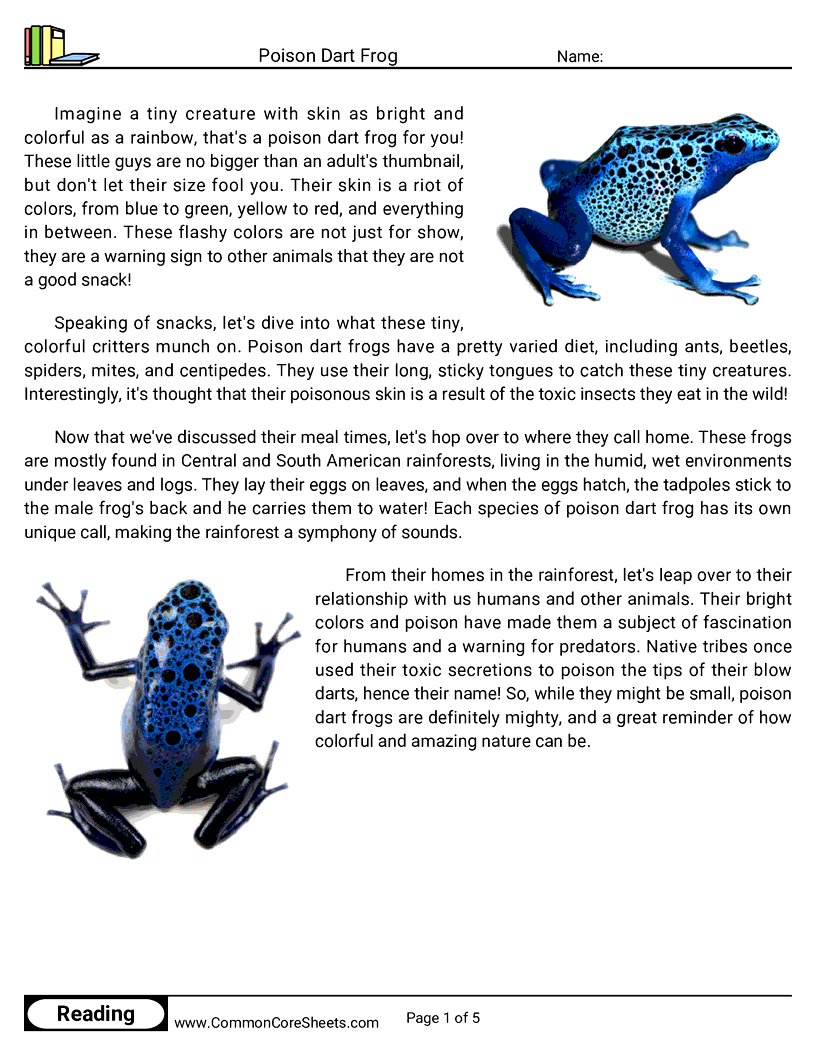
Imagine a tiny creature with skin as bright and colorful as a rainbow, that's a poison dart frog for you! These little guys are no bigger than an adult's thumbnail, but don't let their size fool you. Their skin is a riot of colors, from blue to green, yellow to red, and everything in between. These flashy colors are not just for show, they are a warning sign to other animals that they are not a good snack!
Speaking of snacks, let's dive into what these tiny, colorful critters munch on. Poison dart frogs have a pretty varied diet, including ants, beetles, spiders, mites, and centipedes. They use their long, sticky tongues to catch these tiny creatures. Interestingly, it's thought that their poisonous skin is a result of the toxic insects they eat in the wild!
Now that we've discussed their meal times, let's hop over to where they call home. These frogs are mostly found in Central and South American rainforests, living in the humid, wet environments under leaves and logs. They lay their eggs on leaves, and when the eggs hatch, the tadpoles stick to the male frog's back and he carries them to water! Each species of poison dart frog has its own unique call, making the rainforest a symphony of sounds.
From their homes in the rainforest, let's leap over to their relationship with us humans and other animals. Their bright colors and poison have made them a subject of fascination for humans and a warning for predators. Native tribes once used their toxic secretions to poison the tips of their blow darts, hence their name! So, while they might be small, poison dart frogs are definitely mighty, and a great reminder of how colorful and amazing nature can be.
Let\'s learn about the amazing poison dart frog, a small and colorful creature that lives in the rainforests. They can be found in Central and South America, with the highest concentration in countries like Costa Rica, Brazil, and Colombia. These tiny frogs have vibrant colors that warn predators to stay away, as their skin is coated with a toxic substance. There are over 170 different species of poison dart frogs, and they come in a variety of colors, patterns, and sizes.
Poison dart frogs have a fascinating life cycle that begins with their eggs. The female frog lays her eggs on leaves or other surfaces near water, and the male frog guards them until they hatch into tadpoles. Once the tadpoles hatch, they climb onto the male\'s back, who carries them to a safe water source where they continue to grow. After a few weeks, the tadpoles transform into adult frogs and start their life on land.
These intriguing frogs have quite an appetite and eat a variety of insects. Their diet mainly consists of ants, termites, flies, and even small spiders. In the wild, the insects they eat have toxins in their bodies that the poison dart frogs store in their skin, making them toxic to predators. However, poison dart frogs raised in captivity are not toxic, as their diet does not contain these toxin-carrying insects.
Poison dart frogs are called so because some indigenous tribes used their toxic secretions to poison the tips of their blowdarts for hunting. These tribes have a deep understanding of the frogs and their habitats, which allows them to use the frogs' toxins without harming themselves. Nowadays, researchers are studying the toxins of these frogs for potential medical uses, such as painkillers and heart stimulants. It is important to remember that these frogs should not be touched, as their toxins can cause harm to humans.
Lastly, let\'s discover some interesting facts about poison dart frogs and their relationship with other animals. Their bright colors are a warning sign to predators that they are toxic and should not be eaten, a defense mechanism called 'aposematism'. Some animals, like snakes and birds, have adapted to be able to eat poison dart frogs without being affected by their toxins. Despite their small size and toxic defense, poison dart frogs play a crucial role in the rainforest ecosystem as both predators and prey.
Poison dart frogs are fascinating creatures that come in a variety of vibrant colors. These small frogs are native to Central and South America, usually found in tropical rainforests near water sources such as ponds and streams. Their bright colors aren\'t just for show, as they serve as a warning to predators that these frogs are toxic and not to be messed with. There are over 100 different species of poison dart frogs, each with their unique appearance and level of toxicity. Some of the most well-known species include the golden poison dart frog, the strawberry poison dart frog, and the blue poison dart frog.
When it comes to their diet, poison dart frogs are insectivores. This means they primarily consume insects such as ants, termites, flies, and small beetles. These insects provide the frogs with the toxins that make them poisonous, as they themselves are not naturally toxic. Some species of poison dart frogs have even been found to eat tiny spiders and other small invertebrates. In captivity, however, these frogs lose their toxicity as their diet changes to non-toxic insects.
The life cycle of a poison dart frog is unique and fascinating. Females lay their eggs on leaves or other surfaces near water, and the male frog then fertilizes them. When the eggs hatch, the tadpoles are carried on the backs of their parents to nearby water sources. Here, they develop into froglets and eventually into fully grown frogs. The process from egg to adult takes about three months, with the frogs living for an average of three to six years.
Poison dart frogs have an interesting relationship with both humans and other animals. Their bright colors and unique patterns make them popular attractions at zoos and aquariums around the world. For centuries, indigenous people have used the toxins from these frogs to coat the tips of their blow darts for hunting. In the natural world, the frogs' vibrant colors serve as a warning to predators, making them less likely to become prey. Some other animals, like the harmless mimic poison frog, have evolved to resemble the colorful poison dart frogs, benefiting from their reputation without actually being toxic.
There are several fascinating facts about poison dart frogs that set them apart from other species. For example, not all poison dart frogs are toxic, with some species possessing little to no toxins. The level of toxicity varies between species, with the golden poison dart frog being the most toxic of all, containing enough poison to kill up to 20 adult humans. Interestingly, poison dart frogs raised in captivity lose their toxicity due to the change in their diet. These incredible amphibians continue to captivate us, showcasing the wonders of the natural world and the importance of protecting their habitats.
About this worksheet
Students read an informational passage about poison dart frogs and answer comprehension questions about the details they read.
This worksheet is designed to educate children about the fascinating world of Poison Dart Frogs. Engaging in 20 interactive reading problems, students will explore varied aspects of these frogs, including their lifecycle, habitat, and unique characteristics. The customizable worksheet also offers the ability to be converted into flashcards, and is perfectly suited for distance learning environments, making it an adaptable educational resource for various teaching strategies.
Student objectives
- Read a nonfiction passage and understand the main idea
- Find and recall facts about poison dart frogs from the text
- Answer questions using details from what you read
- Learn new vocabulary related to frogs and their habitat
Everyday practice
- Understand facts when reading an animal book or magazine article
- Answer questions about a story or article you just read
- Pick out important details while reading at the library or online
- Explain what an article was about to a friend or family member