Peregrine Falcon Worksheet Download
Free reading worksheets on Peregrine Falcon. Each worksheet has 20 problems with an answer key and are ideal for teachers and homeschooling. You can download the PDF, create a set of flash cards or set it up for online learning.
Select a Different Activity
>


Sheet Information >
Available at 2nd grade, 3rd grade, 4th grade, 5th grade and 6th grade reading levels.
Read the passage
Hello there, have you ever heard about Peregrine Falcons? They are amazing birds, known for their speed, as they can swoop down on their prey at over 240 miles per hour! These falcons love to eat other birds, like pigeons and ducks, and sometimes bats too.
Now, let's talk about where Peregrine Falcons live and their life cycle. These falcons can be found all over the world, from the cold Arctic tundra to the hot desert, and they live in tall structures like cliffs, skyscrapers, and bridges. They lay their eggs in a scrape, a shallow hole in the ground, and after the babies hatch, they stay with their parents for up to two months before they're ready to fly on their own.
Finally, let's learn about their relationship with humans and other animals, their defenses, and how they're different from other birds. Peregrine Falcons are very important to humans as they help control the population of other birds that can be pests, and while they have no natural predators, they defend themselves by flying high and fast. They are smaller than other falcons, but they are much faster, which makes them unique and fascinating to learn about.
Let's dive into the amazing world of peregrine falcons! These awesome birds are known for their speed, reaching over 240 miles per hour during their high-speed hunting dives, making them the fastest members of the animal kingdom. Peregrine falcons are carnivorous birds, meaning they eat meat, and their favorite meals are other birds like pigeons and doves. They also have sharp, hooked beaks for tearing their food into small, easy-to-eat pieces.
Now, let's talk about where these incredible birds live and their life cycle. Peregrine falcons are found all over the world, except in extreme polar areas and very high mountains. They lay their eggs in high cliffs, tall buildings, or bridges. The life cycle of a peregrine falcon begins when it hatches from an egg, grows into a young falcon, or "fledgling," then becomes an adult capable of hunting and laying eggs.
Peregrine falcons have a fascinating relationship with humans and other animals. While they are natural predators to other birds, they generally don't pose a threat to humans and can even be helpful by controlling populations of pest birds. Despite being predators, peregrine falcons also have defenses against threats, like their incredible speed and sharp talons. And remember, while they may look like other birds of prey, peregrine falcons are unique with their distinctive blue-gray back, barred white underparts, and a dark head with thick sideburns.
In conclusion, peregrine falcons are truly remarkable creatures, with their incredible speed, wide distribution, and interesting life cycle. They are a testament to the wonders of the animal kingdom.
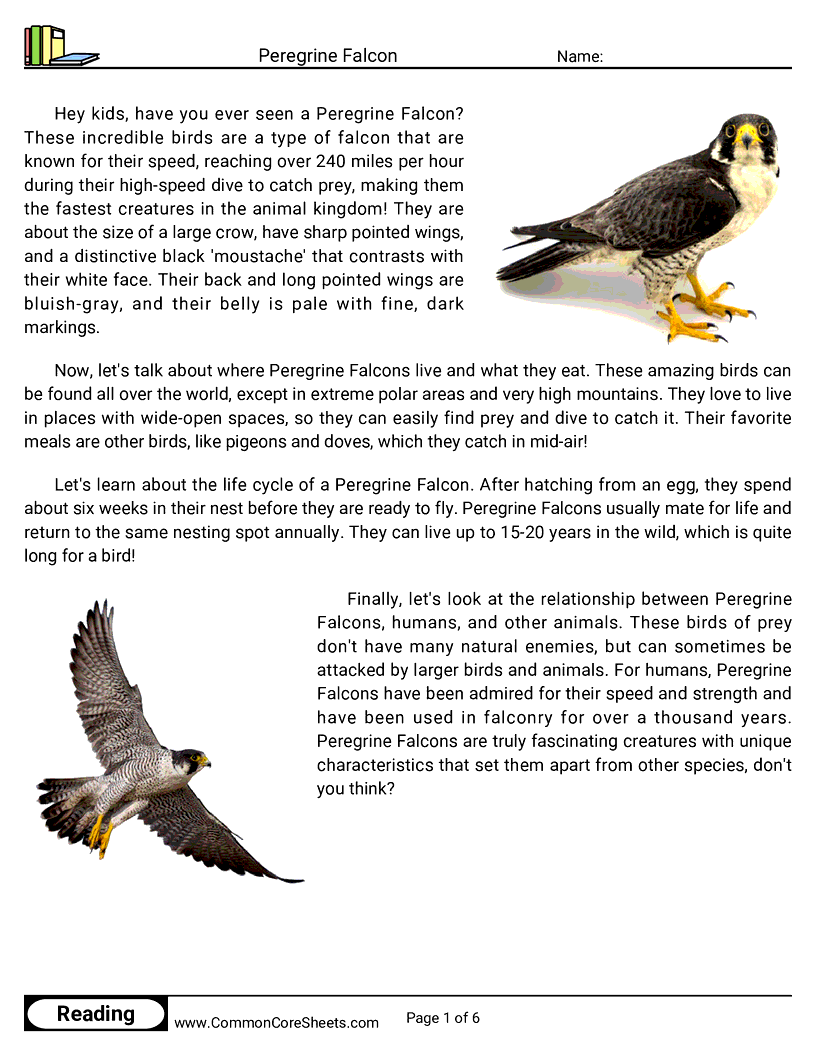
Hey kids, have you ever seen a Peregrine Falcon? These incredible birds are a type of falcon that are known for their speed, reaching over 240 miles per hour during their high-speed dive to catch prey, making them the fastest creatures in the animal kingdom! They are about the size of a large crow, have sharp pointed wings, and a distinctive black 'moustache' that contrasts with their white face. Their back and long pointed wings are bluish-gray, and their belly is pale with fine, dark markings.
Now, let's talk about where Peregrine Falcons live and what they eat. These amazing birds can be found all over the world, except in extreme polar areas and very high mountains. They love to live in places with wide-open spaces, so they can easily find prey and dive to catch it. Their favorite meals are other birds, like pigeons and doves, which they catch in mid-air!
Let's learn about the life cycle of a Peregrine Falcon. After hatching from an egg, they spend about six weeks in their nest before they are ready to fly. Peregrine Falcons usually mate for life and return to the same nesting spot annually. They can live up to 15-20 years in the wild, which is quite long for a bird!
Finally, let's look at the relationship between Peregrine Falcons, humans, and other animals. These birds of prey don't have many natural enemies, but can sometimes be attacked by larger birds and animals. For humans, Peregrine Falcons have been admired for their speed and strength and have been used in falconry for over a thousand years. Peregrine Falcons are truly fascinating creatures with unique characteristics that set them apart from other species, don't you think?
Meet the Peregrine Falcon, a fascinating bird that is known as the fastest animal in the world! These birds are easily recognizable because of their pointed wings and long tail, not to mention their impressive speed. Peregrine Falcons have a blue-grey back, barred white underparts, and a black head and "moustache" that contrast with their white face. They are about the size of a crow, so they are not the biggest birds, but they are definitely one of the most powerful.
Now let's talk about where these amazing birds live. Peregrine Falcons are found on every continent except Antarctica; they love tall buildings and cliffs which provide a great view for spotting prey. These birds are not picky about where they live, they can be found in cities or in the wild, anywhere from the snowy Arctic tundra to the sunny tropics. So next time you're in a city, look up! You might spot a Peregrine Falcon.
You might be wondering what Peregrine Falcons eat. Well, they primarily eat other birds, which they catch in mid-air with their strong, sharp talons. Their diet includes pigeons, ducks, and even other types of falcons. The Peregrine Falcon's incredible speed helps them catch their prey in a spectacular aerial chase.
Peregrine Falcons have an interesting life cycle. They mate for life and return to the same nesting spot annually. The female lays up to four eggs, and both parents take care of the chicks until they are ready to fly and hunt on their own. After about six weeks, the young falcons, called "eyasses", take their first flight.
Peregrine Falcons have a unique relationship with humans and other animals. In some places, they are protected by law because their numbers decreased due to pesticides in the 20th century. Thanks to conservation efforts, their numbers have been increasing, and they continue to impress us with their speed and hunting skills. So, the next time you see a bird swooping down at incredible speed, remember - it might be the amazing Peregrine Falcon.
Hello there, have you ever heard about the amazing Peregrine Falcon? This bird is a real champion in the sky, holding the record for being the fastest bird in the world! It's not just fast, but it's also beautiful, with a blue-grey back, barred white underparts, and a black head. They are quite compact, with long, pointed wings that help them dive at incredible speeds to catch their prey! So let's dive deeper and learn more about these fascinating birds.
First up, let's talk about what Peregrine Falcons like to eat. These birds are carnivores, which means they eat meat. Their favorite meals are other birds, like pigeons and doves, which they catch in mid-air! They also eat bats, and occasionally, they'll snatch up small mammals, reptiles, or insects. Their unique hunting style makes them a thrilling sight in nature.
Now, where can we find these incredible birds? Peregrine Falcons are found all over the world, except in very cold regions like the Arctic, high mountains, and very hot areas like the Sahara. They like to live in a wide variety of habitats, but they're most commonly found near coastlines, where they nest on cliff faces. In cities, they've adapted to nest on tall buildings and bridges, which are similar to their natural cliff environment. So, whether you live in the city or the countryside, you might just spot a Peregrine Falcon!
Peregrine Falcons have a very interesting life cycle. After hatching from eggs, the chicks, called 'eyasses,' stay in the nest for about six weeks while their parents bring them food. Then they start learning to fly and hunt, practicing their skills with their parents for another couple of months. By the time they're about a year old, they're ready to have offspring of their own. It's a pretty quick growing-up process compared to humans, isn't it?
Lastly, let's talk about the Peregrine Falcon's relationship with humans and other animals. Sadly, Peregrine Falcons were once endangered due to pesticides like DDT, but thanks to humans' efforts, their numbers have greatly recovered. They are also very important for controlling populations of other birds, especially in cities. Their main defenses are their speed and sharp talons, which they use to snatch their prey right out of the sky! So remember, every time you see a Peregrine Falcon, you're looking at a true survivor and a champion of the skies!
About this worksheet
Students read a short passage about the peregrine falcon and answer comprehension questions about its speed, habitat, diet, and behavior.
This worksheet is designed to educate children about Peregrine Falcons, covering all aspects from the bird's identification features, lifestyle, diet, lifespan, and their association with human activities. It consists of 20 problems that stimulate reading and comprehension skills. Customizable for various age groups, this educational tool is perfect for distance learning environments and can easily be transformed into flashcards for improved retention.
Student objectives
- Read a nonfiction passage about the peregrine falcon and understand the main ideas
- Find specific facts and details in the text to answer questions
- Learn new vocabulary related to birds and their habits
- Practice pulling information directly from what you read
Everyday practice
- Read facts about an animal at the zoo and remember what makes it special
- Look up information about a bird you spotted outside
- Share interesting facts about fast animals with friends or family
- Answer questions after reading an article in a kids' nature magazine