Exponents Multiplication Worksheets
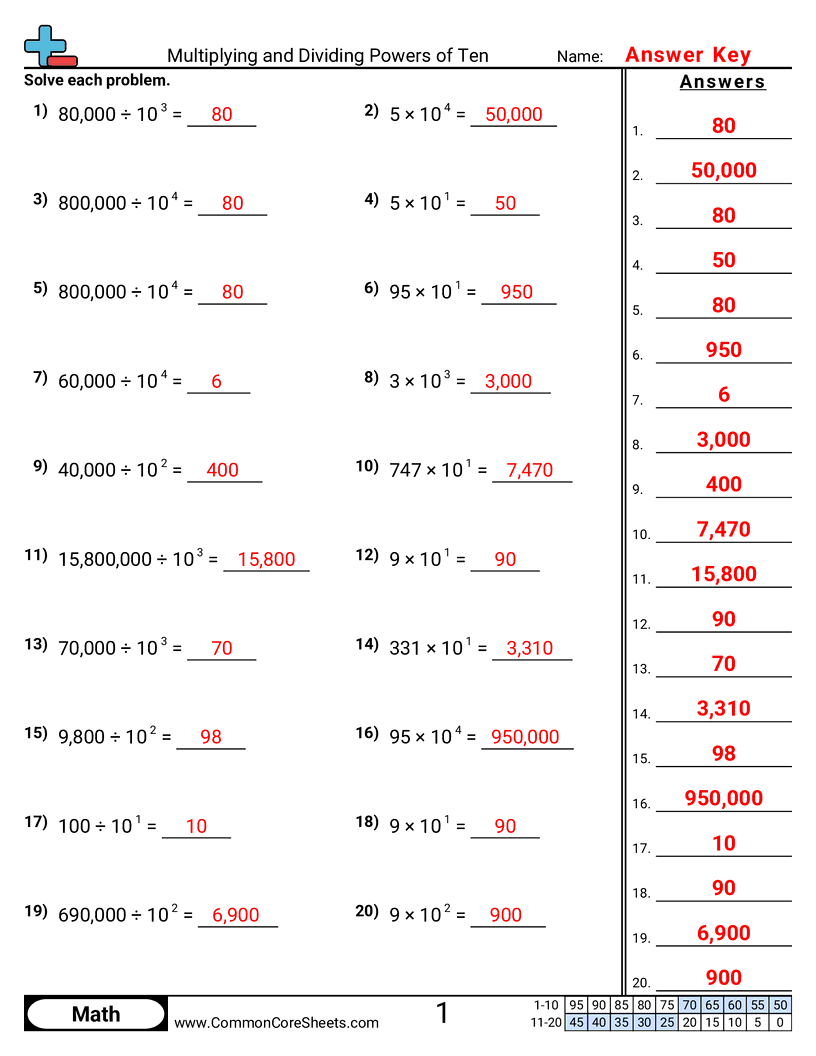
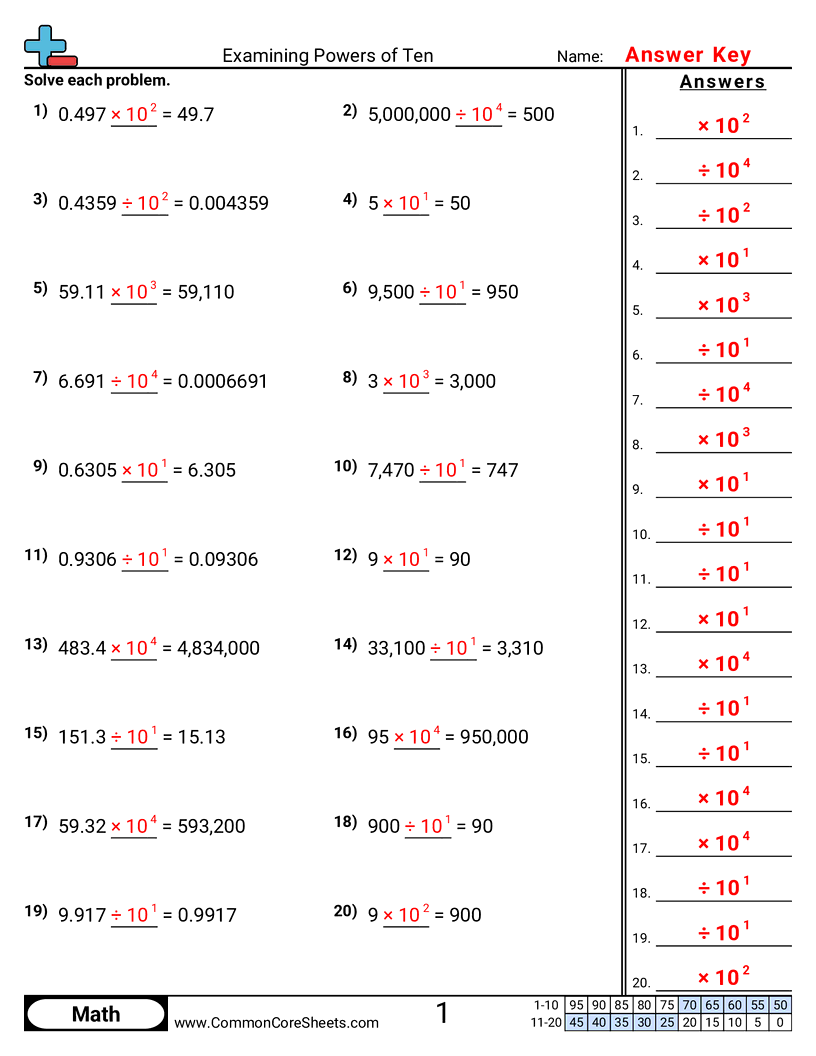
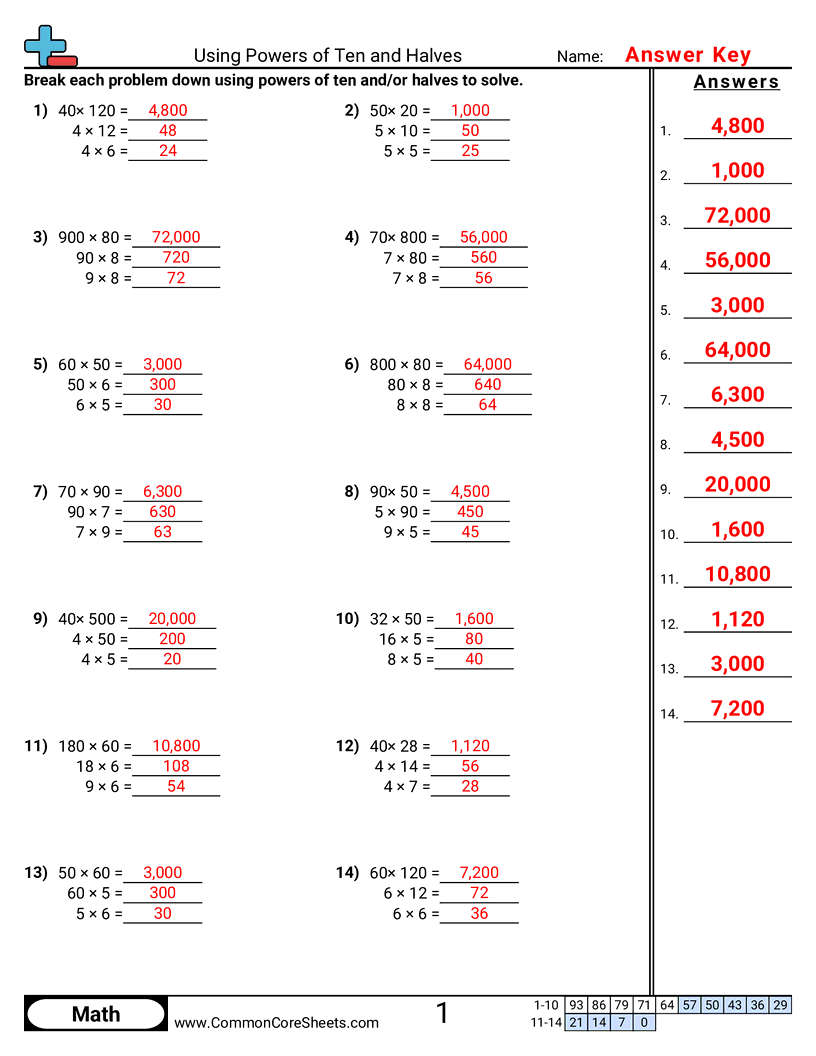
These exponents worksheets for 5th-6th grade students introduce fundamental concepts of powers of ten and whole-number exponents. Students practice multiplying and dividing by powers of ten, examining digit patterns, filling in equations with correct powers, and applying doubling-halving strategies through 97 engaging problems.
More about these worksheets ▾ Show less ▴
×
About these worksheets
These worksheets introduce exponents and powers of ten. Students practice multiplying and dividing by powers of ten, examining what happens to digits when multiplying by 10, 100, or 1,000, filling in equations with the correct power of ten, and using doubling and halving strategies. Aligned with fifth grade standards.
5nbt2
Multiply a number by 10, 100, 1,000 (and other powers of ten) by shifting the digits to the left. Divide a number by 10, 100, 1,000 (and other powers of ten) by shifting the digits to the right. Use place value to keep track of zeros and decimal points when multiplying or dividing by powers of ten.
5nbt2
Multiply a number by 10, 100, 1,000 (and other powers of ten) by shifting the digits to the left. Divide a number by 10, 100, 1,000 (and other powers of ten) by shifting the digits to the right. Use place value to keep track of zeros and decimal points when multiplying or dividing by powers of ten.
5nbt2
Multiply a whole number by 10, 100 or 1,000 without writing out the computation. Explain that multiplying by 10 shifts every digit one place to the left. Predict how many zeros the product will have before working it out.
5nbt2
Divide a whole number by 10, 100 or 1,000 without writing out the computation. Explain that dividing by 10 shifts every digit one place to the right. Predict how many zeros the quotient will have before working it out.
5nbt2
Recognize and write powers of ten using exponents (like 10^3). Multiply by powers of ten by shifting digits and adding the right number of zeros. Match an equation to the correct power of ten that makes it true.
5nbt2
Use doubling and halving to make multiplication easier (like halving one factor and doubling the other). Solve multi-step multiplication equations by breaking them into simpler parts you can do mentally.
6ee1
Read exponent notation and say what the base and exponent mean. Rewrite powers as repeated multiplication (expanded form). Evaluate simple powers to find the value of an expression. Convert between exponent form and expanded multiplication form.
6ee1
Evaluate a power with a whole-number base and exponent. Recognize that an exponent of 1 leaves the base unchanged. Work beyond squares and cubes.
6ee1
Continue a pattern of consecutive powers. Write a number as a power of a given base. See that a power pattern multiplies rather than adds.
6ee1
Decide whether a number is a perfect square. Recall the squares up to 400. Reject a number that is close to a square but is not one.
Playwire Advertisement