Montezuma Quail Worksheet Download
Free reading worksheets on Montezuma Quail. Each worksheet has 20 problems with an answer key and are ideal for teachers and homeschooling. You can download the PDF, create a set of flash cards or set it up for online learning.
Select a Different Activity
>


Sheet Information >
Available at 2nd grade, 3rd grade, 4th grade, 5th grade and 6th grade reading levels.
Read the passage
Hey there, have you ever heard about Montezuma Quails? They are small, round birds that are found in Mexico, Texas, and Arizona, living in grassy areas and forests. With their fancy feather patterns, males look like they're wearing a mask and a necklace, while females have a more simple, brown color.
Now, let's learn about what they eat and their life cycle. Montezuma Quails love to eat insects, seeds, and especially bulbs of plants, which they can find with their strong, short beaks. After mating in the summer, the female lays about a dozen eggs that hatch in only three weeks - that's super fast!
Finally, let's find out how they get along with humans and other animals, and how they protect themselves. People usually don't see them because they are shy and hide when they sense danger, they can even run really fast if they need to! They are different from other quails because they spend most of their time on the ground instead of flying, and did you know that the male Montezuma Quail can make a sound like a popping balloon to scare off enemies?
Let's start our adventure with a peek at the Montezuma Quail, a fascinating bird to learn about. These distinctive birds are easily spotted by their bold black and white face pattern and chunky bodies, covered in beautiful, speckled feathers. The Montezuma Quails are homebodies, preferring to live in Mexico and the southwestern United States, particularly within grasslands, oak woodlands, and pine forests. Interestingly, they are quite shy and prefer to walk or run rather than fly.
Let's explore what these quails eat and their life cycle. Montezuma Quails are omnivores, which means they eat both plants and small animals, like insects, seeds, and tubers (which are like plant roots). When it's time to start a family, the female quail lays about 10 to 12 eggs, which hatch after only three weeks. After hatching, the baby quails, called chicks, can walk and feed themselves almost immediately - isn't that amazing?
Finally, let's learn about their relationship with humans and other animals, their defenses, and what makes them unique. Humans often enjoy watching these birds in the wild, but sometimes Montezuma Quails can be skittish and hide from people. As for other animals, Montezuma Quails can be prey for larger predators, but they have a clever trick - they freeze in place and blend into their surroundings to avoid being noticed! Compared to other quail species, Montezuma Quails are more round in shape and have a very unique call that sounds like a laugh - making them one of the most interesting birds to spot in the wild!
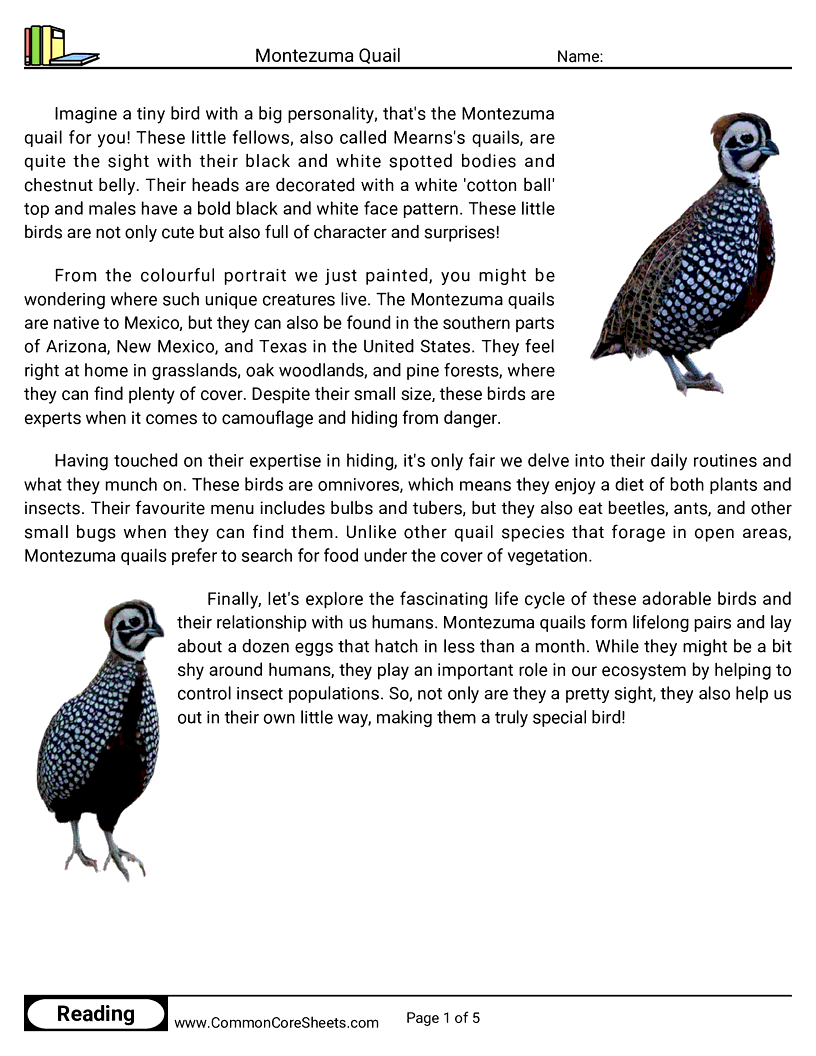
Imagine a tiny bird with a big personality, that's the Montezuma quail for you! These little fellows, also called Mearns's quails, are quite the sight with their black and white spotted bodies and chestnut belly. Their heads are decorated with a white 'cotton ball' top and males have a bold black and white face pattern. These little birds are not only cute but also full of character and surprises!
From the colourful portrait we just painted, you might be wondering where such unique creatures live. The Montezuma quails are native to Mexico, but they can also be found in the southern parts of Arizona, New Mexico, and Texas in the United States. They feel right at home in grasslands, oak woodlands, and pine forests, where they can find plenty of cover. Despite their small size, these birds are experts when it comes to camouflage and hiding from danger.
Having touched on their expertise in hiding, it's only fair we delve into their daily routines and what they munch on. These birds are omnivores, which means they enjoy a diet of both plants and insects. Their favourite menu includes bulbs and tubers, but they also eat beetles, ants, and other small bugs when they can find them. Unlike other quail species that forage in open areas, Montezuma quails prefer to search for food under the cover of vegetation.
Finally, let's explore the fascinating life cycle of these adorable birds and their relationship with us humans. Montezuma quails form lifelong pairs and lay about a dozen eggs that hatch in less than a month. While they might be a bit shy around humans, they play an important role in our ecosystem by helping to control insect populations. So, not only are they a pretty sight, they also help us out in their own little way, making them a truly special bird!
Let's dive into the fascinating world of Montezuma quails! These unique birds are small and plump with striking patterns that make them look like they're wearing a fancy suit. Native to the southwestern United States and parts of Mexico, they love to hang out in oak woodlands and pine-oak forests. Incredible fact, they are also known as 'Mearns Quail' after the American naturalist Edgar Alexander Mearns who discovered them.
Now, let's talk about the fabulous diet of Montezuma quails. Primarily, they feast on plant materials such as bulbs, seeds, and fruits. However, during the breeding season, they switch to a protein-rich diet and munch on insects like beetles and ants. Interestingly, they have a unique way of finding food by turning over rocks and leaves using their beaks.
Montezuma quails have an interesting life cycle. After hatching, the young ones, also known as 'chicks', can run and feed themselves within a few hours. However, they rely on their parents for warmth and protection for the first few weeks. By the time they are two months old, they are ready to start their own adventure.
Humans and Montezuma quails share a very special bond. Bird watchers and nature lovers adore them for their beauty and unique behavior. Hunters, on the other hand, respect them for their elusiveness and consider them a prized game bird. Moreover, they play a crucial role in the ecosystem by controlling the insect population and spreading seeds.
Lastly, let's explore how Montezuma quails interact with other animals and their defense mechanisms. Predators such as bobcats, coyotes, and hawks often pose a threat to these quails. Their primary defense is their camouflaged plumage which blends perfectly with the surrounding vegetation, making them almost invisible. So, the next time you venture into a forest, remember to tread lightly, you might be stepping into the secret world of the Montezuma quails!
Hey there, have you ever heard about Montezuma Quails? These are pretty cool birds, known for their round bodies and speckled feathers. They have a unique look with males having a striking pattern of black and white on their face and chest. Females, on the other hand, have more subdued colors to help them blend in with their surroundings. These birds are also quite small, usually only the size of a pigeon!
Now, let's talk about where these interesting birds live. Montezuma Quails are found in the southwestern United States and down through Mexico and into Central America. They prefer to live in areas with lots of brush and grass, like the foothills of mountains. You might even find them in your backyard if you live in these areas. They also prefer to stay on the ground rather than flying around.
So what do these peculiar birds eat? Well, Montezuma Quails are omnivores which means they eat both plants and animals. They love to snack on things like seeds, fruits, insects, and small creatures. They are pretty good at finding food and use their sharp beaks to dig into the ground for tasty treats. Their diet changes with the seasons, in the winter they eat more plants and in the summer they eat more insects.
Now let's talk about their relationship with humans and other animals. Montezuma Quails are not typically pets, but they can be helpful to humans by eating pests in gardens and farms. As for other animals, they have to be careful of predators like foxes, coyotes, and birds of prey. Their best defense is their ability to blend in with their surroundings, becoming nearly invisible in the brush. They also have a unique way of escaping danger - when threatened, they explode into flight, startling their predator.
Lastly, let's talk about their life cycle and some interesting facts. Montezuma Quails have a pretty short life span, usually around 3 years. They mate for life, which is pretty rare among birds, and the female lays about a dozen eggs at a time. An interesting fact about them is that it's the male who incubates the eggs and takes care of the young ones. So there you have it, a glimpse into the fascinating life of the Montezuma Quail!
About this worksheet
Students read an informational passage about the Montezuma quail and answer questions about its habitat, appearance, and behavior.
This worksheet is designed to enhance children's reading and comprehension skills, focused on the Montezuma Quail. It comes with 20 varied questions; kids learn about their lifecycle, habitat, diet, and beneficial ecological role. These customizable worksheets are perfect for distance learning, adaptable to flash cards, offering a dynamic and flexible approach to environmental education.
Student objectives
- Read a nonfiction passage about a specific bird species
- Find and recall facts stated directly in the text
- Understand new vocabulary words used to describe animals
- Answer questions using details from the reading
Everyday practice
- Read a sign at a zoo or park describing an animal and its habitat
- Look up facts about a bird you spotted outside
- Explain what you learned about an animal to a friend or family member
- Read an article in a nature magazine and remember key details