Mole Crickets Worksheet Download
Free reading worksheets on Mole Crickets. Each worksheet has 20 problems with an answer key and are ideal for teachers and homeschooling. You can download the PDF, create a set of flash cards or set it up for online learning.
Select a Different Activity
>


Sheet Information >
Available at 2nd grade, 3rd grade, 4th grade, 5th grade and 6th grade reading levels.
Read the passage
Mole crickets are fascinating insects that live underground. These little creatures have front legs designed for digging, and they create tunnels to move around. They are usually brown or black, and they have wings, so you might see them flying at night.
These insects have an interesting life cycle and eating habits. Mole crickets lay their eggs in the soil, and when they hatch, the babies (called nymphs) look like mini versions of their parents. They eat plant roots, small insects, and worms, making them both herbivores and carnivores.
Mole crickets have unique features and relationships with other creatures. Their main defense is their ability to burrow underground quickly to escape predators like birds and frogs. Sometimes, they can be a nuisance for gardeners, but they also help break down organic matter in the soil, making it healthier for plants.
Hey there, have you ever heard of mole crickets? Mole crickets are fascinating little insects that look like a combination of a cricket and a mole, with their front legs adapted for digging. These unique creatures can be found in many parts of the world, such as North and South America, Europe, Africa, Asia, and Australia. Mole crickets prefer to live in moist environments, like grasslands, gardens, and fields, where they can burrow into the soil and create their own underground homes.
Now, let\'s talk about the life cycle of a mole cricket and what they eat. Mole crickets begin their life as eggs, which are laid by the female in underground chambers, and after a few weeks, they hatch into little nymphs. As they grow, they will molt several times, shedding their old exoskeletons until they become fully grown adults. These nocturnal insects are omnivores, which means they eat both plants and other insects, such as grasses, roots, and small insects like ants or worms.
Lastly, let\'s explore the relationship between mole crickets, humans, and other insects. Although mole crickets may be a nuisance to some people, especially gardeners and farmers, they are an important part of the ecosystem as they help break down organic matter in the soil. Their burrowing activities can also help to aerate the soil, which is beneficial for plant growth. Mole crickets use their powerful front legs to defend themselves from predators like birds and other insects, and they can produce a loud, chirping sound to communicate with each other.
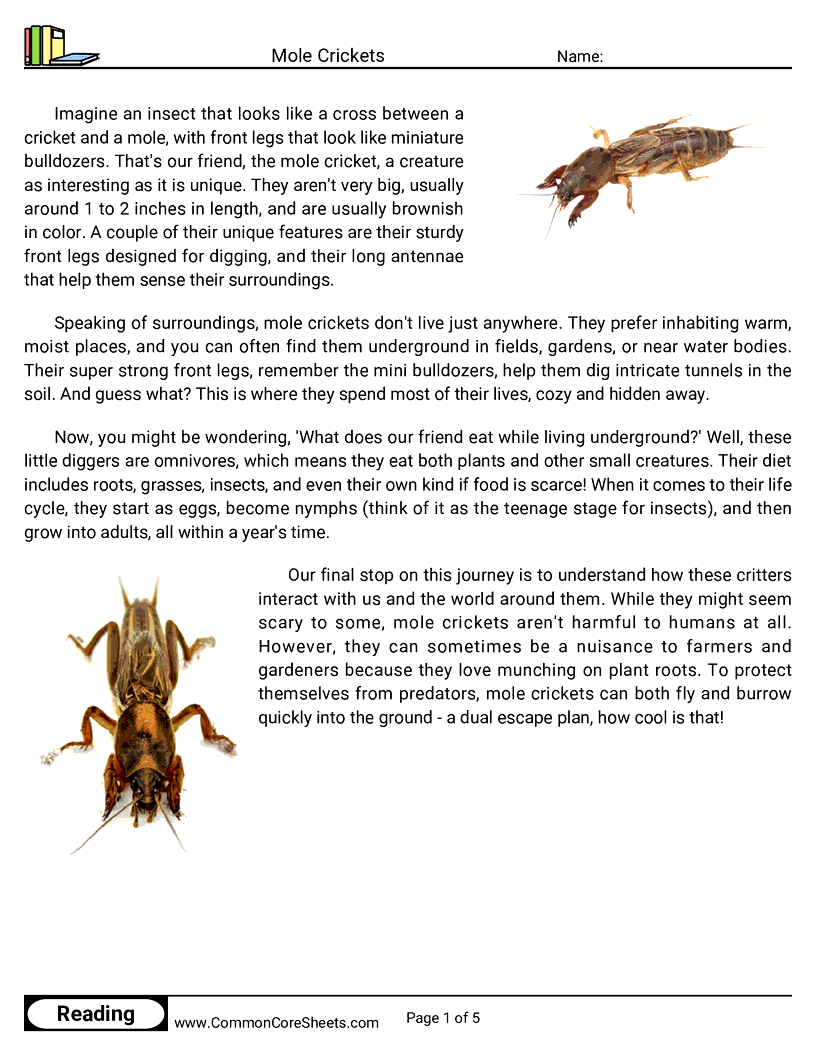
Imagine an insect that looks like a cross between a cricket and a mole, with front legs that look like miniature bulldozers. That's our friend, the mole cricket, a creature as interesting as it is unique. They aren't very big, usually around 1 to 2 inches in length, and are usually brownish in color. A couple of their unique features are their sturdy front legs designed for digging, and their long antennae that help them sense their surroundings.
Speaking of surroundings, mole crickets don't live just anywhere. They prefer inhabiting warm, moist places, and you can often find them underground in fields, gardens, or near water bodies. Their super strong front legs, remember the mini bulldozers, help them dig intricate tunnels in the soil. And guess what? This is where they spend most of their lives, cozy and hidden away.
Now, you might be wondering, 'What does our friend eat while living underground?' Well, these little diggers are omnivores, which means they eat both plants and other small creatures. Their diet includes roots, grasses, insects, and even their own kind if food is scarce! When it comes to their life cycle, they start as eggs, become nymphs (think of it as the teenage stage for insects), and then grow into adults, all within a year's time.
Our final stop on this journey is to understand how these critters interact with us and the world around them. While they might seem scary to some, mole crickets aren't harmful to humans at all. However, they can sometimes be a nuisance to farmers and gardeners because they love munching on plant roots. To protect themselves from predators, mole crickets can both fly and burrow quickly into the ground - a dual escape plan, how cool is that!
Mole crickets are fascinating creatures that many people don\'t know much about. They are insects that belong to the family Gryllotalpidae and are quite different from other crickets. These unique creatures have powerful front legs that they use for digging, which is why they\'re called 'mole crickets'. There are many interesting things about mole crickets, including their appearance, habitat, and behavior.
Starting with their appearance, mole crickets have a cylindrical body and can vary in color from brown to black. They usually measure around 3 to 5 centimeters long, with large, beady eyes and strong, shovel-like front legs. Mole crickets are nocturnal, meaning they are active at night and spend most of their time underground during the day. Their wings enable them to fly but are mostly used to attract mates by producing a unique song.
The habitat of mole crickets is quite diverse, as they can be found in various parts of the world. These insects prefer moist, soft soil where they can easily dig and create tunnels. Mole crickets can be found in grasslands, gardens, and even near bodies of water. Their extensive network of underground tunnels serves as protection from predators and a place to lay their eggs.
Mole crickets have a fascinating life cycle, which starts when the female lays her eggs in the soil. The eggs hatch into nymphs, which look like smaller versions of adult mole crickets. As they grow, nymphs go through several stages called instars, shedding their exoskeleton to accommodate their increasing size. It takes about two to three months for nymphs to transform into adult mole crickets, completing their life cycle.
Lastly, let\'s talk about their relationship with humans and other insects. Mole crickets are mostly harmless to humans but can be a nuisance in gardens due to their tunneling activities, which may damage plant roots. These insects are omnivores and eat a variety of food, including roots, insects, and worms. While they may have some negative impacts, mole crickets also play a vital role in maintaining soil health by aerating it through their digging.
Meet the mole cricket, a fascinating creature that is sure to capture your imagination. These insects are unique because they have large, shovel-like front legs that help them dig through soil with ease. Mole crickets can be found in various shades of brown and can grow up to 1.5 inches in length. They are nocturnal creatures, which means they are most active during the night. You can identify a mole cricket by its cylindrical body and the velvety texture of its wings.
Now let\'s talk about where these creatures live and what they eat. Mole crickets are found in many parts of the world, including North and South America, Europe, Asia, and Africa. They prefer to live in moist, loose soil where they can easily dig their tunnels. Their diet consists of plant roots, stems, and leaves, as well as small insects and larvae. Mole crickets are known to be quite the little gardeners, as their tunneling can help aerate the soil.
The life cycle of the mole cricket is quite interesting. Adult females lay eggs in underground chambers, where they will hatch into nymphs after a few weeks. These nymphs look like miniature versions of the adults but without wings. As they grow, they will go through several molts, or shedding of their exoskeleton, before reaching adulthood. The whole process from egg to adult takes about two to three months.
Mole crickets have a unique relationship with both humans and other insects. While they can be considered pests due to their tunneling habits and feeding on plant roots, they also provide benefits like aerating the soil. Other insects, such as ants and predatory beetles, may prey on mole crickets, while some birds and mammals also consider them a tasty treat. In some parts of the world, mole crickets are even considered a delicacy for humans to eat! These complex relationships make mole crickets an important part of their ecosystem.
Finally, let\'s explore some interesting facts and differences between mole cricket species. There are around 100 different species of mole crickets, each with their own unique characteristics. Some species can fly, while others are completely wingless. Mole crickets are also known for their loud, chirping song that they produce by rubbing their wings together. These captivating creatures are a fascinating example of the diversity and complexity of the insect world.
About this worksheet
Students read a passage about mole crickets and answer questions to show they understood the key details and main ideas.
This worksheet is designed to boost reading comprehension through intriguing topics about mole crickets. Covering 20 questions on the insect's characteristics, defense mechanisms, lifecycle, and habitat, it offers a unique blend of learning. Suitable for distance learning, the customizable content can be easily converted into interactive flash cards, accommodating varying pedagogical approaches.
Student objectives
- Read an informational passage about mole crickets and understand it
- Find specific facts and details in what you read
- Answer questions using information from the text
- Figure out the main idea of a passage
- Build vocabulary by learning words about insects and their habits
Everyday practice
- Read a fact card or sign about an animal at the zoo and tell someone what it said
- Understand a short article about a bug you find in the backyard
- Answer questions about a nature show after watching it
- Explain what you learned from a science book to a friend or parent