Lice Worksheet Download
Free reading worksheets on Lice. Each worksheet has 20 problems with an answer key and are ideal for teachers and homeschooling. You can download the PDF, create a set of flash cards or set it up for online learning.


Sheet Information >
Available at 2nd grade, 3rd grade, 4th grade, 5th grade and 6th grade reading levels.
Read the passage
Hey kids, let's talk about lice, those tiny insects that live on our heads and bodies! Lice like to munch on our blood, which they get by biting through our skin, but don't worry, it doesn't hurt too much. They're very small, about the size of a sesame seed, and they can be different colors like brown, tan, or gray.
Now, let's learn about the life cycle of lice and how they relate to humans and other insects. Lice go through three stages in their life: eggs (also called nits), nymphs, and adults, and they usually complete their life cycle in about a month. Although lice are related to other insects like fleas and ticks, they are different because they only live on humans and don't have wings.
Lastly, let's discover some cool facts about lice and their unique features. Did you know that lice can hold their breath for up to 8 hours? That's a long time! Also, they have six legs with claws at the end, which they use to hold onto our hair and crawl around.
Now you know more about lice, those tiny creatures that live in our hair and on our bodies. Even though they might be a bit icky, they are still fascinating little insects with their own special features and life cycle. Remember, it's always important to learn about the world around us, even the tiniest of creatures!
Let's learn about tiny, pesky insects called lice! Lice are small, wingless insects with six legs that love to live in human hair or on animal fur. These little bugs are not picky eaters, as they feed on human blood or other animals' blood. You might be surprised to know that there are three types of lice that choose humans as their hosts: head lice, body lice, and pubic lice.
Now, let's dive into the fascinating life cycle of lice. Their life cycle has three stages - eggs, nymphs, and adults. Female lice lay eggs, also known as nits, on hair strands or in animal fur, which take about 7-10 days to hatch into nymphs. Nymphs molt three times before becoming adult lice, and then they live for about 30 days while laying even more eggs.
Lastly, here are some interesting facts and differences about lice compared to other insects. Unlike some insects, lice don't jump or fly; they crawl from one hair strand to another, making close contact the main way they spread. Lice are related to other insects like fleas and ticks but have their own unique defenses, such as being able to hold their breath for up to eight hours! And did you know that lice have been around for millions of years, even living on dinosaurs' feathers?
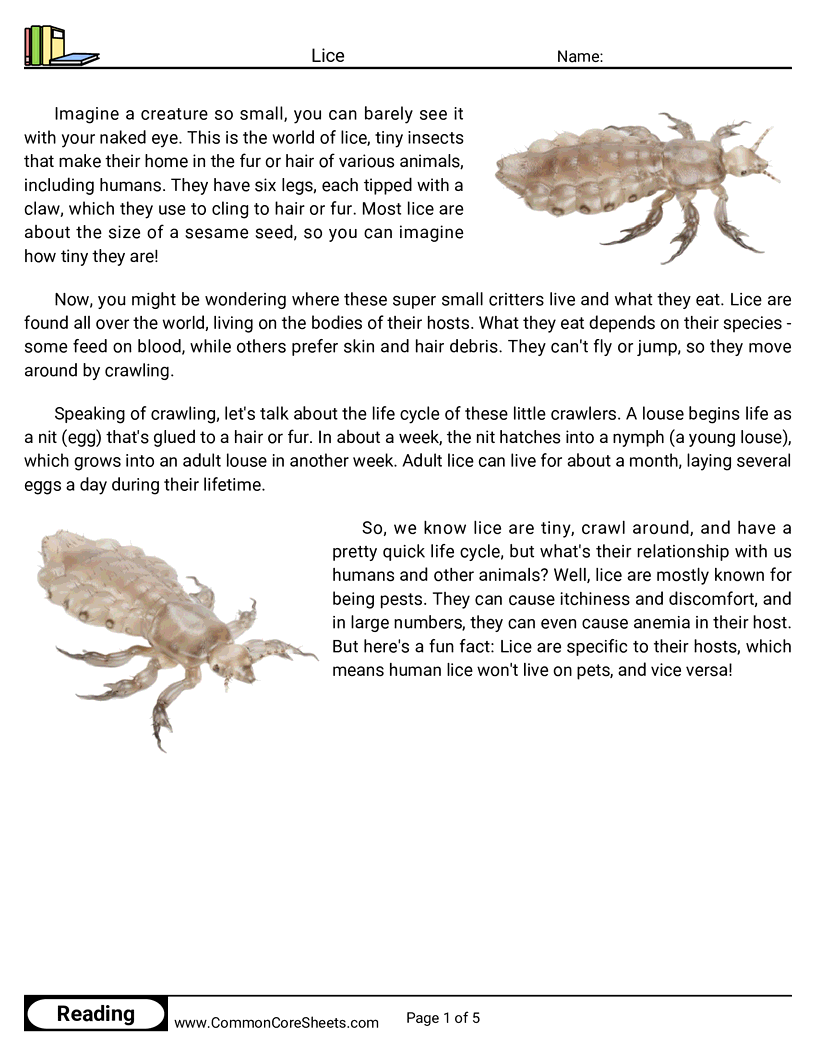
Imagine a creature so small, you can barely see it with your naked eye. This is the world of lice, tiny insects that make their home in the fur or hair of various animals, including humans. They have six legs, each tipped with a claw, which they use to cling to hair or fur. Most lice are about the size of a sesame seed, so you can imagine how tiny they are!
Now, you might be wondering where these super small critters live and what they eat. Lice are found all over the world, living on the bodies of their hosts. What they eat depends on their species - some feed on blood, while others prefer skin and hair debris. They can't fly or jump, so they move around by crawling.
Speaking of crawling, let's talk about the life cycle of these little crawlers. A louse begins life as a nit (egg) that's glued to a hair or fur. In about a week, the nit hatches into a nymph (a young louse), which grows into an adult louse in another week. Adult lice can live for about a month, laying several eggs a day during their lifetime.
So, we know lice are tiny, crawl around, and have a pretty quick life cycle, but what's their relationship with us humans and other animals? Well, lice are mostly known for being pests. They can cause itchiness and discomfort, and in large numbers, they can even cause anemia in their host. But here's a fun fact: Lice are specific to their hosts, which means human lice won't live on pets, and vice versa!
Lice are tiny insects that can sometimes be found living on humans. They are about the size of a sesame seed and can be light brown or grey in color. These small creatures have six legs, each with a claw at the end, which helps them cling to hair or clothing. While they may be small, they can cause a lot of discomfort and annoyance, so it's important to learn about them.
These little insects have a special diet that might surprise you. Lice feed on human blood, which they get by biting into the scalp or skin. While their bites can be itchy and irritating, they don't spread any diseases. In fact, lice rarely cause any serious health problems.
It's fascinating to learn about the life cycle of lice. Lice start as eggs, also known as nits, which are laid by adult females on hair shafts close to the scalp. After about a week, the eggs hatch into nymphs, which are immature lice that will grow into adults in around 10 days. Adult lice can live for about a month on a human host, laying more eggs and continuing the cycle.
When it comes to their relationships with humans and other insects, lice have some unique characteristics. Unlike other insects like mosquitoes, lice can't fly or jump, which means they can only move from one person to another through direct contact. This is why lice are often spread at schools, where children are in close contact with each other. Lice are specific to humans and cannot be spread to or from pets.
There are some interesting differences between lice and other similar insects. For example, there are three types of lice that infest humans: head lice, body lice, and pubic lice, each living in different areas and with slightly different appearances. Additionally, lice are different from fleas, which are insects that live on animals and can jump long distances. Understanding these differences can help you recognize and deal with a lice infestation more effectively.
In this article, you learned about lice, their diet, life cycle, relationship with humans and other insects, differences between them and other species, and some interesting facts. We hope this information helps you understand these tiny creatures a bit better, and how to handle them if you ever encounter them.
Lice are tiny insects that can be quite a nuisance, especially for us humans. These little critters are usually found living in our hair, feeding on our blood. There are three different types of lice: head lice, body lice, and pubic lice, each targeting specific areas of our body. While they may be small, they can cause a lot of itching and discomfort. Let's learn more about these fascinating little creatures!
The life cycle of lice is an interesting process that happens in three stages. First, they start as eggs called nits, which are laid close to the scalp and usually take about a week to hatch. Once hatched, they become nymphs, which are immature lice that will feed on blood and grow for about 9-12 days before becoming adults. Adult lice can live for approximately 30 days on their human host. If they fall off and don't find another host, they will only survive for a couple of days.
Though lice are insects, they have some unique features that set them apart from other insects. For instance, they have six legs with tiny claws that help them cling to hair or clothing fibers. Unlike other insects, lice do not have wings and cannot fly or jump. Instead, they crawl from one person to another through direct contact or by sharing personal items like combs, hats, or headphones. This is why it is essential to be cautious about sharing such things with others.
Lice have developed some pretty impressive defenses to help them survive. For example, their flat bodies help them cling tightly to hair strands, making them difficult to remove. They can also hold their breath for up to 8 hours, which allows them to survive underwater during swimming or bathing. Additionally, lice have a unique camouflage ability, as their color can change to blend with the hair color of their host. This makes them even harder to spot and remove.
There are many interesting facts about lice that you might not have known. For example, female lice can lay up to 10 eggs per day, which means they can spread very quickly. Also, lice have been around for a very long time – even ancient Egyptians dealt with lice infestations! While lice might be annoying and cause itching, they don't spread diseases like other insects such as mosquitoes or ticks. Now that you know more about these tiny insects, you can better understand how to prevent and deal with them if they make an appearance in your life.
About this worksheet
Students read a short informational passage about lice and answer questions to show their understanding of the text.
This worksheet is designed to educate children on the topic of lice through a series of 20 interactive reading problems. It explores facts about lice, including their anatomy, lifespan, habits, and effects on their hosts. Accommodating various learning styles, this resource can be tailored to individual needs, converted into flash cards, or incorporated into distance learning programs, providing a flexible and easily accessible educational tool.
Student objectives
- Read an informational passage carefully and understand the main idea
- Find specific details and facts stated in the text
- Answer questions using evidence from what was read
- Learn new vocabulary related to lice and how they spread
- Summarize key information about the topic in your own words
Everyday practice
- Read a health flyer sent home from school and understand its warnings
- Follow instructions on a shampoo or treatment label
- Explain to a sibling or friend how lice spread after reading about it
- Pick out important facts when reading an article at the doctor's office