Las Posadas Worksheet Download
Free reading comprehension worksheet about Las Posadas in Mexico. Pick the reading level (1st grade to 8th grade), print the passage with its questions, or assign it online.


Sheet Information >
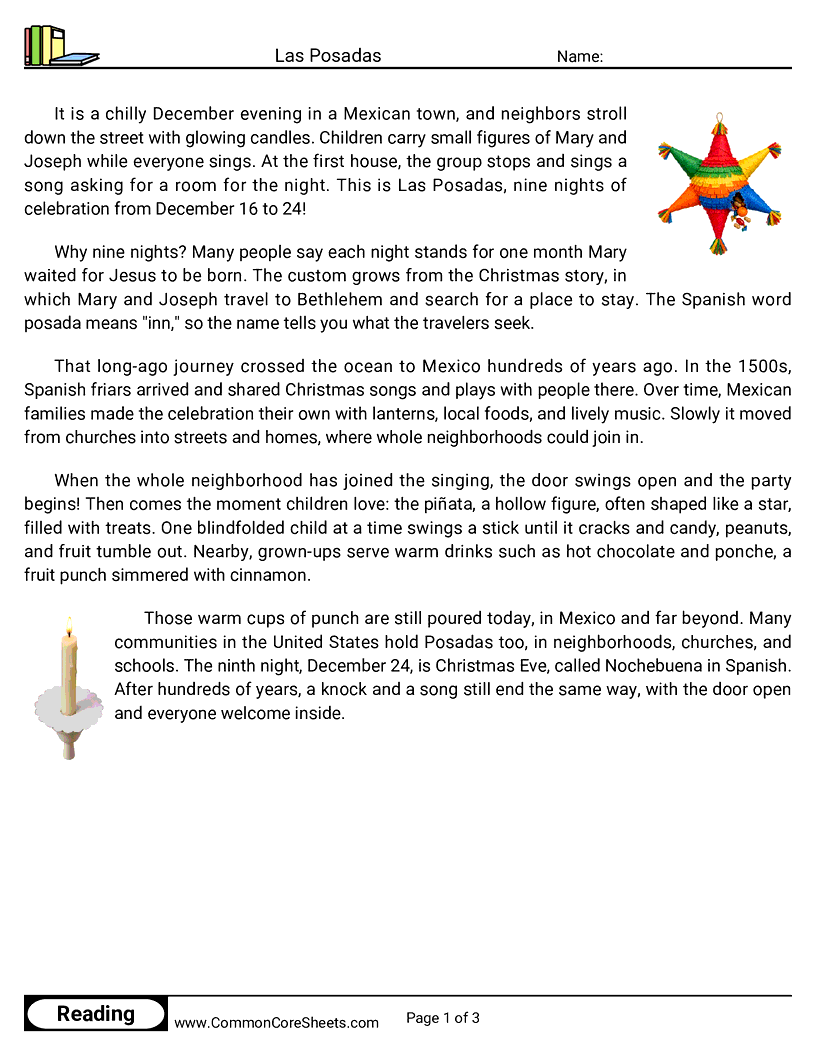
Available at 1st grade, 2nd grade, 3rd grade, 4th grade, 5th grade, 6th grade, 7th grade and 8th grade reading levels.
Read the passage
Have you ever joined a singing parade with glowing candles? In Mexico and many U.S. towns, families do this for nine nights. The party, called Las Posadas, runs from December 16 to 24.
Those nine nights remind Christians of Mary and Joseph from long ago. In the story, they knocked on doors for shelter, a safe place to sleep. Posada is the Spanish word for inn, a place to stay.
At the end of each walk, a door opens wide! Inside, kids swing at a piñata full of candy and sip warm drinks. After nine nights of singing and knocking, everyone is welcomed in!
Wow, imagine a party that walks down the street! In Mexico, neighbors carry candles and sing as they go from house to house. This happens for nine nights, from December 16 to 24.
The singers stop at each door because of an old Christmas story about Mary and Joseph looking for a place to stay. Posada is the Spanish word for inn, a place where travelers sleep. In the song, the people inside first say there is no room, but then they open the door.
Can you guess what waits behind that open door? A piñata, a paper figure filled with candy, hangs ready for children to break with a stick. Afterward, everyone sips a warm drink, such as ponche, a hot fruit punch.
Warm drinks and cheerful songs are not only found in Mexico, because many communities in the United States hold posadas too. Families there also walk with candles and take turns hosting the party. That is a lot of singing, all because of one story about finding a warm place to stay.
Imagine you are walking down a dark street in Mexico, holding a small candle. Neighbors sing, and the flames flicker like tiny stars. Up ahead, the group stops at a door and knocks: tap, tap, tap! This is Las Posadas, nine nights of Christmas celebration from December 16 to 24.
So why is everyone knocking? The singers are acting out the story Christians tell about Mary and Joseph, who searched for a place to stay in Bethlehem before Jesus was born. The word posada is Spanish for "inn," a place where travelers sleep. In the song, the people inside say no at first, but then they open the door and welcome everyone in!
That welcome has been repeated for hundreds of years. Many historians say the custom grew from Christmas prayers led by Spanish priests in Mexico in the 1500s. Those prayers lasted nine days, and many people say the nights remind them of the nine months before Jesus was born. Over time, neighbors carried the celebration into the streets, so each night a different home hosts the party.
A party needs a grand finale, and here comes the piñata, a decorated container stuffed with treats! Blindfolded children take turns swinging a stick until candy, fruit and peanuts tumble out. Then everyone sips ponche, a warm fruit punch with cinnamon, in Mexico and in many U.S. communities today. Nine nights, nine parties, and each one starts with a closed door and ends with an open one!
It is a chilly December evening in a Mexican town, and neighbors stroll down the street with glowing candles. Children carry small figures of Mary and Joseph while everyone sings. At the first house, the group stops and sings a song asking for a room for the night. This is Las Posadas, nine nights of celebration from December 16 to 24!
Why nine nights? Many people say each night stands for one month Mary waited for Jesus to be born. The custom grows from the Christmas story, in which Mary and Joseph travel to Bethlehem and search for a place to stay. The Spanish word posada means "inn," so the name tells you what the travelers seek.
That long-ago journey crossed the ocean to Mexico hundreds of years ago. In the 1500s, Spanish friars arrived and shared Christmas songs and plays with people there. Over time, Mexican families made the celebration their own with lanterns, local foods, and lively music. Slowly it moved from churches into streets and homes, where whole neighborhoods could join in.
When the whole neighborhood has joined the singing, the door swings open and the party begins! Then comes the moment children love: the piñata, a hollow figure, often shaped like a star, filled with treats. One blindfolded child at a time swings a stick until it cracks and candy, peanuts, and fruit tumble out. Nearby, grown-ups serve warm drinks such as hot chocolate and ponche, a fruit punch simmered with cinnamon.
Those warm cups of punch are still poured today, in Mexico and far beyond. Many communities in the United States hold Posadas too, in neighborhoods, churches, and schools. The ninth night, December 24, is Christmas Eve, called Nochebuena in Spanish. After hundreds of years, a knock and a song still end the same way, with the door open and everyone welcome inside.
Why would a whole neighborhood spend nine nights being turned away at the door? Every evening from December 16 to 24, neighbors across Mexico walk from house to house holding candles, and some carry small figures of Mary and Joseph. At each stop, the visitors sing a song asking for shelter, and voices inside sing back that there is no room. Stick around, because the clues are hidden in the song, the number nine, and the party at the end.
The first clue is in that song, which tells of Mary and Joseph searching for a place to stay in Bethlehem. Christians celebrate the birth of Jesus at Christmas, and in the Gospel of Luke, the couple finds no room at the inn. That explains the name, since posada is the Spanish word for an inn. The number nine is the second clue: it is often said to stand for the nine months before a baby is born.
Nine nights take planning, and many accounts say the tradition took shape in the 1500s, after Spanish friars arrived in what was then New Spain. They shared the Christmas story through songs, processions, and plays that people could join. Over the centuries, it moved from church courtyards to neighborhood streets and homes, with a different household hosting each night. The ninth night falls on Nochebuena, the Spanish name for Christmas Eve, which means "Good Night."
On that last night, as on every night, the door swings open and the party begins, with a piñata dangling overhead. Traditional piñatas were clay pots, often decorated as a star with seven points, though many today are made of papier-mâché. Blindfolded children take turns swinging a stick until the piñata cracks and candy and fruit, like oranges and sugar cane, tumble out. Everyone warms up with ponche, a hot fruit punch, or atole, a hot corn drink, plus plates of tamales.
Warm drinks and sweet treats help explain why the posada has traveled, and today many communities across the United States celebrate it too. Churches, schools, and neighborhoods host them, and some shorten the fun to one evening so busy families can join in. Their songs and candles link people today to a tradition hundreds of years old. And that is the answer to the puzzle: the neighbors who are turned away at the start of every night are always welcomed inside by the end of it.
If you think a piñata belongs only at birthday parties, get ready for a surprise! In Mexico, and in many neighborhoods across the United States, piñatas star in Las Posadas, a celebration that lasts nine nights, from December 16 to December 24. Picture a dark street at dusk, where neighbors walk slowly with flickering candles and voices rise in song. When the walk ends, the fun explodes: a blindfolded child swings at a star-shaped piñata while everyone cheers, and cups of hot punch steam in the cool air. It is part parade, part concert, and part block party, all wrapped around a very old story.
That old story explains why the walk comes before the candy. Christians celebrate the birth of Jesus at Christmas, and Las Posadas remembers Mary and Joseph searching for a place to stay in Bethlehem. In Spanish, posada means "inn" or "lodging," so the name itself gives away the plot. Each night, a group stops at a chosen house and sings a song asking for shelter, while the people inside sing back that there is no room. After a few verses, the hosts throw open the door, and the music switches from asking to celebrating.
That switch from asking to celebrating has been happening in Mexico for centuries. Many historians say the custom grew from Christian traditions that Spanish friars brought to Mexico in the 1500s, and it blended with local ways of celebrating over time. Why nine nights? Many people link the number to the nine months before a baby is born, and the last night lands on Christmas Eve. Piñatas have a long history too, one that historians still trace across several continents. The classic posada piñata is a clay pot covered in bright paper and often decorated with seven points, with oranges, sugarcane, peanuts, and candy hidden inside.
Piñatas aren't the only travelers, because the whole celebration has crossed borders, too. In the United States, Mexican American families in places such as Texas, California, and New Mexico hold posadas in neighborhoods, churches, and schools. Some are small, with a few dozen neighbors on one street, while others fill city blocks with hundreds of people. The night often ends with ponche, a hot fruit punch simmered with cinnamon, guava, and sugarcane, and with tamales for everybody. Even when the setting changes, the shape stays the same: a walk, a song, a door, and a party.
The party may be the loudest part, but I think the quietest moment matters most: the moment a door opens. In many communities, families take turns hosting, so over nine nights a neighborhood visits many doorsteps and learns who lives behind them. That makes Las Posadas feel like a trail of candlelight stitching neighbors together. In a busy world full of screens, a slow walk with people you know is a rare and welcome treat. So the next time you swing at a piñata, remember that it may be the sweet finish to a nine-night journey that began with a knock.
Imagine a party that lasts nine nights in a row, and every single night begins with someone being told to go away. That is the surprising start of Las Posadas, a celebration that fills Mexican streets from December 16 to December 24. Neighbors gather at dusk, holding candles that flicker like tiny stars, and walk together from house to house. At each stop, they sing, knock, and wait for an answer. Only after the door opens do the smells of cinnamon and warm fruit drift out to greet them.
That refusal is not rudeness; it is a scene from the Christmas story. In the Gospel of Luke, Mary and Joseph travel to Bethlehem, and Luke writes that there was no room for them in the inn. Christians celebrate the birth of Jesus at Christmas, and Las Posadas lets families act out the couple's search for shelter. The Spanish word posada means "inn" or "lodging," so the name itself points back to that search. Many people also say the nine nights stand for the nine months before a baby is born, which adds a feeling of waiting and hope.
That story of hope crossed an ocean, too, when Spanish missionaries arrived in Mexico in the 1500s. Many of the people they met spoke Indigenous languages such as Nahuatl, so the friars often taught through pictures, music, and plays rather than long speeches. Processions and short dramas were a natural fit, because anyone could watch the story unfold and even join in. Over time, the custom moved out of church courtyards and into neighborhoods, where families took turns hosting. Historians still debate how each detail developed, but the mixing of traditions from Spain and Mexico gives the celebration its unique flavor.
Hosting is where the drama heats up, because the group outside and the family inside sing a conversation back and forth. The travelers, often children dressed as Mary and Joseph or carrying small figures of them, sing a plea for shelter. At first, the voices inside refuse, singing that this is not an inn and the travelers should move along. Then someone recognizes the visitors, and the verses turn welcoming: "Enter, holy pilgrims." Because the verses rhyme and repeat, even young guests learn them quickly, so everyone becomes both actor and audience.
Once everyone is inside, the mood switches from ceremony to celebration, and out comes the piñata. Traditional posada piñatas are often shaped like a star with seven points, and a common explanation is that the points stand for temptations people try to resist. Blindfolded children take turns swinging a stick while the crowd sings, and when it finally bursts, oranges, peanuts, and candy tumble out. Guests then sip ponche, a hot punch simmered with cinnamon, sugar cane, and tejocotes, small fruits that look like tiny yellow apples. Many hosts add tamales, warm bundles wrapped in corn husks, so nobody leaves hungry.
Tamales and punch have traveled far, too, because posadas are now held in many communities across the United States, including cities such as Los Angeles and San Antonio. Some are candlelit processions led by churches, while others are lively parties at schools or workplaces on any evening in December. The shape of the custom has changed, but the pattern of asking, waiting, and welcoming has stayed. Think of it as a story with a built-in twist: each night begins with a "no" and ends with a "yes." Nine nights, nine closed doors, and in the end every single one swings open.
In 1586, according to an account historians often repeat, a friar named Diego de Soria in the Mexican town of Acolman asked the pope for permission to hold special Christmas masses, and that request is still linked to one of Mexico's best-loved traditions. The tradition is Las Posadas, nine nights of celebration that run from December 16 to December 24. Picture it: each evening, neighbors gather with candles and walk from house to house, singing as they go. At every stop, the travelers sing a plea for shelter, and the people inside sing back, until at last a door swings open. The night ends with a piñata swinging overhead and warm cups of fruit punch, and today the same glowing processions wind through neighborhoods in many communities across the United States.
A piñata and a cup of punch may sound like pure party, but historians trace the celebration to a much older story: Mary and Joseph traveling to Bethlehem and searching for a place to stay. Christians celebrate the birth of Jesus at Christmas, and the Spanish word posada means an inn or lodging. Spanish friars who arrived in Mexico in the 1500s, including the Augustinians at Acolman, often taught through processions and dramatic scenes, because a story acted out in the open can be followed by anyone watching. The widely told account says that Fray Diego de Soria received permission from Pope Sixtus V for a series of Christmas masses, called misas de aguinaldo, held from December 16 through Christmas Eve. Many historians see those nine days of masses as an ancestor of the nine nights of the posadas.
Why nine nights, though, and not seven or ten? One popular explanation is that the nine nights stand for the nine months Mary carried Jesus before his birth. That is a meaning many families treasure, but notice that it explains what the number symbolizes, while the masses at Acolman offer a possible explanation of where the custom actually came from. A third idea points to the Aztecs, also called the Mexica, who held ceremonies honoring their god Huitzilopochtli near the end of the year, and some writers argue that friars chose that season so the new celebrations would fit the calendar people already knew. Other historians reply that Christmas was already fixed on December 25 across the Christian world and that Spain had its own Christmas-season customs, so no outside explanation is required.
Even the piñata, which looks like the simplest part of the party, arrives with competing explanations. Some writers say the idea traveled to Mexico from Europe with Spanish settlers, and its name may come from the Italian word pignatta, meaning a clay pot. Others argue that ceremonies in Mexico before the Spanish arrived also played a part, so the piñata may be a blend of both. The classic Christmas version is a star with seven points, which many families explain as standing for the seven deadly sins in Christian teaching. Children take turns swinging a stick while blindfolded, and when the clay pot or paper shell finally cracks, fruit and candy tumble out for everyone to scramble after!
Fruit, in fact, links the piñata to the drink waiting at the end of the night: old-style piñatas were often stuffed with fruit such as oranges and sugar cane, and ponche navideño simmers with guavas, apples, cinnamon and tejocotes, a small fruit native to Mexico. Many families add tamales, so the hosts are busy cooking as well as singing. In the United States, posadas are held in homes, churches, schools and public plazas, especially in communities with strong Mexican and Mexican American roots. Some are small enough to fit on one block, while others draw large crowds, yet both follow the same script of knocking, singing and finally welcoming.
That script is the secret of the tradition's staying power, because everyone who joins has a part to play. Unlike a play watched from a seat, a posada turns the audience into the cast, so if you join in, you might be a pilgrim outside in the cool December air or an innkeeper behind the door. At first the innkeepers answer no in song, which is part of the drama, and the crowd waits until they finally sing an invitation: a request, a refusal, then a welcome. And if the account of 1586 is right, neighbors have been knocking, singing and opening doors this way for more than four centuries.
About this worksheet
Students read a nonfiction passage about Las Posadas in Mexico, written at 8 reading levels (1st grade to 8th grade), and answer multiple-choice questions about it.
A reading comprehension worksheet about Las Posadas in Mexico with a different article for each reading level, 1st grade to 8th grade, each with its own multiple-choice questions aligned to the Common Core Reading: Informational Text standards. Printable with an answer key, and available as an online assignment at any level.
Student objectives
- Read a nonfiction passage about Las Posadas and find key details about how it is celebrated.
- Explain why the celebration lasts nine nights and where its name comes from.
- Identify how a paragraph is organized by describing how a custom changed over time.
- Use context to work out the meaning of words such as posada and ponche.
Everyday practice
- Ask a family member or neighbor about a tradition where people gather, sing, or share food, and notice how it is the same every year.
- Look at a map and trace the route from Mexico to your own state, then think about how customs travel when people move.
- Learn a few Spanish words from the article, such as posada and Nochebuena, and try using them this week.