Kwanzaa Worksheet Download
Free reading comprehension worksheet about Kwanzaa. Pick the reading level (1st grade to 8th grade), print the passage with its questions, or assign it online.


Sheet Information >
Available at 1st grade, 2nd grade, 3rd grade, 4th grade, 5th grade, 6th grade, 7th grade and 8th grade reading levels.
Read the passage
Can you guess what holds seven glowing candles at Kwanzaa? It is a kinara, a candleholder that sits beside fruits and corn. Three are red, three are green, and one is black.
Families light one candle each night, so the kinara grows brighter. Kwanzaa lasts seven nights, from December 26 to January 1. Each night shares a big idea, like unity, which means working together.
Those big ideas came from a teacher named Maulana Karenga. He started this holiday in 1966 to honor African American culture and history. Kwanzaa even means "first fruits" in Swahili, an African language.
Wow, the name Kwanzaa comes from a Swahili phrase that means "first fruits"! Swahili is a language spoken in eastern Africa. Families celebrate for seven days, from December 26 to January 1.
Those seven days began in 1966, when a professor named Maulana Karenga created the holiday. He wanted families to honor their heritage, which means the history passed down to them. He also borrowed ideas from African harvest festivals.
Those harvest ideas show up on the table, where families set out fruits, vegetables, and corn on a woven mat. Often there is one ear of corn for each child. A shared cup, called the unity cup, is passed around for everyone to sip.
Sharing a cup is a bit like sharing light, and a candleholder called the kinara holds seven candles: one black, three red, and three green. Each night, families light one more candle, starting with the black one in the middle. Each stands for a principle, such as unity, so on the last night all seven glow together.
Imagine you are sitting down at a Kwanzaa table on a chilly December evening. A woven mat lies on the table with ears of corn, bright fruits, and a candleholder called a kinara. The kinara holds seven candles: one black in the middle, three red on one side, and three green on the other. Each night, one more candle is lit, until the whole kinara glows!
Those glowing candles are not just pretty, because each one stands for an idea. The seven ideas are called principles, which are basic beliefs that guide how people live. They have Swahili names, from an East African language, and the first, umoja, means unity, or working together. Families talk about one principle each night, such as creativity or faith.
Those ideas may sound ancient, but the holiday began in 1966, when a teacher named Maulana Karenga created it in California. He wanted African American families to celebrate their history together. He chose the name from a Swahili phrase, matunda ya kwanza, which means "first fruits," because harvest festivals in Africa inspired him.
Harvest festivals inspired that name, and Kwanzaa ends with a feast just like one! On December 31, families share a big meal called a karamu, with music and stories. On January 1, the seventh candle is lit and gifts are given. A holiday that began with one teacher in 1966 now lights seven candles, one for each day from December 26 to January 1.
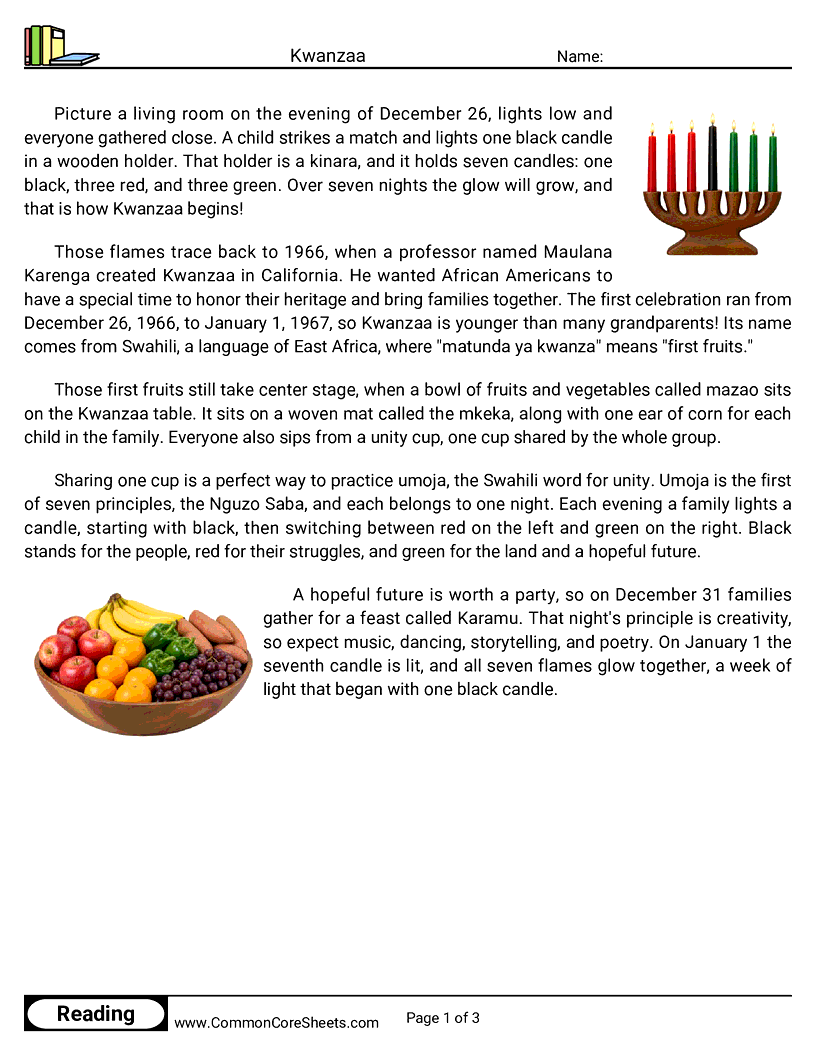
Picture a living room on the evening of December 26, lights low and everyone gathered close. A child strikes a match and lights one black candle in a wooden holder. That holder is a kinara, and it holds seven candles: one black, three red, and three green. Over seven nights the glow will grow, and that is how Kwanzaa begins!
Those flames trace back to 1966, when a professor named Maulana Karenga created Kwanzaa in California. He wanted African Americans to have a special time to honor their heritage and bring families together. The first celebration ran from December 26, 1966, to January 1, 1967, so Kwanzaa is younger than many grandparents! Its name comes from Swahili, a language of East Africa, where "matunda ya kwanza" means "first fruits."
Those first fruits still take center stage, when a bowl of fruits and vegetables called mazao sits on the Kwanzaa table. It sits on a woven mat called the mkeka, along with one ear of corn for each child in the family. Everyone also sips from a unity cup, one cup shared by the whole group.
Sharing one cup is a perfect way to practice umoja, the Swahili word for unity. Umoja is the first of seven principles, the Nguzo Saba, and each belongs to one night. Each evening a family lights a candle, starting with black, then switching between red on the left and green on the right. Black stands for the people, red for their struggles, and green for the land and a hopeful future.
A hopeful future is worth a party, so on December 31 families gather for a feast called Karamu. That night's principle is creativity, so expect music, dancing, storytelling, and poetry. On January 1 the seventh candle is lit, and all seven flames glow together, a week of light that began with one black candle.
Here's a puzzle for you: how can a holiday be young enough that your grandparents may remember its beginning, yet built from customs that are very old? The answer is Kwanzaa, a seven-day celebration of African American culture and heritage that runs from December 26 to January 1. Each evening, a family gathers around a glowing candleholder called a kinara and lights one more flame. Nearby, a woven mat holds ears of corn, fruits, and vegetables, like a harvest table for everyone to see.
That table of fruits and vegetables is your first clue, because the name Kwanzaa comes from the Swahili phrase matunda ya kwanza, meaning "first fruits." Swahili is a language spoken in East Africa, and Maulana Karenga, a scholar and activist, chose it to connect African Americans with their African roots. In 1966, he created Kwanzaa in California, inspired by the harvest celebrations that have long been held in many parts of Africa. Even the spelling is a neat match, since Kwanzaa has seven letters and the holiday lasts seven days.
Those seven days each carry a purpose, because Karenga also created seven principles, called the Nguzo Saba, which is Swahili for "seven principles." Each night families talk about one principle, starting with umoja, which means unity, and later reaching ideas such as kuumba, or creativity, and imani, or faith. Can you imagine a holiday where every night has its own big idea? For many families, sharing thoughts around the table is the heart of the evening.
Back at the kinara, the candles turn those ideas into something you can see: seven flames, one for each principle. One black candle stands in the middle, with three red candles on its left and three green candles on its right. Black stands for the people, red for their struggles, and green for the future and its hope. After lighting the black candle first, families usually alternate between red and green, so the kinara grows brighter until all seven glow.
As the last candles are lit, the celebration builds toward a big feast called karamu, held on December 31. There are stories, music, and dancing, and a unity cup, the kikombe cha umoja, is passed so everyone can sip. Gifts called zawadi are often handmade, and although some families celebrate Christmas too, Kwanzaa is its own holiday with its own traditions. So here is the answer to our puzzle: a holiday first celebrated in 1966 carries the long-loved idea of first fruits into homes today.
Here's a surprise: Kwanzaa, which many people assume is thousands of years old, began in 1966, before the first moon landing. Picture a table with a woven mat, ears of corn, bright fruit and a glowing candleholder. Seven candles stand in a row, three red, one black and three green, and one more flame joins the glow each night. Families celebrate from December 26 to January 1, honoring African American culture and heritage in a holiday all its own. So how did a holiday so young come to feel so deeply rooted?
The answer starts with a professor named Maulana Karenga, who created the holiday in 1966. He wanted African American families to have a celebration honoring their heritage, a goal that fit the 1960s, when many people worked for civil rights and pride. Instead of copying one old festival, he borrowed from many African harvest celebrations, where communities gave thanks for the first crops of the season. He chose a Swahili name from the phrase matunda ya kwanza, which means "first fruits." Swahili is widely spoken in East Africa, and the extra "a" in the spelling gives the word seven letters, a nod to the holiday's favorite number.
Seven shows up everywhere, but it glows brightest on the kinara, the candleholder at the center of the table. Its seven candles are arranged with one black candle in the middle, three red on the left and three green on the right. Black stands for the people, red for the struggles they have faced, and green for the land and the hope growing from it. On the first night the black candle is lit, and after that the family alternates between the red side and the green side. Around it sit harvest symbols: fruits and vegetables, a woven mat and one ear of corn for each child.
Each flame also stands for an idea, and together the seven ideas are called the Nguzo Saba, or seven principles. Think of them as seven stepping stones, one for each day, starting with umoja, which means unity, on December 26. Later days celebrate self-determination, working together, cooperative economics, purpose, creativity and, finally, faith. Families talk about what each word means and how to live it, and on December 31 many gather for a feast called karamu. There is music, storytelling and dance, and a shared unity cup reminds everyone they belong to something bigger.
All that togetherness explains why Kwanzaa still matters today. In my view, its greatest gift is turning big ideas like unity and creativity into small habits, such as lighting a candle or telling a story. Families across the United States and beyond celebrate it, adding their own poems, songs and recipes. Many families also celebrate other holidays, proving that traditions can shine side by side. So when someone says a tradition must be ancient to matter, remember the holiday that began before the first moon landing and still lights homes every December.
Seven days, seven candles, seven principles, and a name with seven letters: Kwanzaa is a holiday built around the number seven! Every year from December 26 to January 1, families gather around a table set with a woven mat, fruits and vegetables, ears of corn, and a candleholder called a kinara. Each evening someone lights one more candle, so the glow grows a little brighter night by night. Can you imagine a holiday planned almost like a design project, with every symbol chosen for a reason?
Behind that plan stood Maulana Karenga, a professor who first celebrated the holiday in the United States in 1966. He created it during a time of great change and struggle, when many Black Americans were looking for ways to celebrate their own history and strengthen their communities. Instead of starting from scratch, he borrowed an idea from African harvest festivals, where people gather to give thanks for the first crops of the season. In fact, the name Kwanzaa comes from the Swahili phrase matunda ya kwanza, which means “first fruits.”
Swahili was a deliberate choice, because it is spoken in several countries in East Africa and so reaches beyond any one nation. Karenga used it for the seven principles of Kwanzaa, called the Nguzo Saba. Each day belongs to one, in this order: umoja (unity), kujichagulia (self-determination), ujima (working together and sharing responsibility), ujamaa (cooperative economics), nia (purpose), kuumba (creativity), and imani (faith). Because these are shared values rather than the teachings of one religion, Kwanzaa is a cultural holiday that families of many faiths can join.
Taking part is wonderfully hands-on, and the star of the show is the kinara, a candleholder with seven cups set in a row. Its candles, called mishumaa saba, are one black, three red, and three green, with the black one in the middle. On the first night families light the black candle; after that they alternate, red from the left and green from the right, so the flames grow outward from the center. The colors echo the red, black, and green flag promoted by Marcus Garvey's movement in the early 1900s. In Kwanzaa, black stands for the people, red for their struggle, and green for the land and for hopes for the future.
Hopes for the future sit on the table too, in the form of the harvest symbols. Fruits and vegetables, called mazao, honor the rewards of people's work together, while ears of corn, called muhindi, stand for children, with one ear for each child in the family. Everything rests on a woven mat, the mkeka, a symbol of the traditions that hold a community up. Family members also share sips from a unity cup, the kikombe cha umoja, and on December 31 they gather for a big feast called karamu. Gifts called zawadi are often handmade.
Handmade gifts are a perfect example of kuumba, the principle of creativity, and creativity is a big reason the holiday has spread. Since 1966, Kwanzaa has been celebrated in homes, schools, community centers, and museums across the United States, and in some other countries too. Some families celebrate it in addition to other winter holidays, while others keep it as their main celebration, and no two gatherings look exactly alike. Even so, the heart of it stays the same: a celebration that began as one professor's plan in 1966 still starts each year with a single black candle glowing in the middle of the kinara.
In late December 1966, a small group in Los Angeles gathered to light candles for a holiday that had never been celebrated before. That evening marked the first Kwanzaa, a seven-day celebration of African American culture and heritage that runs from December 26 to January 1. Walk into a home during the week and you might see red, black, and green cloth, a table of fruits and vegetables, and a candleholder glowing with one more flame each night. Most traditions are so old that nobody can say who began them, but this one is different. Because we know who created Kwanzaa and when, we can study it like a design, choice by choice.
The first choice belonged to Maulana Karenga, a professor and activist who wanted African American families to have a celebration built on shared values. He created it in 1966, only a year after the 1965 Watts uprising in Los Angeles, when many people in the city were asking hard questions about community and identity. Karenga later led the Black Studies department at California State University, Long Beach, so it is fitting that Kwanzaa feels like a lesson wrapped inside a celebration. He said he drew on first-fruits harvest festivals held in various parts of Africa, including those of the Ashanti and Zulu peoples. That makes Kwanzaa a blend: a holiday only about six decades old that borrows the spirit of harvest celebrations far older.
Those harvest roots echo in the name, which comes from the Swahili phrase matunda ya kwanza, meaning "first fruits." Why Swahili? Karenga chose it because it is widely spoken across East Africa and is not tied to a single ethnic group, so it could link African Americans with the whole continent rather than one region. Notice the reasoning: the language works as a symbol as much as a vocabulary. Even the spelling was engineered, because the word was written with an extra a so that it would have seven letters. Seven, it turns out, is the number that organizes nearly everything else about the holiday!
Nowhere is seven easier to see than in the kinara, the candleholder at the center of the Kwanzaa table. It holds seven candles: one black in the middle, three red on the left, and three green on the right. Those colors come from the red, black, and green flag that Marcus Garvey's Universal Negro Improvement Association adopted in 1920, and in Kwanzaa they are often explained as black for the people, red for their struggle, and green for the future and the land. Families light the black candle first, then alternate between red and green, moving outward one candle per night. Around the kinara sit other symbols: crops called mazao, an ear of corn for each child in the family, a shared cup for unity, and a woven mat called the mkeka. The mat matters most in a quiet way, because it stands for the foundation on which everything else rests.
Each candle also stands for one of the Nguzo Saba, the seven principles that give Kwanzaa its meaning. They begin on December 26 with Umoja, or unity, and continue through Kujichagulia (self-determination), Ujima (collective work and responsibility), Ujamaa (cooperative economics), Nia (purpose), Kuumba (creativity), and Imani (faith). Notice that these are values, not rules or commandments, so they are meant to be discussed and put into practice. One of them has a life beyond the holiday: Ujamaa is the same Swahili word that Julius Nyerere, a founding leader of Tanzania, used for his vision of a nation built on cooperation. As each candle is lit, a week of small flames becomes a week of big questions, such as what people owe their community and what they can build together.
Big questions like these are one reason Kwanzaa works as a cultural holiday rather than a religious one. Karenga described it as a celebration of heritage and values that does not replace anyone's faith, so people of many backgrounds take part, and many families observe it alongside Christmas while treating it as its own celebration. The week builds toward the Karamu, a community feast on December 31 filled with music, storytelling, and food, and it closes on January 1 with a day of reflection. Skeptics sometimes ask whether a holiday invented in the 1960s can feel authentic, but supporters answer that every tradition began somewhere and that meaning grows from the families who practice it. Perhaps the best proof of the holiday's care is its smallest detail: even the extra a in Kwanzaa was chosen on purpose, a reminder that every piece of this celebration, down to its spelling, was designed to carry meaning.
About this worksheet
Students read a nonfiction passage about Kwanzaa, written at 8 reading levels (1st grade to 8th grade), and answer multiple-choice questions about it.
A reading comprehension worksheet about Kwanzaa with a different article for each reading level, 1st grade to 8th grade, each with its own multiple-choice questions aligned to the Common Core Reading: Informational Text standards. Printable with an answer key, and available as an online assignment at any level.
Student objectives
- Read a nonfiction passage about Kwanzaa and identify key details about its symbols and traditions.
- Find the meanings of Swahili words by using context clues in the text.
- Explain the order in which the Kwanzaa candles are lit and what the colors stand for.
- Explain why certain Kwanzaa customs, such as the ear of corn and the Karamu feast, are part of the holiday.
Everyday practice
- Look at a calendar and count the seven days from December 26 to January 1.
- Notice how many things in your home or classroom are shared by a whole group, like the unity cup.
- Try naming one way you could use creativity, such as music, drawing, or storytelling, to bring people together.