Komodo Dragon Worksheet Download
Free reading worksheets on Komodo Dragon. Each worksheet has 20 problems with an answer key and are ideal for teachers and homeschooling. You can download the PDF, create a set of flash cards or set it up for online learning.
Select a Different Activity
>
Sheet Information >
Available at 2nd grade, 3rd grade, 4th grade, 5th grade and 6th grade reading levels.
Read the passage
Hey kids, did you know Komodo dragons are the largest lizards in the world? They can grow up to 10 feet long and weigh around 150 pounds! Komodo dragons are carnivores, which means they eat meat, and their favorite meals are deer, pigs, and even water buffalo.
Komodo dragons live on a few islands in Indonesia, with the most famous being the island of Komodo. These amazing creatures have a unique life cycle, starting as eggs that the mother lays in a nest. After about 8 months, baby Komodo dragons hatch and live in trees for safety, eventually growing up and moving to the ground.
Humans and Komodo dragons share a unique relationship, as people on the islands often live close to these fascinating creatures. Komodo dragons have a powerful defense mechanism, which is their venomous bite that they use to protect themselves and catch their prey. One interesting fact about Komodo dragons is that they have an excellent sense of smell and can detect a meal from miles away!
In conclusion, Komodo dragons are truly amazing creatures with unique features and an interesting relationship with humans and other animals.
Komodo dragons are fascinating creatures that can only be found in Indonesia. These giant lizards live on a few islands, including Komodo Island and Rinca Island. Komodo dragons are the largest lizards in the world, growing up to 10 feet long and weighing up to 150 pounds. They have a rough, scaly skin, sharp claws, and a long, powerful tail.
These amazing animals are carnivores, which means they love to eat meat. Their favorite meals include deer, pigs, and even smaller Komodo dragons! Komodo dragons have a unique way of finding food – they use their long, forked tongues to smell for their prey. Their saliva contains bacteria that can make their bite very dangerous to other animals.
Komodo dragons play an important role in their ecosystem. They help keep the population of other animals in check, and their presence helps the overall health of the environment. Humans and Komodo dragons usually don\'t interact much, but humans need to be careful around them because of their powerful bite. By learning about and respecting these incredible creatures, we can help protect them and the beautiful islands they call home.
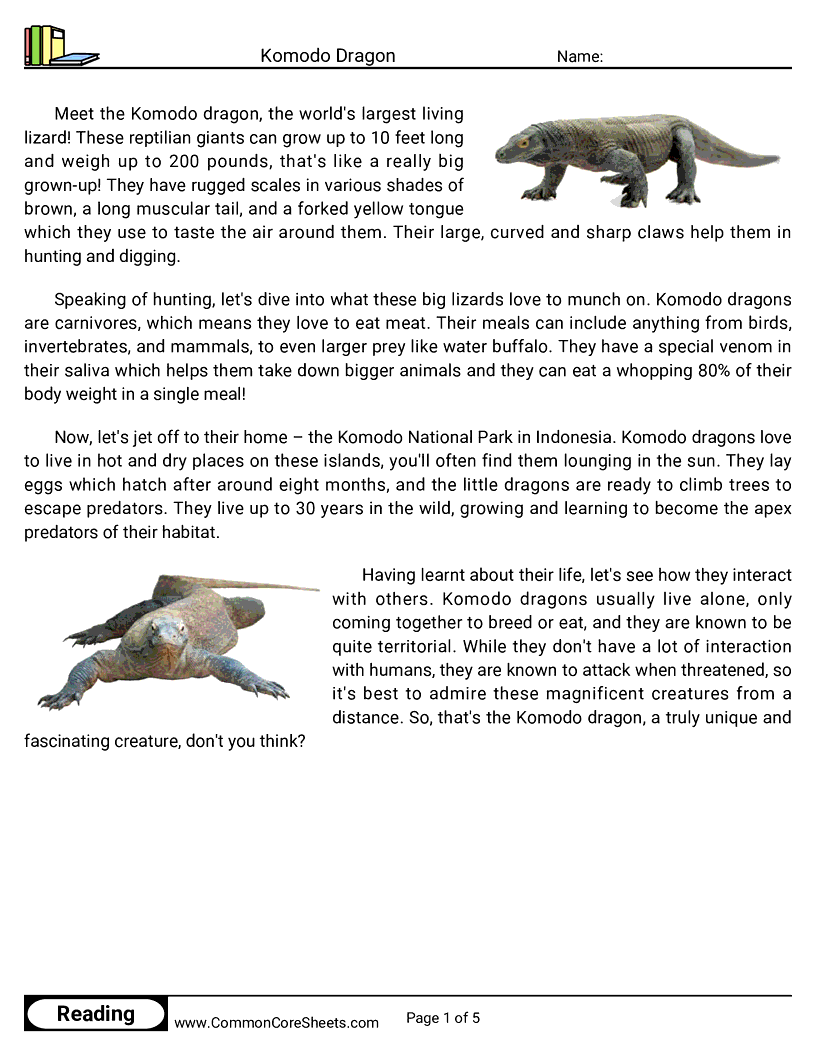
Meet the Komodo dragon, the world's largest living lizard! These reptilian giants can grow up to 10 feet long and weigh up to 200 pounds, that's like a really big grown-up! They have rugged scales in various shades of brown, a long muscular tail, and a forked yellow tongue which they use to taste the air around them. Their large, curved and sharp claws help them in hunting and digging.
Speaking of hunting, let's dive into what these big lizards love to munch on. Komodo dragons are carnivores, which means they love to eat meat. Their meals can include anything from birds, invertebrates, and mammals, to even larger prey like water buffalo. They have a special venom in their saliva which helps them take down bigger animals and they can eat a whopping 80% of their body weight in a single meal!
Now, let's jet off to their home – the Komodo National Park in Indonesia. Komodo dragons love to live in hot and dry places on these islands, you'll often find them lounging in the sun. They lay eggs which hatch after around eight months, and the little dragons are ready to climb trees to escape predators. They live up to 30 years in the wild, growing and learning to become the apex predators of their habitat.
Having learnt about their life, let's see how they interact with others. Komodo dragons usually live alone, only coming together to breed or eat, and they are known to be quite territorial. While they don't have a lot of interaction with humans, they are known to attack when threatened, so it's best to admire these magnificent creatures from a distance. So, that's the Komodo dragon, a truly unique and fascinating creature, don't you think?
Komodo dragons are truly fascinating creatures, and there\'s so much to learn about them. These large lizards are the biggest in the world, and they can grow up to 10 feet long and weigh around 150 pounds. They have strong, muscular bodies, sharp claws, and powerful jaws filled with venomous saliva. Their scaly skin is usually gray or brown, which helps them blend in with their natural surroundings.
These amazing animals are found in the wild on only a few Indonesian islands. Komodo National Park, which is made up of several islands including Komodo, Rinca, and Flores, is their primary home. They live in a variety of habitats, such as grasslands, forests, and savannas. Komodo dragons prefer warm climates and can often be seen basking in the sun to regulate their body temperature.
When it comes to their diet, Komodo dragons are carnivorous and eat a wide range of animals. They are known to eat deer, pigs, buffalo, and even smaller Komodo dragons! These lizards are excellent hunters and use their strong sense of smell to track down their prey. They can eat up to 80% of their body weight in a single meal, which is pretty impressive!
The life cycle of a Komodo dragon is quite interesting as well. Females lay around 20 eggs, which they bury in the ground to protect them from predators. After about eight months, the baby dragons hatch, and they immediately need to climb trees to avoid being eaten by other animals, including adult Komodo dragons. They grow quickly and can live up to 30 years in the wild.
Lastly, it\'s important to understand the relationship between Komodo dragons, humans, and other animals. While they are dangerous predators, Komodo dragons usually avoid contact with humans. However, they have been known to attack if they feel threatened or if humans get too close. Conservation efforts are in place to protect these amazing animals and their habitats, so future generations can continue to learn about and appreciate them.
In conclusion, Komodo dragons are incredible creatures with unique features and adaptations. By understanding and respecting their wild nature, we can help ensure their survival for years to come.
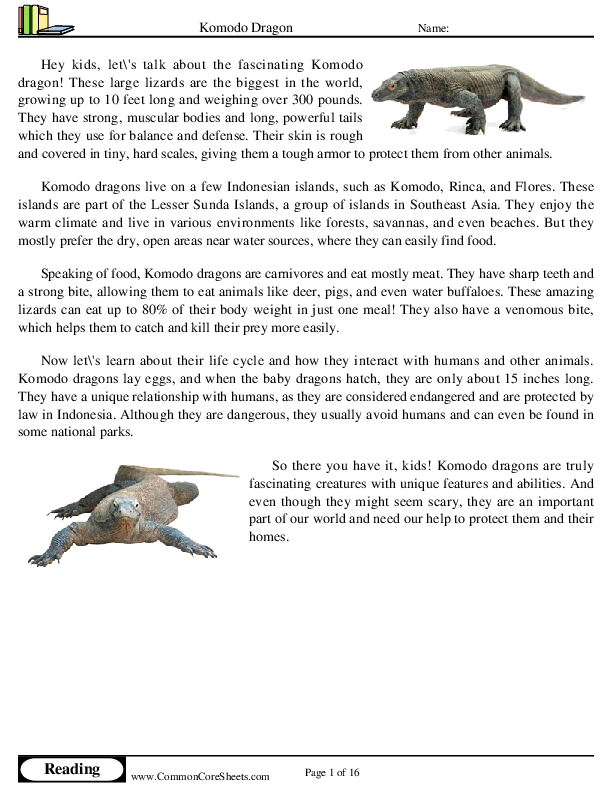
Hey kids, have you ever heard about the amazing creature called the Komodo dragon? Well, it is the largest living lizard on Earth, reaching up to 10 feet in length and weighing over 300 pounds! Komodo dragons have a powerful bite and sharp, serrated teeth that can tear through flesh easily. Their skin is tough and covered in small, bony plates called osteoderms, which act like armor to protect them from injuries. These incredible creatures are found mainly on the Indonesian islands of Komodo, Rinca, Flores, and Gili Motang.
Now, let\'s talk about what these giant lizards like to eat. Komodo dragons are carnivores, which means they eat meat. Their diet consists mainly of deer, pigs, and even water buffaloes, but they will also eat smaller animals like birds and other reptiles if given a chance. Komodo dragons are known to be patient hunters, waiting in ambush for their prey to come close before striking with lightning speed. They can also eat up to 80% of their own body weight in a single meal!
Now it\'s time to learn about the life cycle of a Komodo dragon. Komodo dragons lay eggs, and a female can lay up to 30 of them at a time. The eggs are buried in the ground, and after about 7 to 8 months, the baby dragons hatch. Young Komodo dragons are vulnerable to predators, so they often live in trees for safety until they are big enough to defend themselves. Komodo dragons can live for more than 30 years in the wild!
Let\'s discuss the relationship between Komodo dragons and other animals, including humans. While they are top predators in their environment, Komodo dragons have been known to share their territory with other large animals like wild boars and deer. However, they can be dangerous to humans if they feel threatened or hungry. Due to their fascinating appearance and unique behaviors, Komodo dragons are protected by law in Indonesia and are a popular attraction for tourists. Efforts are being made to conserve their habitat and protect them from threats like habitat loss and poaching.
Finally, let\'s explore some interesting facts about Komodo dragons that make them different from other species. Komodo dragons have a unique way of detecting their prey - they use their long, forked tongues to pick up scent particles from the air and analyze them with an organ in the roof of their mouth. They are also known to be excellent swimmers, which helps them travel between the islands where they live. Surprisingly, Komodo dragons are capable of reproducing through a process called parthenogenesis, where a female can produce offspring without needing a male to fertilize her eggs. This ability allows them to reproduce even when there are no males around, ensuring their survival.
So, there you have it - an exciting introduction to the world of Komodo dragons! These fascinating creatures have adapted to their environment in incredible ways, and their unique characteristics make them truly one-of-a-kind.
About this worksheet
Students read a short informational passage about Komodo dragons and answer comprehension questions about the details.
This worksheet is designed to enrich children's knowledge about Komodo Dragons, delving into their habits, characteristics, and ecological role. Comprising of 20 multifaceted reading questions, from diet to survival strategies, it complements distance learning seamlessly. Moreover, it's easily customizable and convertible into flashcards, making learning interactive and personalized for each child's needs.
Student objectives
- Read a nonfiction passage about Komodo dragons
- Find and recall facts stated in the text
- Answer questions using details from the reading
- Learn new information about how Komodo dragons live and hunt
Everyday practice
- Read a fact sheet at the zoo about an animal you just saw
- Look up information about a favorite reptile in a library book
- Share facts about Komodo dragons with a friend or family member
- Understand a nature article or magazine story about wild animals