Hummingbird Worksheet Download
Free reading worksheets on Hummingbird. Each worksheet has 20 problems with an answer key and are ideal for teachers and homeschooling. You can download the PDF, create a set of flash cards or set it up for online learning.
Select a Different Activity
>
Sheet Information >
Available at 2nd grade, 3rd grade, 4th grade, 5th grade and 6th grade reading levels.
Read the passage
Hey kids! Let\'s talk about the amazing hummingbirds, small birds with colorful feathers that flap their wings faster than any other bird. These tiny creatures love to eat nectar from flowers, which gives them lots of energy to fly around quickly. Besides nectar, they also eat insects and spiders for protein.
Hummingbirds can be found in different parts of the world, from the United States to South America. They build their nests out of leaves and spider silk, which makes them very strong and cozy. Some hummingbirds even migrate long distances, like the Ruby-throated Hummingbird that travels all the way from Canada to Mexico!
These tiny birds have a special relationship with humans and other animals. For example, people love to watch hummingbirds in their gardens and sometimes even put up feeders filled with sugar water to attract them. Hummingbirds also help flowers grow by pollinating them as they drink their nectar, which is great for both the flowers and the environment.
In conclusion, hummingbirds are fascinating little creatures with their vibrant colors, fast wing movements, and unique way of living. They bring joy to people who watch them and play an important role in nature. So next time you see a hummingbird, take a moment to appreciate their beauty and all the amazing things they do!
Hey there, do you know hummingbirds are amazing little creatures? They are tiny birds with bright, colorful feathers that can flap their wings faster than you can blink! Hummingbirds live mostly in North, Central, and South America, where they enjoy hanging out in gardens, forests, and even deserts. These little birds are so special because they can hover in mid-air and fly in any direction - even backward!
Now, let\'s talk about their diet and some interesting facts. Hummingbirds love to eat sweet nectar from flowers, but they also need insects and spiders for protein. Their long, slender beaks and tubular tongues are perfect for reaching deep into flowers to get a tasty treat. Did you know that they have to eat almost constantly because they use up so much energy while flying?
Finally, let\'s explore their life cycle and relationships with humans and other animals. After a female hummingbird lays her tiny eggs, she takes care of her babies all by herself! Many people love to watch hummingbirds and even put out special feeders filled with sugar water to attract them. These amazing birds help with pollination as they move from flower to flower, but they must watch out for larger birds and other animals that might try to eat them.
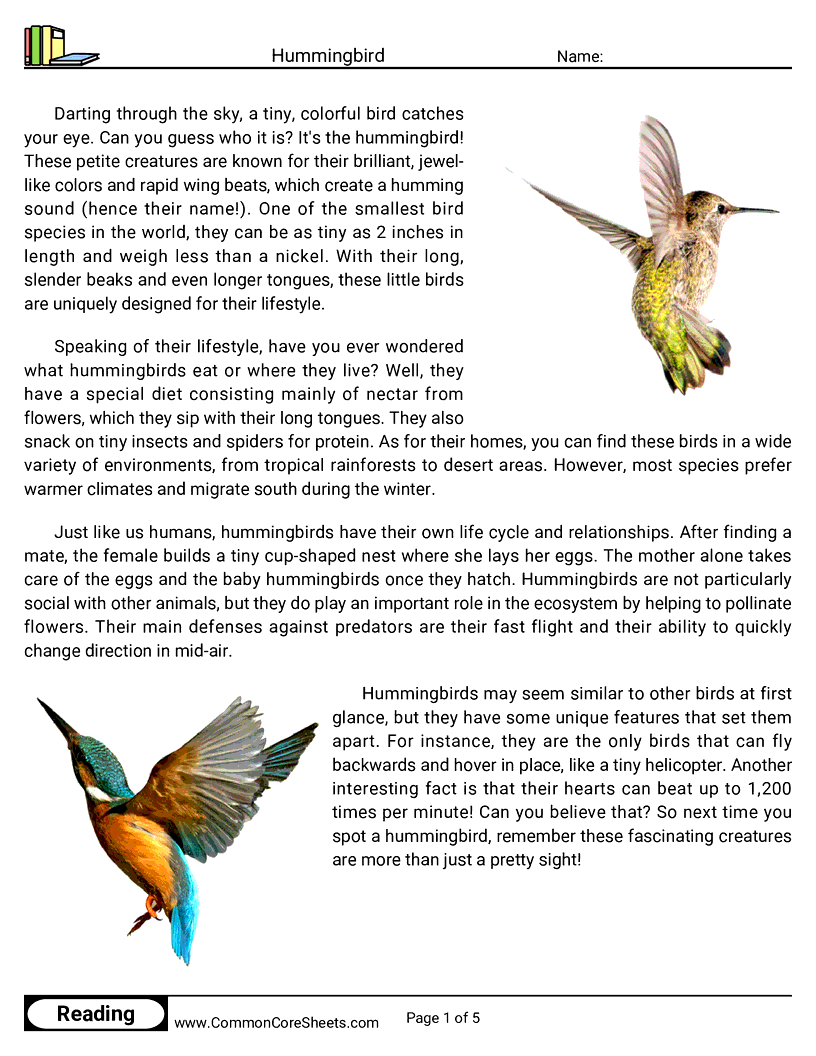
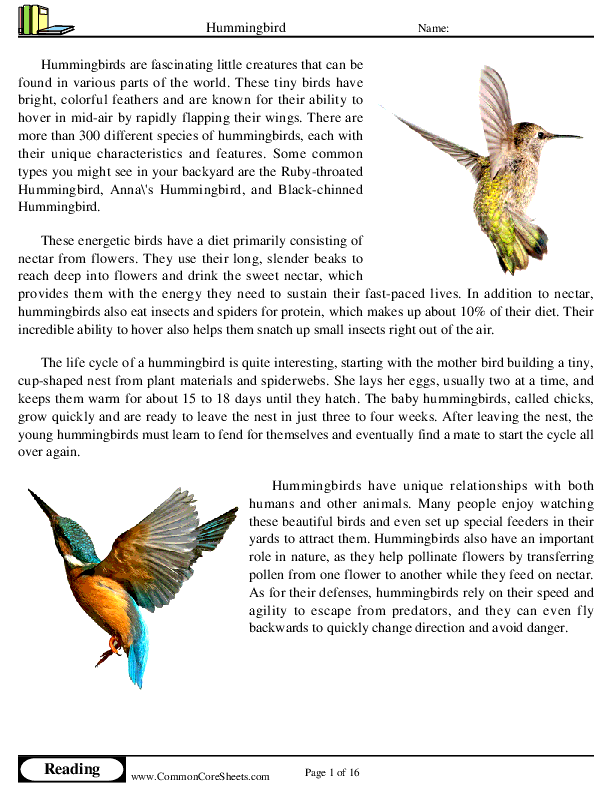
Darting through the sky, a tiny, colorful bird catches your eye. Can you guess who it is? It's the hummingbird! These petite creatures are known for their brilliant, jewel-like colors and rapid wing beats, which create a humming sound (hence their name!). One of the smallest bird species in the world, they can be as tiny as 2 inches in length and weigh less than a nickel. With their long, slender beaks and even longer tongues, these little birds are uniquely designed for their lifestyle.
Speaking of their lifestyle, have you ever wondered what hummingbirds eat or where they live? Well, they have a special diet consisting mainly of nectar from flowers, which they sip with their long tongues. They also snack on tiny insects and spiders for protein. As for their homes, you can find these birds in a wide variety of environments, from tropical rainforests to desert areas. However, most species prefer warmer climates and migrate south during the winter.
Just like us humans, hummingbirds have their own life cycle and relationships. After finding a mate, the female builds a tiny cup-shaped nest where she lays her eggs. The mother alone takes care of the eggs and the baby hummingbirds once they hatch. Hummingbirds are not particularly social with other animals, but they do play an important role in the ecosystem by helping to pollinate flowers. Their main defenses against predators are their fast flight and their ability to quickly change direction in mid-air.
Hummingbirds may seem similar to other birds at first glance, but they have some unique features that set them apart. For instance, they are the only birds that can fly backwards and hover in place, like a tiny helicopter. Another interesting fact is that their hearts can beat up to 1,200 times per minute! Can you believe that? So next time you spot a hummingbird, remember these fascinating creatures are more than just a pretty sight!
Hummingbirds are fascinating little creatures that you\'ll love learning about. These tiny birds are known for their bright colors, rapid wing beats, and incredible flying abilities. There are more than 300 different species of hummingbirds, and they can be found throughout North, Central, and South America. Each species of hummingbird has its unique features and characteristics, making them an exciting subject to explore.
One of the most intriguing aspects of hummingbirds is their diet. These small birds primarily feed on nectar from various flowers, which provides them with the energy they need to sustain their fast-paced lifestyle. In addition to nectar, hummingbirds also eat insects and spiders for protein. Interestingly, they have a specialized long and slender bill, as well as a long tongue, which helps them reach the nectar deep inside flowers.
Let\'s take a look at the life cycle of a hummingbird. Female hummingbirds are responsible for building their tiny, cup-shaped nests using materials such as plant fibers, spider silk, and even bits of lichen. Once the nest is complete, the female lays one or two eggs and takes care of them until they hatch, which usually takes about two to three weeks. The baby hummingbirds, called chicks, are born helpless but grow quickly and leave the nest after just three to four weeks.
Hummingbirds have unique relationships with humans and other animals. Many people set up hummingbird feeders in their yards to attract and enjoy the beauty of these birds. In the wild, hummingbirds are important pollinators, as they transfer pollen between flowers while feeding on nectar. Some animals, such as praying mantises and large spiders, may prey on hummingbirds, but their fast flight and agility help them avoid most predators.
There are many interesting facts and differences between hummingbird species. For example, the smallest hummingbird is the bee hummingbird, which is only about 2 inches long, while the largest is the giant hummingbird, measuring up to 8 inches in length. Hummingbirds can fly forwards, backwards, and even upside-down, thanks to their ball-and-socket shoulder joints. In conclusion, hummingbirds are truly remarkable creatures with amazing features and abilities that make them an exciting and fascinating topic for young learners to explore.
Hummingbirds are truly fascinating creatures, small in size but filled with intriguing characteristics. These tiny birds can be found in a variety of colors, such as green, blue, and red, with their iridescent feathers shimmering in the sunlight. They have the unique ability to hover in mid-air, making them seem almost magical as they zip around. Did you know that hummingbirds are the only birds that can fly forwards, backwards, and even upside-down? Now, let\'s dive into the world of hummingbirds and learn more about their eating habits, habitats, and relationships with other creatures.
First, let\'s discuss what hummingbirds eat to keep their energetic little bodies going. Their diet mainly consists of nectar from various flowers, which provides them with the sugar they need for energy. In addition to nectar, hummingbirds also eat insects and spiders for protein, as well as tree sap, fruit juice, and even pollen. To find their food, hummingbirds use their long, needle-like bills to reach deep into flowers. They have a fantastic memory and can remember every flower they have visited, so they don\'t waste energy going back to an empty one.
Hummingbirds can be found in a wide range of environments, from the mountains to the tropics. They mostly reside in North, Central, and South America, with the highest diversity of species found in South America. These birds prefer habitats with plenty of flowers, such as gardens, meadows, and forests, where food is abundant. Some species of hummingbirds even migrate, traveling long distances between their breeding and wintering grounds. During migration, they can fly non-stop for up to 18 hours, covering distances of up to 500 miles!
Now, let\'s explore the life cycle of these amazing birds and their relationships with other animals. Hummingbirds lay their eggs in tiny nests made of plant fibers, spider silk, and lichen, usually built on a tree branch. When the eggs hatch, the mother takes care of her babies, feeding them a mixture of nectar and insects. In terms of their relationship with other animals, hummingbirds have a special partnership with certain flowers, as they help pollinate the plants while feeding on nectar. As for their defenses, hummingbirds rely on their incredible agility and speed to escape predators like hawks and other larger birds.
Finally, let\'s compare hummingbirds to other bird species and learn some more captivating facts. Unlike most birds, hummingbirds have a rapid heartbeat, reaching over 1,200 beats per minute when in flight. They also have the highest metabolism of any bird species, which means they need to consume a lot of food to keep up their energy levels. In fact, hummingbirds eat around half their body weight in food every day! As we\'ve seen, hummingbirds are truly unique and enchanting creatures that captivate the hearts of many, especially when you take the time to learn about their incredible abilities and characteristics.
About this worksheet
Students read a short informational passage about hummingbirds and answer comprehension questions about the main details and facts.
This worksheet is designed to enhance children's reading comprehension and knowledge about hummingbirds. It includes 20 multiple-choice questions covering various aspects like their unique characteristics, diet, habitat and behaviors. Tailored to the learners' needs, this content can be customized, transformed into flashcards or adapted for distance learning to ensure effective and interactive pedagogy.
Student objectives
- Read a short passage about hummingbirds and understand the main ideas
- Find and recall specific facts stated in the text
- Answer questions using details from what was read
- Build vocabulary related to birds and nature
Everyday practice
- Reading a fact card at a zoo or nature center about an animal
- Answering questions about a nature article you just read
- Telling someone facts you learned about hummingbirds from a book
- Looking up information about a backyard bird you spotted