Hoary Marmot Worksheet Download
Free reading worksheets on Hoary Marmot. Each worksheet has 20 problems with an answer key and are ideal for teachers and homeschooling. You can download the PDF, create a set of flash cards or set it up for online learning.
Select a Different Activity
>


Sheet Information >
Available at 2nd grade, 3rd grade, 4th grade, 5th grade and 6th grade reading levels.
Read the passage
Meet the hoary marmot, a furry little creature that lives in the mountains. These cute animals are often called 'whistle pigs' because they make a loud whistling sound to warn their friends about danger. Hoary marmots love to eat plants, especially flowers, leaves, and grasses, making them herbivores.
These friendly animals have a unique life cycle that involves hibernating for most of the year. They spend about 7 months sleeping during the cold winter months and enjoy the rest of the year playing and eating with their families. Hoary marmots have a special relationship with other animals, such as birds, that help them stay safe from predators like bears and wolves.
When comparing hoary marmots to other species, they have a few differences that make them stand out. One difference is their size; they are much larger than other marmot species, with adults weighing up to 20 pounds! Another interesting fact is that hoary marmots have a grayish fur, which helps them blend into their rocky mountain homes.
In conclusion, hoary marmots are fascinating creatures with their unique life cycle, relationships with other animals, and differences from other species.
Hey kids, have you ever heard of the hoary marmot? These furry animals are a type of ground squirrel, and they live in the mountains of North America. They have a unique fur color that is a mix of gray, brown, and white, which helps them blend in with the rocks and snow. Hoary marmots are pretty big, too – they can weigh up to 20 pounds and grow to be about 30 inches long!
Now let\'s learn about the life of a hoary marmot. These cool creatures love to eat plants, like grasses, flowers, and even some berries. During the winter, they hibernate in their underground burrows to stay warm. Hoary marmots can live up to 15 years, and they usually have babies called pups every two years.
It\'s time to discover how hoary marmots interact with humans and other animals. They are pretty shy, so they usually try to avoid people, but sometimes they can be found near hiking trails. Hoary marmots have a special whistle to warn each other when a predator, like a bear or eagle, is nearby. Compared to other marmot species, hoary marmots have a more distinct fur color and live in higher, colder mountain areas.
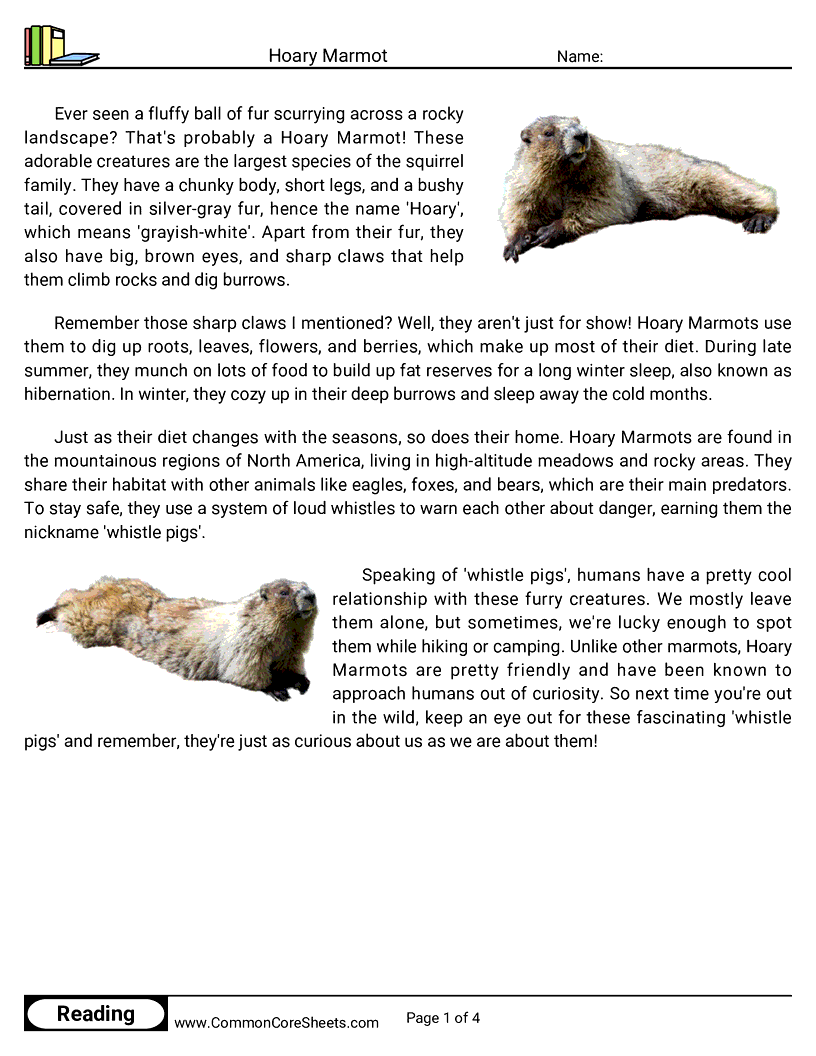
Ever seen a fluffy ball of fur scurrying across a rocky landscape? That's probably a Hoary Marmot! These adorable creatures are the largest species of the squirrel family. They have a chunky body, short legs, and a bushy tail, covered in silver-gray fur, hence the name 'Hoary', which means 'grayish-white'. Apart from their fur, they also have big, brown eyes, and sharp claws that help them climb rocks and dig burrows.
Remember those sharp claws I mentioned? Well, they aren't just for show! Hoary Marmots use them to dig up roots, leaves, flowers, and berries, which make up most of their diet. During late summer, they munch on lots of food to build up fat reserves for a long winter sleep, also known as hibernation. In winter, they cozy up in their deep burrows and sleep away the cold months.
Just as their diet changes with the seasons, so does their home. Hoary Marmots are found in the mountainous regions of North America, living in high-altitude meadows and rocky areas. They share their habitat with other animals like eagles, foxes, and bears, which are their main predators. To stay safe, they use a system of loud whistles to warn each other about danger, earning them the nickname 'whistle pigs'.
Speaking of 'whistle pigs', humans have a pretty cool relationship with these furry creatures. We mostly leave them alone, but sometimes, we're lucky enough to spot them while hiking or camping. Unlike other marmots, Hoary Marmots are pretty friendly and have been known to approach humans out of curiosity. So next time you're out in the wild, keep an eye out for these fascinating 'whistle pigs' and remember, they're just as curious about us as we are about them!
Let\'s learn about the fascinating hoary marmot, a cute furry creature that lives in the mountains. These animals are often called 'whistlers' because they make a loud whistling sound to communicate with each other. Hoary marmots are the largest species of marmot, and they have a thick, silvery-gray fur which helps them blend in with their rocky surroundings. They are social animals and live in groups called colonies, which are led by one dominant adult male.
Now, let\'s find out what hoary marmots like to eat. They are herbivores, which means they only eat plants, and their diet mainly consists of grasses, flowers, and leaves. Hoary marmots spend most of their daytime foraging for food, and they need to eat a lot to store enough fat to survive during hibernation in the winter. Their strong teeth and sharp claws help them dig for roots and tubers to munch on.
The life cycle of a hoary marmot is quite interesting. They are born in burrows during the spring, and the babies, called pups, are born blind and helpless. After about a month, the pups will emerge from the burrow and begin exploring their surroundings, learning how to forage for food. Hoary marmots live for about 10-15 years, and they reach adulthood at around two years of age.
Hoary marmots have a unique relationship with humans and other animals. In some areas, they are considered a tourist attraction, as people love to watch and photograph them in their natural habitat. They also play an important role in the ecosystem, as their burrows provide shelter for other animals, and they are a food source for predators like golden eagles and bears. Hoary marmots are generally not aggressive towards humans but will defend themselves if they feel threatened.
Finally, let\'s explore some interesting facts and differences between hoary marmots and other species. One unique feature of hoary marmots is their ability to hibernate for up to eight months, which is longer than most other marmot species. They are also known for their distinct 'sentries,' or lookout animals, that keep an eye out for danger while the rest of the colony forages for food. With their unique characteristics and charming personalities, hoary marmots are truly fascinating creatures to learn about and observe.
Hoary marmots are fascinating creatures that live in the mountains of North America. These fuzzy animals are part of the rodent family, and are sometimes called 'whistle pigs' because of the loud whistles they make to communicate with each other. They have a thick, grayish-brown fur with a white patch on their chest and a silver sheen, which is where they get the name 'hoary' from. These animals are quite large, weighing between 6-14 pounds, and have a body length of about 20 inches. They also have strong, sturdy legs that help them climb and navigate through the rocky terrain they call home.
The life cycle of a hoary marmot is quite interesting. They are born in litters of three to six, and they spend their first few weeks in a burrow with their mother. After about four weeks, the young marmots start venturing out of the burrow and learning how to forage for food. By the time they are two years old, they are ready to leave their family group and find a new territory of their own. Hoary marmots can live for up to 15 years in the wild, but their average lifespan is around 7 years.
These mountain dwellers have a diverse diet that includes a variety of plants and insects. They love to munch on grasses, flowers, berries, and even tree bark. Hoary marmots also eat insects like ants and grasshoppers, providing them with valuable protein. They are known to be very picky eaters and will often look for the most tender and nutritious plants to eat. Their diet helps them store enough fat to survive the long, cold winters when they hibernate in their burrows.
Hoary marmots have a unique relationship with both humans and other animals. They are generally not afraid of humans and can sometimes be seen near hiking trails or even in campgrounds. However, this can be dangerous for them, as they may try to eat human food or get too close to people. Other animals, like grizzly bears, wolves, and eagles, see hoary marmots as a tasty meal, so they have to be very cautious and use their loud whistles to warn each other of danger. They also have a special bond with the pikas that share their rocky home, as they often live in the same areas and communicate with each other using similar sounds.
One of the most interesting things about hoary marmots is their ability to defend themselves. Their thick fur not only keeps them warm in the cold mountain weather but also provides some protection from predators. They have sharp claws for digging, climbing, and fighting off any threats. In addition, their strong teeth can be used as a powerful defense against predators like eagles or wolves. The unique combination of their physical features and their loud whistles make hoary marmots well-equipped to survive the challenges of their mountain habitats.
In conclusion, hoary marmots are truly amazing animals that play an important role in the ecosystem of the mountains they inhabit. From their diverse diet and fascinating life cycle to their relationships with humans and other animals, these fascinating rodents are a testament to the incredible diversity of life on our planet.
About this worksheet
Students read a nonfiction passage about the hoary marmot and answer questions about its habitat, behavior, and characteristics.
This worksheet is designed to enhance children's reading and comprehension skills through 20 intriguing questions about Hoary Marmots. The content fosters an understanding of these unique animals, covering their habitat, characteristics, behavior, and interaction with humans. The customizable sheet can be converted into flashcards or adapted for distance learning, making it versatile for various teaching styles and learning environments.
Student objectives
- Read a short nonfiction passage about an animal
- Find and recall facts stated in the text
- Answer questions using details from what you read
- Learn about the hoary marmot's habitat and behavior
Everyday practice
- Read a fact sheet about an animal at the zoo and remember key details
- Look up information about a wild animal you saw on a hike
- Explain to someone what you learned after reading about an animal
- Answer questions on a nature center handout about local wildlife