Hanukkah: The Festival of Lights Worksheet Download
Free reading comprehension worksheet about Hanukkah. Pick the reading level (kindergarten to 8th grade), print the passage with its questions, or assign it online.


Sheet Information >
Available at kindergarten, 1st grade, 2nd grade, 3rd grade, 4th grade, 5th grade, 6th grade, 7th grade and 8th grade reading levels.
Read the passage
Look at all those little flames glowing in the window! That is a menorah for Hanukkah. Hanukkah is a Jewish holiday with eight nights.
Why eight nights? Long ago the brave Maccabees won back the Temple in Jerusalem. The story says one little jar of oil burned for eight days.
That oil is why people eat yummy fried foods! Latkes are crispy potato pancakes and sufganiyot are jelly doughnuts. One little jar of oil from the story still makes Hanukkah glow!
Have you ever seen a menorah glow with nine candles? It is a candleholder for Hanukkah, a Jewish holiday of eight nights. A helper candle lights the others, one more each night.
Those eight nights come from a story over 2,000 years old. In Jerusalem, brave Maccabees won back their Temple, a holy place. The story says one day of oil lasted eight days!
That is why families fry latkes, which are crispy potato pancakes! Many also eat sufganiyot, which are doughnuts filled with jelly. One little jar of oil is still remembered on all eight nights!
Wow, one tiny jar of oil is the star of an eight-night holiday! It is Hanukkah, when Jewish families light candles in a holder called a menorah. Each night one more candle glows, so the light grows brighter and brighter.
That growing light reminds families of a story from over 2,000 years ago in Jerusalem. A brave group called the Maccabees won back the Temple, the holy place where Jewish people prayed. Hanukkah means "dedication," or making a place ready for a special purpose.
The Temple's lamp needed oil, but tradition says the Maccabees found only one small jar, enough for one day! Yet the lamp kept burning for eight days, and that is why families light candles for eight nights. Can you imagine a lamp glowing eight times longer than planned?
No wonder oil is the hero, so families fry crispy potato pancakes called latkes and jelly doughnuts called sufganiyot. Children spin a four-sided top called a dreidel. So when a menorah glows in a window, it lights up a story more than 2,000 years old!
Imagine you are standing by a frosty window, watching a family light the first tiny flame on a menorah. Each night of Hanukkah, one more candle joins the glow, until eight shine together. Did you know a Hanukkah menorah has nine branches? Eight are for the nights, and one holds the shamash, a "helper" candle that lights the rest.
Those little lights remind people of a story from over 2,000 years ago in Jerusalem. A brave group called the Maccabees won back the Temple, the holy place where Jewish people worshiped. Then they cleaned it and rededicated it, which means they set it apart for worship again. That is why Hanukkah means "dedication" in Hebrew.
Rededicating the Temple meant lighting its lamp, and that is where the famous story of the oil begins. According to tradition, there was only enough pure olive oil for one day. Yet the flame kept glowing for eight days, long enough for new oil to be made. Because of that, Hanukkah lasts eight nights.
Since oil is the heart of the story, many Hanukkah foods are cooked in it! Families enjoy latkes, which are crispy potato pancakes, and sufganiyot, which are jelly-filled doughnuts. Children spin a dreidel, a four-sided top marked with Hebrew letters that stand for "A great miracle happened there." By the last night, a family has lit 44 candles, counting the helpers, and each one remembers that little lamp that kept shining.
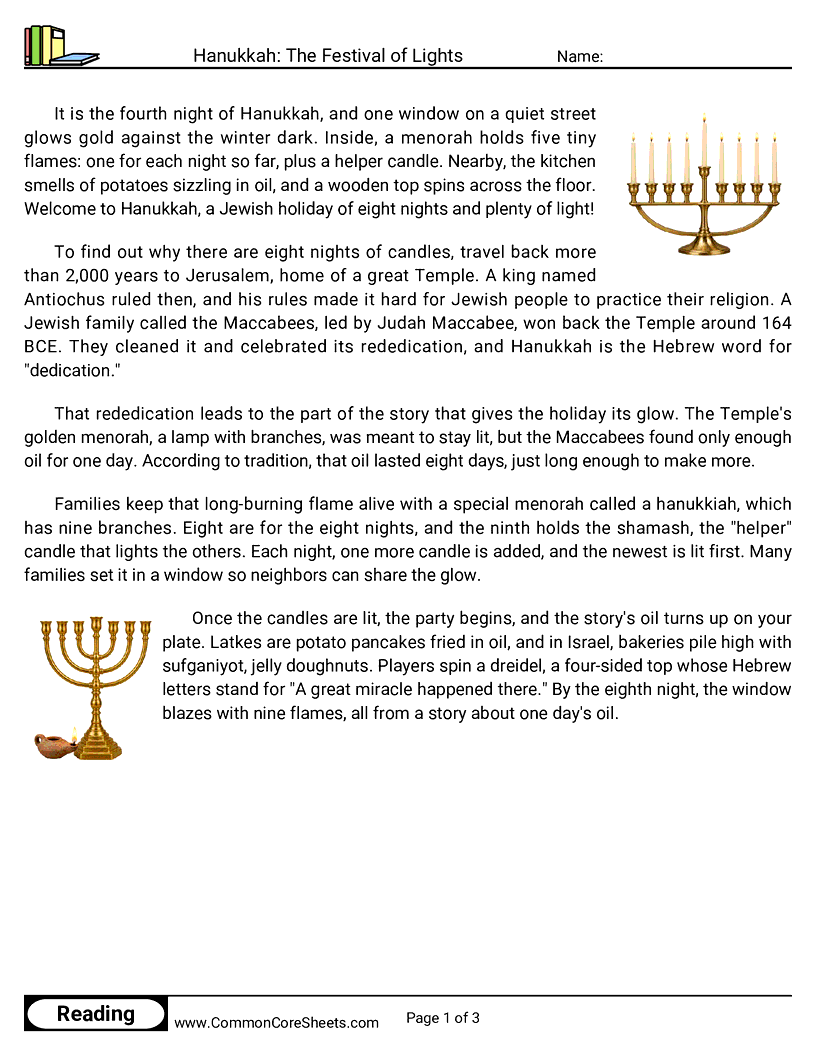
It is the fourth night of Hanukkah, and one window on a quiet street glows gold against the winter dark. Inside, a menorah holds five tiny flames: one for each night so far, plus a helper candle. Nearby, the kitchen smells of potatoes sizzling in oil, and a wooden top spins across the floor. Welcome to Hanukkah, a Jewish holiday of eight nights and plenty of light!
To find out why there are eight nights of candles, travel back more than 2,000 years to Jerusalem, home of a great Temple. A king named Antiochus ruled then, and his rules made it hard for Jewish people to practice their religion. A Jewish family called the Maccabees, led by Judah Maccabee, won back the Temple around 164 BCE. They cleaned it and celebrated its rededication, and Hanukkah is the Hebrew word for "dedication."
That rededication leads to the part of the story that gives the holiday its glow. The Temple's golden menorah, a lamp with branches, was meant to stay lit, but the Maccabees found only enough oil for one day. According to tradition, that oil lasted eight days, just long enough to make more.
Families keep that long-burning flame alive with a special menorah called a hanukkiah, which has nine branches. Eight are for the eight nights, and the ninth holds the shamash, the "helper" candle that lights the others. Each night, one more candle is added, and the newest is lit first. Many families set it in a window so neighbors can share the glow.
Once the candles are lit, the party begins, and the story's oil turns up on your plate. Latkes are potato pancakes fried in oil, and in Israel, bakeries pile high with sufganiyot, jelly doughnuts. Players spin a dreidel, a four-sided top whose Hebrew letters stand for "A great miracle happened there." By the eighth night, the window blazes with nine flames, all from a story about one day's oil.
Here is a puzzle: Hanukkah lasts eight nights, so why does a Hanukkah menorah have nine branches? Peek through a window in December and you might spot a clue, a row of small flames that grows brighter every night. Jewish families light them to celebrate Hanukkah, a festival all its own, filled with sizzling food and spinning tops. To solve the mystery, we must travel back more than 2,000 years to the ancient city of Jerusalem.
Jerusalem was home to the Temple, the holiest place in Jewish life, but about 2,200 years ago a king named Antiochus IV took control of the city and limited Jewish worship. A family of Jewish leaders called the Maccabees, guided by Judah Maccabee, gathered a small band of fighters to win the Temple back. They succeeded, and in about 164 BCE they cleaned the Temple and dedicated it for worship once more. The holiday's name holds a clue, because the Hebrew word Hanukkah means "dedication."
Dedicating the Temple meant relighting its great lamp, and that is where a famous legend begins. According to the Talmud, an ancient collection of Jewish teachings, the Maccabees found only one small jar of pure oil, enough to burn for just one day. The tradition holds that the flame kept burning for eight days, which gave them time to prepare more oil. Imagine a tiny flame that refused to quit, and you can see why Hanukkah lasts eight nights.
Families keep that stubborn flame alive today with a Hanukkah menorah, and here is the answer to our puzzle. Eight branches stand for the eight days of burning, while the ninth candle, called the shamash, or "helper," is used to light all the others. On the first night, families light one candle plus the helper, then add one more each night until all eight glow together. Many families set the menorah in a window so passersby can share the light.
While the window glows outside, the kitchen sizzles inside, since foods fried in oil recall the legend. Families make latkes, crispy potato pancakes, and in Israel bakeries fill their shelves with sufganiyot, jelly-filled doughnuts. Then comes the dreidel, a four-sided top marked with the Hebrew letters nun, gimel, hey, and shin, standing for "A great miracle happened there." So the menorah, the latkes, and even the spinning top all trace back to one small jar of oil and a Temple made new again.
Many people assume Hanukkah is just a twin of Christmas, with candles standing in for the tree. Look closer, and that idea spins out faster than a wobbly top! Hanukkah is its own celebration, with its own story, its own foods, and its own place on the calendar. For eight nights, a family lights one more flame each evening, until a menorah blazes with light and the kitchen smells of sizzling potatoes. Because it follows the Hebrew calendar, it can begin anywhere from late November to late December.
That glow in the window points back to a story more than 2,000 years old, set in the city of Jerusalem. A ruler named Antiochus IV governed the land then, and he tried to end many Jewish practices, even placing his own religious objects inside the Temple, the holiest place in Jerusalem. A small band of Jewish fighters called the Maccabees, led by Judah Maccabee, stood up to his much larger army. After years of struggle, they won back the city, cleaned the Temple, and dedicated it again in about 164 BCE. That moment gave the holiday its name, because Hanukkah is the Hebrew word for "dedication."
Rededicating the Temple meant relighting its great lamp, and that is where the most famous part of the story begins. According to tradition, the Maccabees found only one small jar of pure olive oil, barely enough for a single day. Yet tradition holds that the flame burned for eight days, long enough to prepare fresh oil, which is why the holiday lasts eight nights. This legend was written down in the Talmud, a collection of Jewish teachings, centuries after the Maccabees lived. Today's menorah has nine branches: eight for the nights and one for the shamash, a "helper" candle that lights all the others.
While those candles burn, the kitchen becomes the second star of the night, because oil is the hero of the menu too. Latkes, crispy potato pancakes, are fried in it, then piled high with applesauce or sour cream. In Israel, bakeries stack up sufganiyot, jelly-filled doughnuts that also take a dip in hot oil. Then comes the dreidel, a four-sided spinning top marked with the Hebrew letters nun, gimel, hei, and shin, which stand for "a great miracle happened there." Here is a twist: dreidels made in Israel often swap the last letter for pe, so the message reads "a great miracle happened here."
That "great miracle" message travels far beyond the kitchen table. Tradition says to place the menorah in a window or doorway, so that people passing by can see the light and remember the story. To me, the best part of Hanukkah is the idea that a small flame, shared with others, can brighten a very dark night. Today, families in many countries light menorahs, and some towns set up giant ones in public squares. Not bad for a holiday whose most famous story begins with one small jar of oil!
One day of oil, eight nights of light: that is the math at the heart of Hanukkah, and it explains why this Jewish festival glows the way it does. On the first night, a family lights one flame on a nine-branched candleholder called a menorah, and every night after that they add another. Eight branches stand for the eight nights, while the ninth, called the shamash, or "helper," is used to light the rest. Count every flame lit over the whole holiday, helper included, and the total reaches 44! Add the sizzle of latkes and the whir of spinning tops, and you have a holiday you can see, hear, and taste.
What you see on the menorah is only the end of a story that began more than 2,100 years ago in and around Jerusalem. At that time the region was ruled by the Seleucid Empire, and its king, Antiochus IV, placed harsh limits on Jewish religious life, including at the Temple, the center of Jewish worship. A Jewish family led first by Mattathias and then by his son Judah Maccabee organized a revolt. After years of struggle, the Maccabees won control of Jerusalem in about 164 BCE. They cleaned the Temple, rebuilt its altar, and dedicated it again for Jewish worship, and the Hebrew word for "dedication" is Hanukkah.
Dedication is the right word, because the earliest accounts describe an eight-day celebration of the Temple's rededication, beginning on the 25th day of the Hebrew month of Kislev. The famous oil legend shows up later, in the Talmud, a vast collection of Jewish teachings written down centuries after the events. According to that tradition, the Maccabees found only one small jar of pure oil for the Temple's lamp, enough for a single day, yet the flame burned for eight. Notice that the two sources stress different things: one remembers a hard-fought victory, while the other remembers a miracle of light. Lamps, not battles, ended up filling the scene each December, because families passed down the custom of lighting flames.
Those lights come with surprisingly careful rules. Candles are placed in the menorah from right to left, but the newest one is lit first, so the flames are lit from left to right. Tradition also says the menorah belongs in a window or doorway, so that passersby can see it and the story is shared with the neighborhood. One explanation for the helper flame is that the Hanukkah lights are meant to be admired rather than used, so the shamash can provide light for reading or working.
Once the flames are lit, another sound joins the evening: the whir of the dreidel, a four-sided spinning top. Each side carries a Hebrew letter, nun, gimel, hey, and shin, which stand for the phrase "Nes gadol haya sham," or "A great miracle happened there." In Israel, the last letter is usually peh instead of shin, which changes the message to "A great miracle happened here." The game itself probably came from Europe, where spinning-top games were played for centuries, and the word "dreidel" comes from a Yiddish word meaning "to turn." So a toy spinning in Tel Aviv or Toronto carries Hebrew letters, a Yiddish name, and a game with roots in Europe.
Europe's kitchens shaped the holiday plate, too, especially the crispy latke. Latkes are fried in oil, a tasty echo of the oil in the story, and today they are usually made from potatoes. Yet potatoes came to Europe from the Americas and only became a staple in much of Eastern Europe in the 1800s, so earlier generations often made their Hanukkah pancakes from other ingredients, such as cheese. In Israel, bakeries pile their shelves with sufganiyot, jelly doughnuts that are also fried in oil. Fried food, a spinning top, a window full of flames: each custom traveled its own road across the centuries, yet all of them still point back to one small jar of oil and eight nights of light.
Two ancient teachers are arguing over how to light a candle, and their argument still shapes the holiday today! About 2,000 years ago, the scholars Hillel and Shammai disagreed about how to light Hanukkah candles: Shammai wanted eight flames on the first night, dropping by one each evening, while Hillel wanted one flame, growing by one each night. Jewish tradition follows Hillel, which is why a menorah glows brighter night after night until all eight branches are burning. Add a ninth candle, the shamash or "helper," and you have the centerpiece of a festival that also brings frying latkes, spinning tops, and glowing windows. Hanukkah is a celebration all its own, and its story is full of puzzles worth untangling.
Those growing flames look back to a struggle in Judea, the region around Jerusalem, about 2,200 years ago. The land was then part of the Seleucid Empire, and its king, Antiochus IV, placed harsh limits on Jewish religious practice and let the Temple in Jerusalem be used for other worship. A family of Jewish priests, led first by Mattathias and then by his son Judah Maccabee, organized a revolt. Historians usually date the turning point to 164 BCE, when the Maccabees regained Jerusalem and rededicated the Temple. That is the heart of the holiday's name, since Hanukkah means "dedication."
Dedication is also where the puzzle begins, because the oldest written accounts never mention a jar of oil. The books of 1 and 2 Maccabees, written not long after the events, describe an eight-day celebration of the rededication, and 2 Maccabees compares it to Sukkot, a joyful autumn festival the Maccabees had missed during the fighting. The famous oil story appears in the Talmud, a vast collection of Jewish teachings written down several centuries later. As tradition holds it, the victors found one small jar of pure oil, enough for a single day, yet the Temple lamp burned for eight. Some scholars think later teachers stressed the miracle of light to keep the focus on faith rather than on a military victory.
Whichever account you favor, the eight days are still counted with fire, in the lighting of the menorah, a word that simply means "lamp." The lamp in the ancient Temple had seven branches, but a Hanukkah menorah, often called a hanukkiah, has nine: one for each night plus the shamash. The shamash stands apart because the Hanukkah lights are meant to be looked at, not used for reading or working. Families traditionally light them after dark and set the menorah where passersby can see it, often in a window. Think of it as a public announcement made of flame.
Follow that glow down the street and you will probably end up in a kitchen, because Hanukkah foods are cooked in oil to echo the oil in the story. Many families in Europe and North America fry latkes, crispy potato pancakes served with applesauce or sour cream. Potatoes only became common in Eastern Europe in recent centuries, so earlier Hanukkah pancakes were often made from other ingredients, such as cheese. In Israel, the star treat is the sufganiyah, a jelly-filled doughnut that fills bakery windows as the holiday approaches. Same idea, different recipes, depending on where a family lives.
Once the plates are empty, the table becomes a game board, thanks to the dreidel, a four-sided spinning top. Its sides bear the Hebrew letters nun, gimel, hey, and shin, which stand for "a great miracle happened there"; in Israel, dreidels usually carry pe instead of shin, changing the message to "happened here." Some historians point out that similar spinning-top games were played in Europe, and suggest the Jewish game adapted a familiar toy by giving it a new meaning. That habit of borrowing and adding meaning is part of how the holiday has changed; religiously it is considered a minor festival, yet in the United States it has grown into a large family occasion. Perhaps the most striking part is that a festival born from a struggle and a debated jar of oil still follows Hillel's simple rule: each night, add one more light.
About this worksheet
Students read a nonfiction passage about Hanukkah, written at 9 reading levels (kindergarten to 8th grade), and answer multiple-choice questions about it.
A reading comprehension worksheet about Hanukkah with a different article for each reading level, kindergarten to 8th grade, each with its own multiple-choice questions aligned to the Common Core Reading: Informational Text standards. Printable with an answer key, and available as an online assignment at any level.
Student objectives
- Read a nonfiction passage about Hanukkah and identify key details about its history and customs.
- Explain why the menorah has nine branches and what the shamash does.
- Find the cause-and-effect link between the story of the Temple oil and Hanukkah traditions.
- Use context to work out the meaning of words such as rededication and shamash.
Everyday practice
- Notice how many candles a menorah would need on each night of Hanukkah, counting the helper candle too.
- Look for a lit window or holiday lights in your neighborhood and think about why people share light with neighbors.
- Ask a friend or family member which holiday foods or games they enjoy and why they matter to them.