Garter Snake Worksheet Download
Free reading worksheets on Garter Snake. Each worksheet has 20 problems with an answer key and are ideal for teachers and homeschooling. You can download the PDF, create a set of flash cards or set it up for online learning.
Select a Different Activity
>


Sheet Information >
Available at 2nd grade, 3rd grade, 4th grade, 5th grade and 6th grade reading levels.
Read the passage
Hey kids, let\'s learn about garter snakes, a fascinating little creature that you might find in your own backyard! Garter snakes come in various colors and patterns, but they usually have a stripe running along their back. These snakes can be found across North America, living in grassy fields, forests, and even near water.
Now, let\'s talk about what garter snakes like to eat and their life cycle. These little hunters enjoy munching on insects, frogs, and even small fish. Garter snakes lay eggs in the summer, which hatch into tiny baby snakes after a few months.
Lastly, let\'s discuss garter snakes' relationship with humans and other animals, as well as their unique defenses. Garter snakes are generally harmless to humans and can even help keep pesky insects under control. When threatened, these snakes release a stinky smell to scare away predators or they may even wiggle their tail to pretend they\'re a dangerous rattlesnake.
Garter snakes are amazing, aren\'t they? Next time you spot one, remember just how interesting and helpful they can be!
Hey kids, did you know that garter snakes are one of the most common snakes in North America? These small, slender snakes come in different colors and patterns, ranging from green to brown or even blue! They\'re not venomous, so they\'re not dangerous to humans, but they do have some cool ways to protect themselves from other animals. For example, they can release a smelly musk to scare away predators or quickly slither away to hide.
Now, let\'s talk about what garter snakes like to eat and where they live. These little guys love to snack on insects, slugs, and even small fish, making them helpful for keeping pests under control. Garter snakes can be found in a variety of habitats, like forests, grasslands, and even your own backyard. They like to live near water, so you might spot them near a pond or stream.
Lastly, let\'s take a look at the garter snake\'s life cycle and their relationship with other animals. After mating in the spring, female garter snakes give birth to live babies instead of laying eggs like some other snakes do. Even though they\'re small, garter snakes are important members of the food chain, serving as both predator and prey. Birds, mammals, and even larger snakes like to eat garter snakes, but they also help control insect and slug populations by eating them.
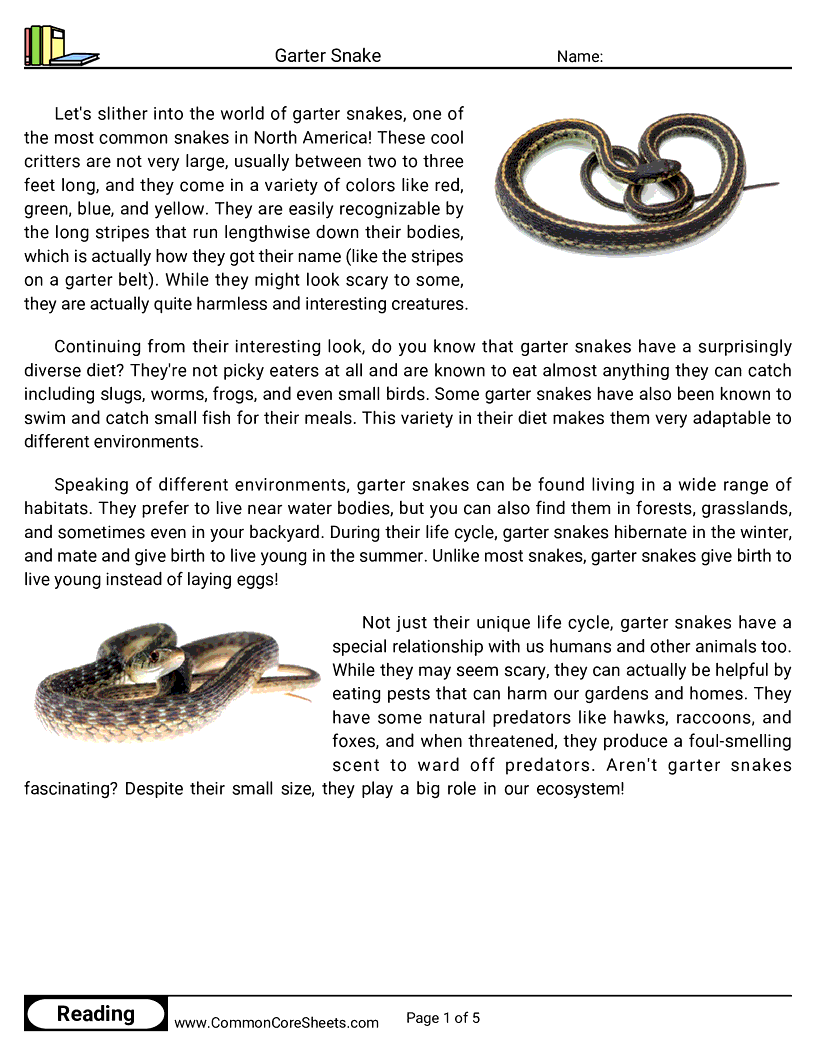
Let's slither into the world of garter snakes, one of the most common snakes in North America! These cool critters are not very large, usually between two to three feet long, and they come in a variety of colors like red, green, blue, and yellow. They are easily recognizable by the long stripes that run lengthwise down their bodies, which is actually how they got their name (like the stripes on a garter belt). While they might look scary to some, they are actually quite harmless and interesting creatures.
Continuing from their interesting look, do you know that garter snakes have a surprisingly diverse diet? They're not picky eaters at all and are known to eat almost anything they can catch including slugs, worms, frogs, and even small birds. Some garter snakes have also been known to swim and catch small fish for their meals. This variety in their diet makes them very adaptable to different environments.
Speaking of different environments, garter snakes can be found living in a wide range of habitats. They prefer to live near water bodies, but you can also find them in forests, grasslands, and sometimes even in your backyard. During their life cycle, garter snakes hibernate in the winter, and mate and give birth to live young in the summer. Unlike most snakes, garter snakes give birth to live young instead of laying eggs!
Not just their unique life cycle, garter snakes have a special relationship with us humans and other animals too. While they may seem scary, they can actually be helpful by eating pests that can harm our gardens and homes. They have some natural predators like hawks, raccoons, and foxes, and when threatened, they produce a foul-smelling scent to ward off predators. Aren't garter snakes fascinating? Despite their small size, they play a big role in our ecosystem!
Garter snakes are fascinating creatures that you might have seen in your own backyard. They come in various colors and patterns, but most have a long, slender body with three stripes running along their length. They can be found all across North America and are known for being very adaptable. In fact, they can live in many different environments such as forests, grasslands, and even near water.
When it comes to food, garter snakes have quite the appetite! They mostly eat insects, frogs, small fish, and earthworms, which they catch using their excellent sense of smell and sight. Garter snakes have a unique way of eating their prey; they swallow it whole, without chewing! This is possible because they have a special jaw that can stretch really wide to fit their meal.
The life cycle of a garter snake is quite interesting. They usually mate in the spring, and the female gives birth to live baby snakes, called 'neonates', in late summer. These tiny snakes are born fully developed and can immediately start hunting for food. Garter snakes can live for up to ten years, growing and shedding their skin several times a year.
Garter snakes have a special place in the ecosystem, as they help control insect and rodent populations. They are generally harmless to humans and are often considered beneficial because they eat pests. However, some larger animals like birds of prey, raccoons, and larger snakes might prey on garter snakes. To protect themselves, garter snakes release a stinky musk when threatened, which usually deters predators.
There are many different species of garter snakes, each with their own unique features. For example, the Eastern Garter Snake has a checkerboard pattern on its back, while the Western Terrestrial Garter Snake sports a vibrant orange stripe. Some interesting facts about garter snakes include their ability to climb trees and swim, as well as their habit of hibernating in large groups during winter. These amazing snakes are an essential part of our ecosystem and a fascinating creature to learn about.
Garter snakes are fascinating creatures that can be found in many parts of North America. These snakes are usually small, measuring from 18 to 54 inches in length, and come in different colors such as greenish, gray, or brown with stripes. Garter snakes are not venomous, which means they are not harmful to humans. They are active during the day, and you can often spot them basking in the sunlight to warm up their cold-blooded bodies. Let\'s explore more about their diet, habitat, and some interesting facts about these snakes.
Garter snakes have a varied diet, making them quite the opportunistic eaters. They mostly feed on insects, slugs, earthworms, small fish, and amphibians like frogs and toads. Sometimes, they can even eat small birds or mammals. Garter snakes use their excellent sense of smell to locate their prey and catch it using their quick reflexes. Once the prey is caught, they swallow it whole.
These snakes can adapt to various habitats, making them quite versatile in where they live. Garter snakes can be found in grasslands, forests, wetlands, and even in urban areas like gardens and parks. They prefer to live near water sources such as ponds, lakes, or streams. During the colder months, garter snakes will hibernate in dens or burrows, sometimes with many other snakes. When the weather gets warmer, they become active again and return to their hunting grounds.
Garter snakes' life cycle starts from the moment they are born. Unlike some other snakes, garter snakes give birth to live babies instead of laying eggs. After mating in spring, the female snake gives birth to 10 to 40 baby snakes in late summer. These little snakes are independent from birth and start hunting for their food almost immediately. Garter snakes can live up to 10 years in the wild, but their average lifespan is around 3 to 5 years.
Garter snakes have a unique relationship with humans and other animals. While they don\'t pose any threat to humans, they can benefit us by keeping the population of insects and other pests under control. In the animal kingdom, garter snakes have predators such as birds of prey, raccoons, and larger snakes. When threatened, garter snakes release a smelly musk as a defense mechanism to deter predators. It\'s important to remember that garter snakes play a vital role in maintaining a balanced ecosystem, and we should treat them with respect and care.
About this worksheet
Students read a short passage about garter snakes and answer questions to show they understand the key details and facts.
This worksheet is designed to refine children's reading comprehension skills through an exploration of garter snakes. It features 20 problems touching upon various factors of these snakes' life, behavior, and habitat. The worksheet aids in not only acquiring facts about garter snakes but also in practicing analytical and deductive reasoning. It's versatile and can be customized, converted into flash cards, or used for distance learning environments, making it suitable for various pedagogical approaches.
Student objectives
- Read a nonfiction passage about garter snakes and understand the main idea
- Find specific facts and details in the text to answer questions
- Learn new information about how garter snakes live and behave
- Practice using the reading to support your answers
Everyday practice
- Read a fact sheet at a zoo or nature center and remember what you learned
- Look up information about an animal you saw outside
- Answer questions after reading an article for a school project
- Share interesting animal facts with family after reading about them