Fruit Flies Worksheet Download
Free reading worksheets on Fruit Flies. Each worksheet has 20 problems with an answer key and are ideal for teachers and homeschooling. You can download the PDF, create a set of flash cards or set it up for online learning.
Select a Different Activity
>
Sheet Information >
Available at 2nd grade, 3rd grade, 4th grade, 5th grade and 6th grade reading levels.
Read the passage
Hey kids, let\'s learn about fruit flies, those tiny insects that we often see flying around ripe fruits! These little bugs love to eat the sugar from fruits, and they also enjoy a tasty meal of vegetables, fungi, and even the bacteria on decaying food. You can usually find fruit flies living in your kitchen, gardens, and other places where there\'s plenty of delicious fruits and veggies for them to munch on.
Fruit flies have a fascinating life cycle that begins when mommy fruit flies lay their eggs on fruits. When the eggs hatch, they become larvae, which are like tiny worms that crawl around and eat before they turn into pupae and then into adult fruit flies. This whole process is super quick and only takes about 8 to 10 days from start to finish!
Now, let\'s talk about how fruit flies interact with humans and other insects. Even though fruit flies can be a bit annoying when they buzz around our food, they are actually helpful to scientists who study their genes to learn more about human genetics! Other insects, like spiders, find fruit flies to be an excellent snack, but fruit flies use their quick flying skills to escape danger and avoid becoming a meal.
In conclusion, fruit flies are tiny insects with a speedy life cycle that love to eat sugar from fruits and vegetables. They play an important role in helping scientists study genetics, and they use their fast flying skills to outsmart other insects. So the next time you see a fruit fly, remember that they\'re not just pesky bugs, but rather fascinating creatures with a unique place in our world!
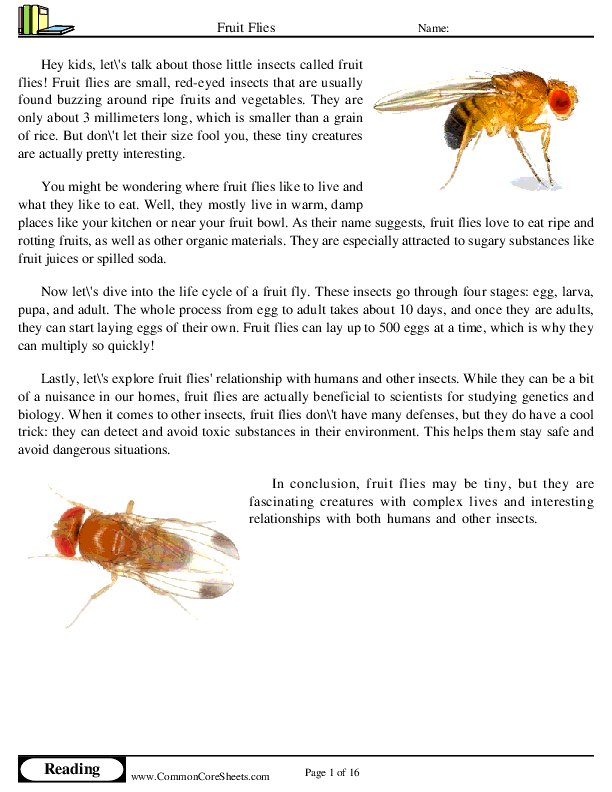
Let\'s learn about fruit flies, those tiny insects that you might see buzzing around your kitchen. Fruit flies are really small, about the size of a pinhead, and they have red eyes and tan-colored bodies. These little insects love to eat ripe fruits, vegetables, and even some sugary drinks. You can often find them living near fruit bowls, trash cans, or places where food is left out.
Now, let\'s talk about the life cycle of a fruit fly and how it relates to other insects. Fruit flies go through four stages in their life: egg, larva, pupa, and adult, just like butterflies and beetles. Their entire life cycle is pretty short, lasting only about 10 days! This short life cycle makes them great for scientific research, especially when studying genetics.
Lastly, let\'s explore some interesting facts and differences between fruit flies and other species. Fruit flies have a unique defense mechanism called 'fly swatting,' where they use their wings to swat away predators. While fruit flies might be annoying to us humans, they play an important role in pollination and breaking down organic materials. One fun fact is that there are over 1,500 different species of fruit flies, each with their own unique characteristics!
In conclusion, fruit flies are fascinating little creatures that play a bigger role in our world than we might realize. So the next time you see one buzzing around, remember all the cool things you\'ve learned about them!
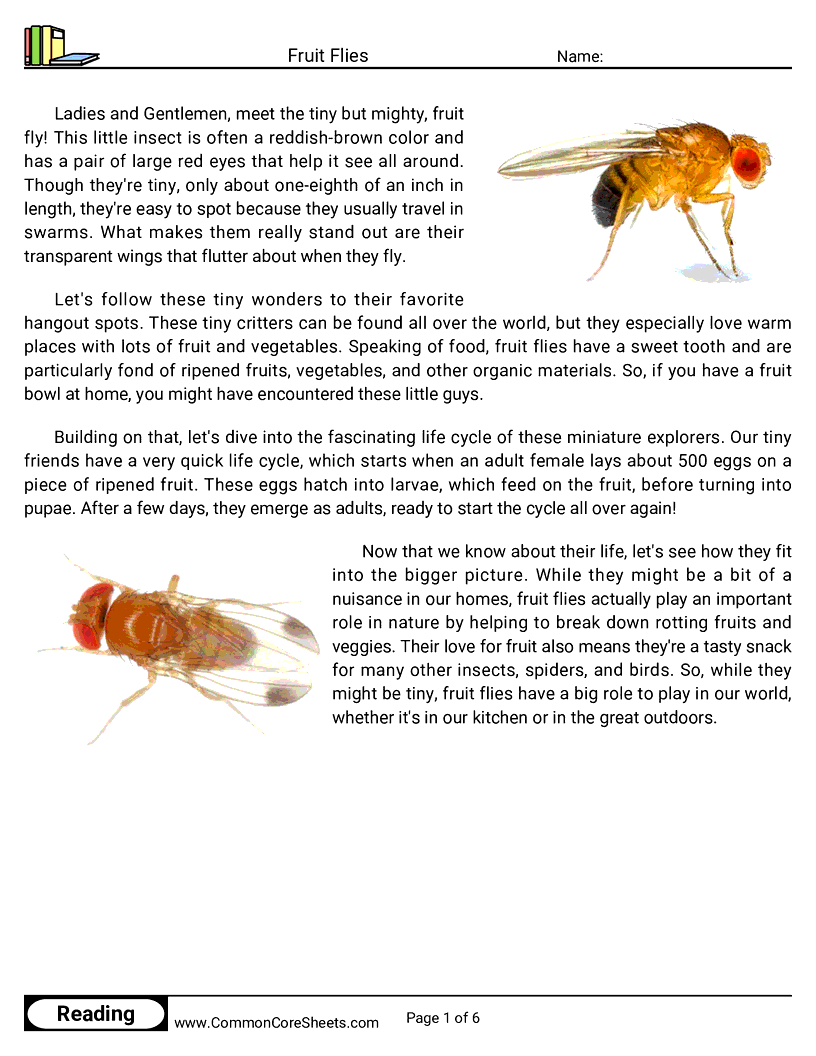
Ladies and Gentlemen, meet the tiny but mighty, fruit fly! This little insect is often a reddish-brown color and has a pair of large red eyes that help it see all around. Though they're tiny, only about one-eighth of an inch in length, they're easy to spot because they usually travel in swarms. What makes them really stand out are their transparent wings that flutter about when they fly.
Let's follow these tiny wonders to their favorite hangout spots. These tiny critters can be found all over the world, but they especially love warm places with lots of fruit and vegetables. Speaking of food, fruit flies have a sweet tooth and are particularly fond of ripened fruits, vegetables, and other organic materials. So, if you have a fruit bowl at home, you might have encountered these little guys.
Building on that, let's dive into the fascinating life cycle of these miniature explorers. Our tiny friends have a very quick life cycle, which starts when an adult female lays about 500 eggs on a piece of ripened fruit. These eggs hatch into larvae, which feed on the fruit, before turning into pupae. After a few days, they emerge as adults, ready to start the cycle all over again!
Now that we know about their life, let's see how they fit into the bigger picture. While they might be a bit of a nuisance in our homes, fruit flies actually play an important role in nature by helping to break down rotting fruits and veggies. Their love for fruit also means they're a tasty snack for many other insects, spiders, and birds. So, while they might be tiny, fruit flies have a big role to play in our world, whether it's in our kitchen or in the great outdoors.
Fruit flies are tiny insects that can be both fascinating and pesky. These little creatures are about the size of a pinhead and have red eyes, making them easy to recognize. They can be found all around the world and have a big appetite for fruits and vegetables. Fruit flies are known for their fast reproduction rate, which is one reason they can be a nuisance in our homes.
The life cycle of a fruit fly is quite interesting and happens quickly. It starts with the female laying her eggs on the surface of a fruit or vegetable. In just a day or two, the eggs hatch into larvae, which is the second stage of their life. After about a week, the larvae transform into pupae, and then eventually emerge as adult fruit flies ready to start the cycle all over again.
In their natural habitat, fruit flies play an important role in the ecosystem. They help break down rotting fruits and vegetables, returning nutrients to the soil. While they can be a nuisance to humans when they infest our homes, they are not harmful. In fact, fruit flies are often used in scientific research, helping us learn more about genetics and diseases.
Fruit flies have some interesting relationships with other insects. For example, they often share their living space with ants, who help protect the fruit fly larvae from predators. In return, the fruit flies provide the ants with a sugary substance that they produce. This is a great example of a mutualistic relationship, where both species benefit from living together.
There are many fascinating facts about fruit flies that set them apart from other species. One unique feature is their ability to taste with their feet, which helps them locate suitable food sources. Fruit flies can also lay up to 500 eggs in their short lifetime, which is only about 40 days long. Despite their small size and simple appearance, fruit flies are truly remarkable creatures that continue to teach us about the world around us.
Hey there, let\'s talk about fruit flies, those tiny insects you might have seen buzzing around your kitchen! Fruit flies, also known as Drosophila melanogaster, are small insects that are usually about 1/8 of an inch long. They have red eyes, a tan-colored body, and translucent wings that help them fly around in search of food. These little creatures are known for their incredible ability to reproduce quickly, making them an interesting subject for scientists to study. In this article, we will explore the fascinating world of fruit flies and learn about their life cycle, diet, and relationship with humans and other insects.
First, let\'s dive into the life cycle of a fruit fly, which is quite amazing for such a small insect. Fruit flies start their life as tiny eggs, which are laid by adult females on the surface of ripe or rotting fruits and vegetables. Within just 24 hours, the eggs hatch into larvae, which are small, white, and worm-like creatures that feed on the decaying organic matter. After a few days of feasting, they transform into pupae, a stage where they develop into adult flies. Finally, after about a week, they emerge as fully-grown fruit flies, ready to continue the cycle with their own offspring.
Now that we know about their life cycle, let\'s find out what fruit flies love to eat. As their name suggests, fruit flies are attracted to fruits, especially those that are overripe or starting to rot. However, they don\'t just munch on fruits; they also feast on vegetables, fungi, and other decaying organic matter. Fruit flies have a great sense of smell, which helps them locate their next meal, even from a distance. Their diet is essential for their survival and plays a significant role in their reproduction process.
You might be wondering how fruit flies interact with humans and other insects. For humans, fruit flies can be quite a nuisance, as they are attracted to our food and can contaminate it with bacteria. However, they also play a vital role in scientific research, as their short life cycle and genetic makeup make them ideal for studying genetics and biology. In the insect world, fruit flies have many predators, including spiders, ants, and even other flies. To avoid these threats, fruit flies rely on their quick flight and small size to escape danger.
Lastly, let\'s explore some interesting facts and differences between fruit flies and other species. While there are many species of fruit flies, Drosophila melanogaster is the most commonly studied and well-known. Interestingly, fruit flies share 75% of their genes with humans, which is one of the reasons they are so valuable for scientific research. Unlike some other insects, fruit flies do not bite or sting, and they are not known to transmit diseases to humans. In fact, fruit flies are considered a valuable part of the ecosystem, as they help break down decaying organic matter and provide a food source for other creatures.
In conclusion, fruit flies are fascinating creatures with intriguing life cycles, diets, and interactions with humans and other insects. While they can be a nuisance in our homes, they also play an essential role in scientific research and ecosystems. So next time you spot a fruit fly, remember that there\'s more to them than meets the eye!
About this worksheet
Students read a short passage about fruit flies and answer questions to show they understood the details and main ideas.
This worksheet is designed to enhance children's reading and comprehension skills, focusing on the subject of 'Fruit Flies'. It includes 20 diverse questions, exploring their color, roles in nature, diet, reproduction, and predators. This multifaceted tool can be personalized, transformed into flash cards or integrated into distance learning, providing a flexible approach to enrich education.
Student objectives
- Read a nonfiction passage carefully and understand what it says
- Find specific facts and details from the text to answer questions
- Figure out the main idea of what you read
- Understand new vocabulary words used in the passage
Everyday practice
- Read the back of a food package to learn how to keep fruit from spoiling
- Understand a science article about bugs you see at home
- Answer questions after reading a nature magazine story
- Explain to someone what a short article you read was about