Falcon Worksheet Download
Free reading worksheets on Falcon. Each worksheet has 20 problems with an answer key and are ideal for teachers and homeschooling. You can download the PDF, create a set of flash cards or set it up for online learning.
Select a Different Activity
>


Sheet Information >
Available at 2nd grade, 3rd grade, 4th grade, 5th grade and 6th grade reading levels.
Read the passage
Let's start off by learning what falcons eat and where they live. Falcons are carnivores, which means they eat meat, and their favorite meals are small birds and rodents they catch while flying high in the sky. These fascinating birds can be found all over the world, but they really love places with open landscapes like deserts, coasts, and mountains.
Now let's discover more about the life cycle of falcons and their relationship with other animals and humans. Falcons go through different stages from being an egg in a nest to a full-grown, fast-flying bird, and they can live up to 15-20 years, which is quite long for birds! Falcons are important to humans and other animals as they help control populations of pests like mice and insects, but they need to watch out for larger predators like eagles and owls.
Let's wrap up by looking at their defenses, how they're different from other species, and some fun facts. Falcons defend themselves with their strong beaks and sharp talons, and they are unique from other birds because they are among the fastest, reaching speeds over 240 miles per hour! Did you know that people have been training falcons to hunt with them for over 3,000 years? How cool is that!
Let's start by talking about the falcon's characteristics and where they live. Falcons are beautiful birds with sharp beaks, long wings and they are very fast flyers. They can be found all over the world, living in places from cold Arctic tundra to hot deserts. Unlike many birds, falcons don't build nests in trees; instead, they often use cliffs, tall buildings or even the old nests of other birds to lay their eggs. Many falcons have a special notch in their beak that they use to break the neck of their prey, which is pretty cool, don't you think?
Now, let's discuss what falcons eat, their life cycle, and their relationship to other animals. Falcons are carnivores and they love to eat other birds, small mammals, fish, and insects. Their sharp beak and powerful talons make them excellent hunters. Falcons are born in eggs; a baby falcon is called an eyas. They learn to fly within a few weeks and then they start hunting on their own. While falcons are predators to many smaller animals, they sometimes have to watch out for bigger birds and animals who might try to eat them or their eggs.
Finally, let's explore how falcons interact with humans and some interesting facts about them. Falcons have a long history with humans; people have been training them for hunting for thousands of years, a sport known as falconry. One fascinating fact about falcons is that the peregrine falcon is the fastest bird in the world, reaching speeds of over 240 miles per hour when they dive to catch prey! Isn't it amazing how much there is to learn about falcons? They're really quite remarkable creatures.
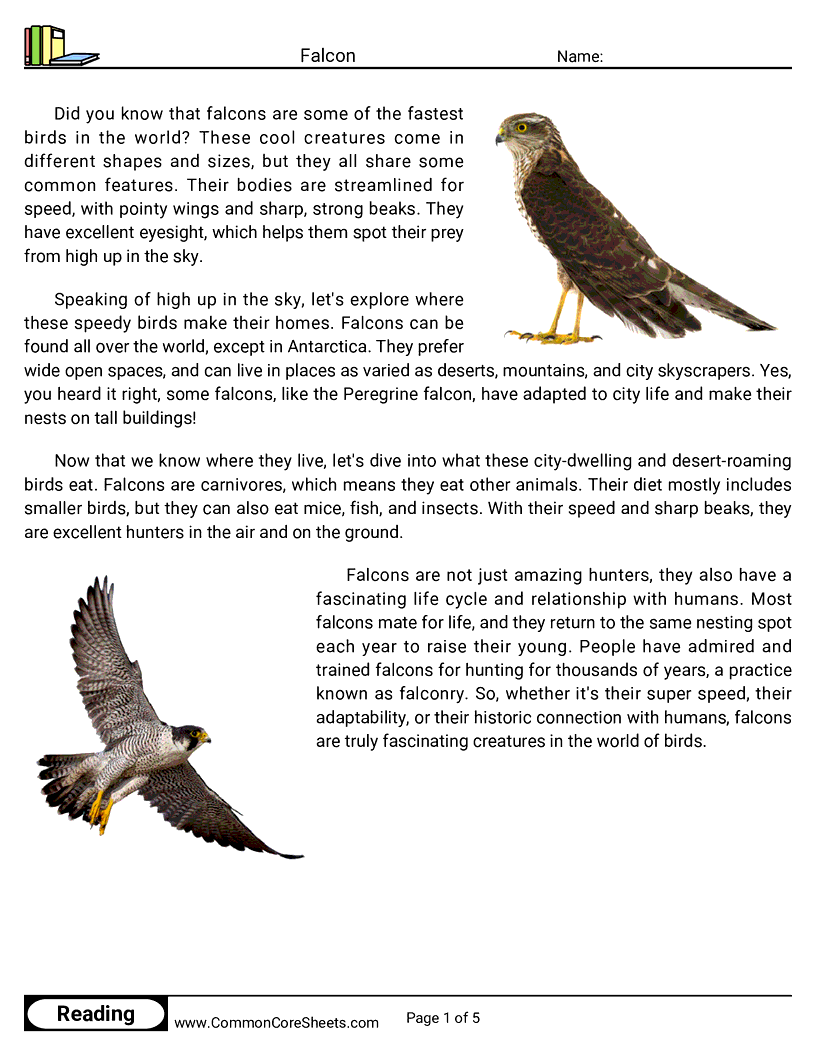
Did you know that falcons are some of the fastest birds in the world? These cool creatures come in different shapes and sizes, but they all share some common features. Their bodies are streamlined for speed, with pointy wings and sharp, strong beaks. They have excellent eyesight, which helps them spot their prey from high up in the sky.
Speaking of high up in the sky, let's explore where these speedy birds make their homes. Falcons can be found all over the world, except in Antarctica. They prefer wide open spaces, and can live in places as varied as deserts, mountains, and city skyscrapers. Yes, you heard it right, some falcons, like the Peregrine falcon, have adapted to city life and make their nests on tall buildings!
Now that we know where they live, let's dive into what these city-dwelling and desert-roaming birds eat. Falcons are carnivores, which means they eat other animals. Their diet mostly includes smaller birds, but they can also eat mice, fish, and insects. With their speed and sharp beaks, they are excellent hunters in the air and on the ground.
Falcons are not just amazing hunters, they also have a fascinating life cycle and relationship with humans. Most falcons mate for life, and they return to the same nesting spot each year to raise their young. People have admired and trained falcons for hunting for thousands of years, a practice known as falconry. So, whether it's their super speed, their adaptability, or their historic connection with humans, falcons are truly fascinating creatures in the world of birds.
Let's dive into the world of falcons, those incredible birds of prey! With their sharp beaks, powerful talons, and keen eyesight, falcons are exciting to learn about. They come in different sizes and colors, but all of them share the characteristics of being top-notch hunters. The peregrine falcon, for example, is known to be the fastest bird in the world, reaching speeds up to 240 miles per hour when diving to catch prey!
Falcons have a pretty varied menu. Their diet mainly consists of other small birds, rodents, and insects. Some species of falcons, like the peregrine, are even known to grab fish out of the water. They use their amazing speed and precise hunting techniques to catch their meals.
Where can you find these magnificent creatures? Falcons live all over the world, from the Arctic to the deserts. They prefer wide open spaces, and some species can be found in cities, nesting on tall buildings. These adaptable birds can make a home just about anywhere!
Ever wondered about the life cycle of a falcon? Well, it starts when they hatch from eggs, then they grow into fledglings, and finally into adult birds. Falcons are known to live a long time, some even up to 20 years! They mate for life and return to the same nesting spot each year.
Falcons have a fascinating relationship with humans and other animals. For hundreds of years, people have trained falcons for hunting, a sport known as falconry. In the wild, they help control the population of rodents and other small animals. So next time you see a falcon, remember how cool and important these birds really are!
Let's dive into the world of falcons, fascinating birds of prey. Falcons are known for their sharp, curved beaks and long, pointed wings, allowing them to fly at high speeds. They come in various sizes, from the small American Kestrel to the large Gyrfalcon. Falcons have a strong vision, almost eight times better than humans, helping them spot their prey from great distances. Their feathers range from a mix of grey, brown, and white to sometimes having streaks of bright colors.
Falcons have a diverse diet, dictated mainly by their habitat and the available food sources. Their diet typically consists of small to medium-sized birds, insects, and small mammals such as rodents. Falcons are known for their unique hunting style, often diving down at high speeds to catch their prey unaware. Some species have even been observed hunting fish! These carnivorous birds have adapted to be effective hunters in their respective environments.
The life cycle of a falcon is quite interesting. They begin as eggs laid in nests, usually high up on cliff edges or tall structures to avoid predators. After about a month, the eggs hatch into chicks, which are cared for by both parents until they learn to fly and hunt. Falcons typically live for about 12-15 years, although some have been known to live for up to 20 years in the wild. Falcons play a crucial role in their ecosystems by controlling the population of their prey.
Falcons have a long history of interaction with humans. In many cultures, they are considered symbols of speed and agility, and have been featured in numerous works of literature and art. They have also been trained for hunting and falconry, a practice that dates back thousands of years. Despite this, falcons have often been threatened by human activity, leading to several species being endangered. Efforts are now being made to protect and conserve these magnificent birds.
Finally, let's explore some fun facts about falcons. Did you know that the Peregrine Falcon is considered the fastest bird, and indeed the fastest animal, reaching speeds of up to 240 mph? Also, unlike most birds, falcons have a tooth-like notch on their beak that they use to break their prey's neck. Falcons are also known to mate for life, showing a level of loyalty not seen in many other species. So, there you have it! Falcons are not just fast and fearless hunters, but they are also majestic, loyal, and play a crucial role in our ecosystem.
About this worksheet
Read a short informational passage about falcons and answer comprehension questions about the key facts and details.
This worksheet is designed to improve children's reading comprehension with a focus on the fascinating world of falcons. It presents 20 problems that explore falcon biology, diet, habitat, and their relationship with humans. Highly versatile, this learning tool can be customized to suit various educational needs, transformed into flashcards for efficient revision, or incorporated into distance learning curricula.
Student objectives
- Read an informational passage about falcons
- Find key facts and details in the text
- Answer questions using information from the reading
- Learn new vocabulary related to birds and hunting
Everyday practice
- Read a fact sheet at the zoo about birds of prey
- Understand a nature documentary about falcons
- Look up facts about an animal for a school report
- Talk about what you learned when spotting a hawk or falcon outside