Elephant Hawk Moth Worksheet Download
Free reading worksheets on Elephant Hawk Moth. Each worksheet has 20 problems with an answer key and are ideal for teachers and homeschooling. You can download the PDF, create a set of flash cards or set it up for online learning.
Select a Different Activity
>
Sheet Information >
Available at 2nd grade, 3rd grade, 4th grade, 5th grade and 6th grade reading levels.
Read the passage
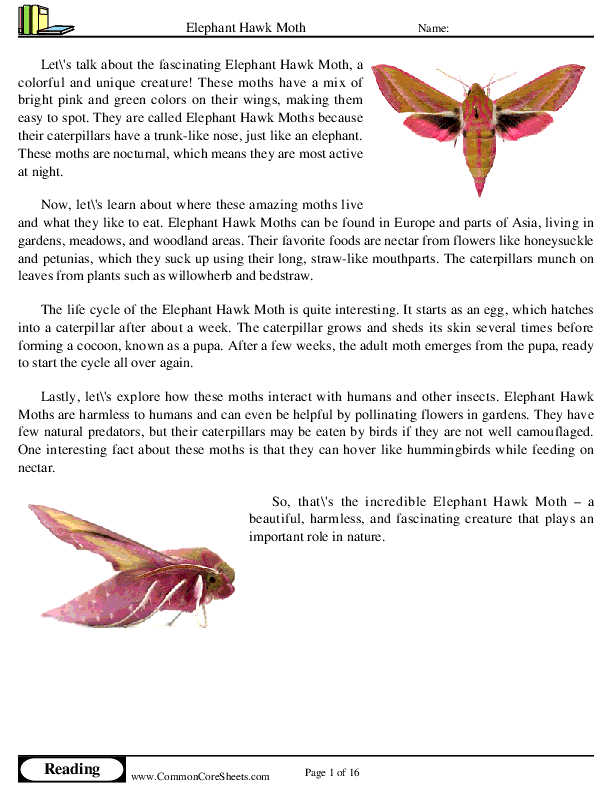
Let\'s learn about the fascinating Elephant Hawk Moth, a beautiful and unique insect. These moths are known for their vibrant colors, with bright pink and olive green wings, and a thick body that looks like an elephant\'s trunk. Elephant Hawk Moths are found in Europe and parts of Asia, living in grasslands, gardens, and forests.
Now, let\'s explore the life cycle and diet of the Elephant Hawk Moth. Their life begins as tiny eggs, which then turn into caterpillars that munch on leaves from plants like fuchsia and willowherb. After growing and shedding their skin several times, the caterpillars form a cocoon and emerge as beautiful adult moths that drink nectar from flowers with their long, straw-like tongues.
Finally, let\'s discover some interesting facts and relationships the Elephant Hawk Moth has with humans and other insects. These moths are harmless to humans, but they do have some amazing defenses against predators, like their ability to camouflage with their surroundings or mimic other insects. One interesting fact is that while many moths are nocturnal, Elephant Hawk Moths are active both during the day and at night, making them quite unique among their kind.
In conclusion, Elephant Hawk Moths are intriguing creatures with their beautiful colors, fascinating life cycle, and interesting relationships with other living beings. Learning about them helps us appreciate the diversity and beauty of the insect world.
Meet the Elephant Hawk Moth, a fascinating and colorful insect that is sure to capture your imagination! These moths are known for their unique look, with large, bright pink wings and a long, elephant trunk-like nose called a proboscis. Elephant Hawk Moths can be found in places like gardens, woodland edges, and grassy areas throughout Europe and Asia. These beautiful creatures are nocturnal, which means they are mostly active during the night.
Now let\'s explore the life cycle of the Elephant Hawk Moth and how they grow and change over time. Their life begins as tiny eggs laid on the leaves of plants, which then hatch into caterpillars. These caterpillars love to munch on plants like willowherb and bedstraw, which helps them grow big and strong. Once they\'re ready, they form a cocoon called a pupa, and after a few weeks, they emerge as the stunning Elephant Hawk Moth we know.
You might be wondering how these moths interact with humans and other insects. Well, Elephant Hawk Moths are mostly harmless to humans and are even considered helpful by some gardeners because they eat pests that could harm plants. Their bright colors and quick movements help scare off predators like birds and other insects, keeping them safe in their environment. One interesting fact is that they are great at hovering, making them resemble hummingbirds as they fly from flower to flower sipping nectar.
Imagine a moth as big as your hand, with wings that look like an elephant's skin! That's the elephant hawk moth, a dazzling insect with large, olive-brown wings that resemble the rough texture of an elephant's hide. This moth also has bright pink stripes that make it one of the most colorful creatures you'll ever see in your garden! And guess what, it's not just big and beautiful; it's also a master of disguise, able to blend in perfectly with leaves and twigs.
Speaking of gardens, these flying wonders are usually found in places with lots of plants. Elephant hawk moths love to live in meadows, gardens, and woodland areas, especially in the United Kingdom. But these aren't the only places you can find them; they also pop up in parts of Asia and all across Europe. Wherever they are, they're busy sipping nectar from flowers with their long tongues, much like a hummingbird!
Remember the nectar that these moths love so much? Well, it's not their only food; their caterpillars are big fans of willowherbs and bedstraws. These munching machines transform into pupae during the winter, and when spring arrives, they emerge as the spectacular elephant hawk moths we know and love. And while they're mostly harmless to humans, they can give a nasty surprise to any unsuspecting predator with a sudden flash of their bright colors.
You might be wondering how these moths are different from others, right? Well, apart from their unique looks and large size, elephant hawk moths are also unusual because they're nocturnal, which means they are most active at night. They also have an exceptional ability to see colors even in the dark, something most other moths can't do. So, from their elephant-like textures to their hummingbird-like dining habits, it's clear that the elephant hawk moth is one truly remarkable creature!
Elephant hawk moths are fascinating creatures that are sure to capture your attention. These moths are named after the elephant due to their large size and long, trunk-like noses. They are also known for their beautiful pink and green colors, which make them stand out among other insects. In this article, we\'ll explore their habitats, diets, life cycle, and relationships with other living beings.
First, let\'s talk about where you might find an elephant hawk moth in the wild. These moths can be found throughout Europe and parts of Asia, living in gardens, woodlands, and grassy meadows. During the daytime, they like to rest on tree trunks or other surfaces that match their colors, which helps them blend in and stay hidden from predators. At night, they become active and fly around in search of food and mates.
Speaking of food, elephant hawk moths have a very specific diet. As caterpillars, they love to munch on the leaves of plants like fuchsia and willowherb. Once they transform into adult moths, they use their long noses to drink nectar from flowers like honeysuckle. This makes them important pollinators, as they help plants reproduce by carrying pollen from one flower to another.
The life cycle of an elephant hawk moth is quite interesting. It begins when a female moth lays her eggs on the leaves of a suitable plant. After about a week, the eggs hatch into caterpillars, which grow and shed their skin several times before spinning a cocoon to become a pupa. After two to three weeks, the adult moth emerges, ready to start the cycle all over again.
Elephant hawk moths have unique relationships with humans and other insects. While they do not pose any danger to humans, their caterpillars are sometimes considered pests in gardens due to their appetite for certain plants. As for their relationship with other insects, they have few natural predators, thanks to their effective camouflage and ability to emit a loud, high-pitched squeak when threatened. This makes them quite different from other moth species, which may not have such effective defenses.
We hope you enjoyed learning about these amazing creatures and will continue to explore the fascinating world of insects.
Get ready to learn about the amazing Elephant Hawk Moth! This fascinating creature is known for its striking appearance, with its bright pink and olive-green wings. Despite its name, the Elephant Hawk Moth isn\'t related to elephants at all, but rather gets its name from its caterpillar stage, during which it resembles an elephant\'s trunk. In this article, you\'ll discover what this unique insect eats, where it lives, and other interesting facts. So let\'s dive into the colorful world of the Elephant Hawk Moth.
First, let\'s talk about what the Elephant Hawk Moth feeds on. As a caterpillar, it loves to munch on the leaves of plants like willowherbs and bedstraws. Once it transforms into a moth, its diet changes to nectar from flowers like honeysuckle, which it sips using its long proboscis. The Elephant Hawk Moth is actually a nocturnal creature, meaning it\'s active at night, when it\'s easier to find food. This moth\'s excellent sense of smell helps it locate flowers in the dark, even when they\'re hiding among other plants.
Now let\'s explore where the Elephant Hawk Moth calls home. These moths can be found all across Europe and Asia, particularly in the United Kingdom. They thrive in various habitats, including woodlands, grasslands, and gardens. During the day, they can often be spotted resting in flowers or shrubs. Their unique coloring also helps them blend in with their surroundings, making it difficult for predators to spot them.
The life cycle of the Elephant Hawk Moth is truly fascinating. They start as tiny eggs, which the female moth lays on the leaves of its favorite plants. After about a week, the eggs hatch into caterpillars, which grow rapidly by eating plant leaves for several weeks. Eventually, the caterpillar forms a cocoon, called a pupa, where it undergoes a remarkable transformation into a moth. Once it emerges, the adult moth begins its search for a mate, and the life cycle starts all over again.
Lastly, let\'s discuss the Elephant Hawk Moth\'s relationship with humans and other insects. Generally, these moths are considered harmless to humans and can even be helpful in controlling the population of certain plants. As for their relationship with other insects, they may occasionally compete for food resources, but they\'re not known to be aggressive. Their main defense against predators, such as birds or bats, is their incredible camouflage and ability to fly swiftly. Overall, the Elephant Hawk Moth is a fascinating and unique species that plays an important role in its ecosystem.
About this worksheet
Read a nonfiction passage about the elephant hawk moth and answer comprehension questions about its life cycle, appearance, and habits.
This worksheet is designed to enhance children's reading comprehension through a fascinating exploration of the Elephant Hawk Moth. Consisting of 20 engaging questions, it covers concepts such as the moth's unique characteristics, habitat, eating habits, and self-defense mechanisms. This customizable worksheet can be easily converted into flashcards and is well-suited for distance learning, making science education fun and flexible.
Student objectives
- Read a nonfiction passage about the elephant hawk moth
- Find and recall facts stated in the text
- Understand new vocabulary about insects and moths
- Answer questions using details from what you read
- Summarize the main ideas of the passage
Everyday practice
- Read a fact card about an animal at a zoo or nature center
- Look up information about a bug you found in the garden
- Talk about what you learned after reading a nature article
- Answer questions a friend asks about something you just read