Crane Worksheet Download
Free reading worksheets on Crane. Each worksheet has 20 problems with an answer key and are ideal for teachers and homeschooling. You can download the PDF, create a set of flash cards or set it up for online learning.
Select a Different Activity
>


Sheet Information >
Available at 2nd grade, 3rd grade, 4th grade, 5th grade and 6th grade reading levels.
Read the passage
Hello, little explorers! Today, we're going to learn about a fascinating bird called the crane. Cranes are tall, elegant birds with long necks, long legs, and big wings that can be as wide as 7 feet when they're fully spread out. Cranes are different from other birds because they have a special dance they perform with their partners, which is very fun to watch!
Now, let's talk about where cranes live and what they eat. Cranes are found all over the world, except in South America and Antarctica, and they like to live in wetlands, grasslands, and agricultural fields where they can find their favorite food - plants, grains, insects, and small animals. Did you know? Cranes are also known to eat small pebbles to help them digest their food!
Finally, let's look at cranes' life cycle and their relationship with humans and other animals. Cranes usually live for about 20 to 30 years, and they mate for life, which means they stick with the same partner throughout their life, just like penguins! Humans and cranes have a special relationship; we admire their beauty and grace, and in some cultures, they are even seen as symbols of luck and longevity.
Hello there, have you ever wondered about the amazing world of cranes? These tall, elegant birds are found all around the world in places such as Asia, Africa, North and South America, and Australia! They can live in a variety of habitats including marshes, grasslands, and even in deserts, depending on the species. Cool fact about cranes, did you know that they're the tallest flying birds in the world? Quite impressive, right?
Now let's explore what cranes eat and their life cycle. Cranes are omnivores, which means they eat both plants and animals like insects, fish, mice, and grains. A crane's life begins in an egg, and once they hatch, they stay with their parents for about a year until they are ready to fend for themselves. Unlike most birds, cranes are known to mate for life, which means they stick with the same partner until one of them passes away.
Finally, let's talk about how cranes interact with humans and other animals. Cranes are generally peaceful creatures but they can use their sharp beaks and strong wings to defend themselves if needed. Humans have admired cranes for centuries and they often appear in our folklore and art, but sadly, some species are threatened by habitat loss due to human activities. Despite these challenges, cranes continue to fascinate us with their elegance and beauty, reminding us of the wonders of the natural world.
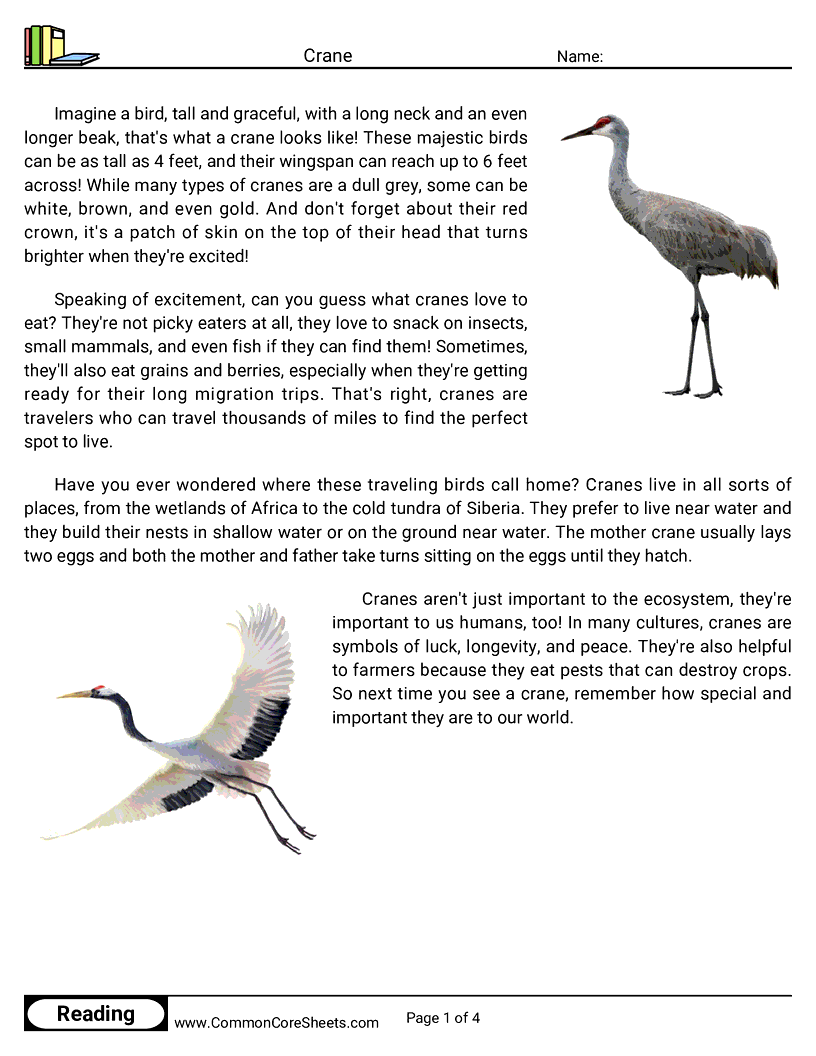
Imagine a bird, tall and graceful, with a long neck and an even longer beak, that's what a crane looks like! These majestic birds can be as tall as 4 feet, and their wingspan can reach up to 6 feet across! While many types of cranes are a dull grey, some can be white, brown, and even gold. And don't forget about their red crown, it's a patch of skin on the top of their head that turns brighter when they're excited!
Speaking of excitement, can you guess what cranes love to eat? They're not picky eaters at all, they love to snack on insects, small mammals, and even fish if they can find them! Sometimes, they'll also eat grains and berries, especially when they're getting ready for their long migration trips. That's right, cranes are travelers who can travel thousands of miles to find the perfect spot to live.
Have you ever wondered where these traveling birds call home? Cranes live in all sorts of places, from the wetlands of Africa to the cold tundra of Siberia. They prefer to live near water and they build their nests in shallow water or on the ground near water. The mother crane usually lays two eggs and both the mother and father take turns sitting on the eggs until they hatch.
Cranes aren't just important to the ecosystem, they're important to us humans, too! In many cultures, cranes are symbols of luck, longevity, and peace. They're also helpful to farmers because they eat pests that can destroy crops. So next time you see a crane, remember how special and important they are to our world.
Hello there, today we're going to learn about the fascinating life of cranes! Cranes are large, elegant birds that belong to the Gruidae family. There are about 15 species of cranes, and they are found all around the world except South America and Antarctica. They have long necks, long legs, and are known for their beautiful and complex dances.
Now, let's talk about what cranes like to munch on. Cranes are omnivores, which means they eat both plants and animals. Their diet includes grains, berries, insects, fish, and small mammals. They use their long bills to dig into the ground or water for food.
You might be wondering where cranes live and about their lifecycle. Cranes are found in a variety of habitats including marshes, grasslands, and forests. They mate for life and usually lay two eggs at a time, which both parents help to incubate. The chicks, known as colts, stay with their parents for about a year.
Cranes have a unique relationship with humans and other animals. In many cultures, they are considered symbols of luck, longevity, and fidelity. As for other animals, cranes usually live in peaceful co-existence, unless their chicks or territory are threatened. In terms of defense, cranes have been known to use their strong beaks and wings to protect themselves.
Now, let's learn about some differences between cranes and other bird species and some fun facts. Unlike most birds, cranes fly with their necks outstretched and legs trailing behind, which makes their flight pattern easily recognizable. One amazing fact is that cranes are among the oldest living birds on the planet, with fossil records dating back several million years. Now, you know quite a bit about cranes, these amazing creatures that share our world. Keep exploring and learning!
Hello there, let's fly into the world of cranes, fascinating birds that have a lot to offer! These are tall, graceful birds that can be found all around the world, from Asia and Africa to Europe and North America. Don't get them confused with other birds, they have long necks and legs, and unlike herons, cranes fly with their necks outstretched, not pulled back. They range in size but the tallest can stand up to 5 feet tall - that's about the height of an adult human! Interesting, isn't it? Now, let's dive a bit deeper and explore more about these elegant birds.
So, what's on the menu for cranes? Well, it's quite diverse! Their diet includes seeds, grains, berries, insects, small mammals, and sometimes fish. They use their long beaks to peck and forage for food, and you might often see them in fields, hunting for a snack. But did you know that some crane species are omnivorous, eating both plants and animals? Yes, they're not picky eaters at all! From tiny insects to juicy berries, cranes have quite a balanced diet, don't they?
Now, let's have a look at the life cycle of a crane. After choosing a mate, cranes build a nest where the female lays one or two eggs. Both parents take turns incubating the eggs, and after about a month, the fluffy chicks hatch. The young cranes stick with their parents for about a year before they go off on their own. Life for a crane is quite an adventure, from the day they hatch until they spread their wings to embark on their own journey!
Cranes have a very unique relationship with humans and other animals. In many cultures, cranes are seen as symbols of luck, longevity, and fidelity. But beyond symbolism, cranes can also be helpful to farmers by eating pests that damage crops. As for other animals, cranes tend to keep to themselves and avoid conflict, but they can defend themselves if necessary by using their powerful beaks and wings. Whether it's with humans or other animals, cranes always seem to find a way to co-exist peacefully.
Lastly, here are some really cool facts about cranes that you might not know. Did you know that cranes are among the oldest living birds on the planet? Fossils of cranes have been found that are over 10 million years old! Also, these birds are known for their elaborate and elegant dancing rituals, which they use to attract a mate. And listen to this, some species of cranes can migrate over 10,000 miles each year. That's like traveling from New York to Tokyo and back! And with that, our journey into the world of cranes comes to an end. Aren't they just amazing?
About this worksheet
Students read a passage about the crane and answer comprehension questions about its details, facts, and main ideas.
This worksheet is designed to bolster children's reading skills through twenty problem sets based on the subject of cranes. Aimed at enhancing knowledge of crane anatomy, behavior, and symbolism, it can be easily customized to suit individual teaching needs. Additionally, the worksheet may be converted into flash cards or incorporated into a distance learning module for the convenience of diverse learning environments.
Student objectives
- Read a short passage carefully and understand its meaning
- Find specific facts and details in the text
- Answer questions using information from the reading
- Identify the main idea of the passage
Everyday practice
- Read an article about an animal and tell someone what you learned
- Look up facts about a bird you saw outside
- Answer a friend's questions after reading a story together
- Pull out key details when reading a book at the library