Common Raven Worksheet Download
Free reading worksheets on Common Raven. Each worksheet has 20 problems with an answer key and are ideal for teachers and homeschooling. You can download the PDF, create a set of flash cards or set it up for online learning.
Select a Different Activity
>
Sheet Information >
Available at 2nd grade, 3rd grade, 4th grade, 5th grade and 6th grade reading levels.
Read the passage
Hello friends! Let's learn about the common raven, a very smart and interesting bird. These birds are all black, from their beaks to their talons, and they are found in many parts of the world, including North America, Europe, Asia, and even the deserts of North Africa! Did you know that common ravens are known for their deep, resonant "caw caw" sound?
Now, let's explore what these ravens eat and how they live. Ravens are omnivores, which means they eat both plants and meat. They often find their food by scavenging, but they can also eat insects, grains, fruits, small animals, and even the leftovers from human trash cans. They build their nests on cliff edges or high up in trees, and a mommy raven usually lays 3 to 7 eggs at a time.
Lastly, let's talk about how ravens interact with humans and other animals. Ravens are often seen in myths and folklore, where they're known for their intelligence and craftiness. They can even mimic human speech and other sounds! With other animals, ravens often work together with wolves to find food. And did you know that, unlike many other birds, ravens can defend themselves against predators by using their sharp beaks and claws? But don't worry, they usually prefer to fly away from danger.
So, how are ravens different from other birds? Well, one thing that sets them apart is their size. Common ravens are much larger than crows and most other birds. They also have a thicker beak and a wedge-shaped tail. Common ravens are truly fascinating creatures, don't you think? They are a perfect example of the amazing diversity in our natural world.
Hey kids, have you ever seen a Common Raven? These birds are completely black, including their feathers, beak, and even their feet! They can live in many places, from deserts to forests, and even in mountains and plains! Common Ravens are quite adaptable and can even be found in cities if they can find enough food.
Speaking of food, do you know what Common Ravens like to eat? They eat almost anything they can find, including insects, fruits, nuts, and small animals. Sometimes, they also eat food that people have thrown away, which is why you might see them around trash cans. But did you know that Common Ravens are also very smart and can use tools to get their food?
Now, let's talk about how Common Ravens live and interact with other creatures. Common Ravens usually live for about 10 to 15 years, and they start having babies when they are about 3 years old. They aren't always friendly to other animals, but they often live peacefully with humans and have been seen playing games with dogs and wolves! So, as we've learned, Common Ravens are fascinating birds that have a lot to offer our world.
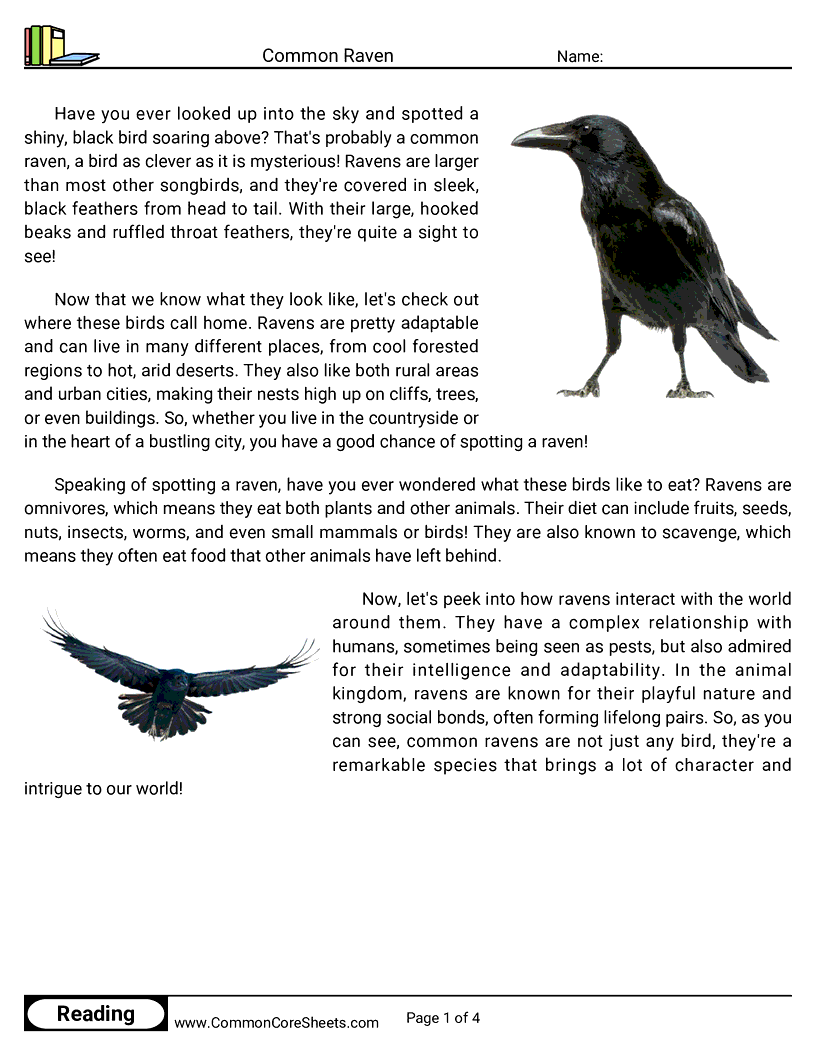
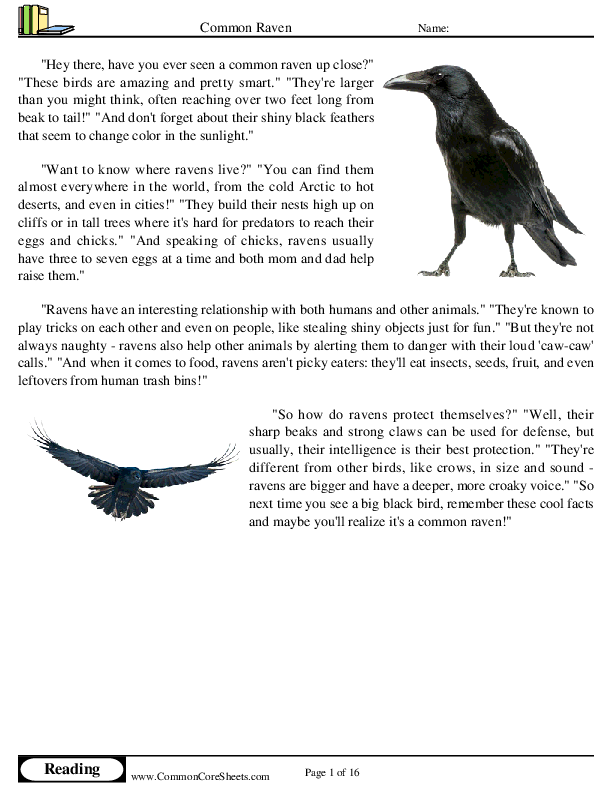
Have you ever looked up into the sky and spotted a shiny, black bird soaring above? That's probably a common raven, a bird as clever as it is mysterious! Ravens are larger than most other songbirds, and they're covered in sleek, black feathers from head to tail. With their large, hooked beaks and ruffled throat feathers, they're quite a sight to see!
Now that we know what they look like, let's check out where these birds call home. Ravens are pretty adaptable and can live in many different places, from cool forested regions to hot, arid deserts. They also like both rural areas and urban cities, making their nests high up on cliffs, trees, or even buildings. So, whether you live in the countryside or in the heart of a bustling city, you have a good chance of spotting a raven!
Speaking of spotting a raven, have you ever wondered what these birds like to eat? Ravens are omnivores, which means they eat both plants and other animals. Their diet can include fruits, seeds, nuts, insects, worms, and even small mammals or birds! They are also known to scavenge, which means they often eat food that other animals have left behind.
Now, let's peek into how ravens interact with the world around them. They have a complex relationship with humans, sometimes being seen as pests, but also admired for their intelligence and adaptability. In the animal kingdom, ravens are known for their playful nature and strong social bonds, often forming lifelong pairs. So, as you can see, common ravens are not just any bird, they're a remarkable species that brings a lot of character and intrigue to our world!
Let's introduce you to the fascinating world of Common Ravens! Known for their all-black color, these birds are large and have shiny feathers with a purplish or bluish sheen in sunlight. Their eyes are bright, and their beaks are big and curved. With a wingspan of about 3.5 feet, they are often mistaken for crows, but they are actually bigger and sound different.
Now, let's talk about where these amazing creatures live. Ravens are versatile and can be found in diverse habitats like forests, mountains, deserts, and even Arctic tundra. They build their nests in tall trees, cliffs, or sometimes even on buildings. Regardless of the place, their homes are always high up and hard to reach.
Curious about what they eat? Ravens are known as 'omnivores', which means they eat both meat and plants. Their diet includes insects, grains, fruits, small animals, and they're even known to eat carrion. They are quite opportunistic and often cheekily steal food from other animals too!
Let's learn about their life cycle and relationship with other animals. Ravens pair for life and each year the female lays 3 to 7 eggs. They often live around 10 to 15 years in the wild, but some have been known to live up to 40 years! Ravens are also known to form alliances with wolves, leading them to food in return for a share.
Ravens have a unique relationship with us humans too. In many cultures, they are seen as symbols of wisdom and magic, but sometimes also as bad omens. Despite this, they are smart birds and can even mimic human speech and other sounds. So, the next time you see a raven, remember, it's not just a bird, it's a creature full of surprises and interesting qualities.
Let's dive into the world of Common Ravens, fascinating birds with lots of cool features. Ravens are large, black birds that are found across the Northern Hemisphere. They are known for their thick, shaggy throat feathers and their shiny, black beaks. Believe it or not, ravens are some of the smartest birds on the planet! In fact, they are known to solve complex problems and even make tools to get food.
Now, let's explore where these interesting birds live and what they eat. Ravens can adapt to a wide range of habitats, from forests to mountains, and even deserts. They are omnivores, meaning they eat both plants and animals. Their diet consists of fruits, seeds, nuts, fish, small mammals, and carrion (that's a fancy word for dead animals). In some areas, they are even known to eat garbage!
Let's take a look at the life cycle of a common raven. Ravens start their life as eggs, laid in a nest built high up in a tree or on a cliff. After about a month of incubation, the chicks hatch and are cared for by both parents. In about four months, the young ravens are ready to leave the nest and live on their own. Ravens can live up to 21 years in the wild, which is pretty impressive!
Ravens have a very interesting relationship with both humans and other animals. In many cultures, ravens have been regarded as symbols of mystery and magic. With other animals, ravens often play the role of scavengers, cleaning up the leftovers from a predator's meal. However, they can also be quite defensive when protecting their nests and young from potential threats. Ravens are known to cooperate with each other, and they even engage in play, just like we do!
Finally, let's discuss how ravens are different from other species. While they may look a lot like crows, ravens are actually much larger and have a deeper, more croaking voice. Another interesting fact is that ravens often travel in pairs, while crows are seen in larger groups. And did you know that a group of ravens is sometimes called a 'conspiracy' or an 'unkindness'? That's a wrap on our journey into the world of ravens - pretty cool birds, aren't they?
About this worksheet
Students read an informational passage about the common raven and answer comprehension questions about its habits, appearance, and behavior.
This worksheet is designed to enhance children's reading skills via an intriguing dive into the life of the Common Raven. Including customization options and potential conversion into flashcards for varied learning styles, it features 20 engaging questions covering raven characteristics, diet, behavioral traits, and more. Equally suitable for distance learning, this tool makes mastering reading through biological sciences approachable and fun.
Student objectives
- Read an informational passage about the common raven
- Find key facts and details in the text
- Answer questions using evidence from the reading
- Learn new vocabulary related to birds and their behavior
- Summarize what the raven passage is about
Everyday practice
- Read a fact sheet at a zoo or park about a bird you spot
- Recognize a raven or crow and know facts about it outdoors
- Look up information about an animal you saw and answer your own questions
- Explain to a friend or parent what you learned about ravens