Common Gray Fox Worksheet Download
Free reading worksheets on Common Gray Fox. Each worksheet has 20 problems with an answer key and are ideal for teachers and homeschooling. You can download the PDF, create a set of flash cards or set it up for online learning.
Select a Different Activity
>


Sheet Information >
Available at 2nd grade, 3rd grade, 4th grade, 5th grade and 6th grade reading levels.
Read the passage
Have you ever heard of the common gray fox, a fascinating little creature? These adorable animals have a mix of gray, white, and red fur, and they are about the size of a small dog. You can find them living in forests, deserts, and even grasslands across North and Central America.
You might be curious about what these fuzzy friends eat and how they live. Gray foxes are omnivores, which means they eat both plants and animals, such as fruits, insects, and small mammals. Their life cycle starts as a tiny pup, and they grow up to be adults who can have their own pups after about a year.
Although gray foxes are shy creatures, they have some interesting relationships with humans and other animals. They usually avoid people, but sometimes they live near our homes, and they can even help control pests like mice and insects. Gray foxes can climb trees to escape from predators, which is a unique ability that sets them apart from other fox species.
So, the next time you think of amazing animals, remember the common gray fox and their incredible tree-climbing skills!
Let\'s learn about the fascinating gray fox, a unique creature that can be found in various parts of North America. These interesting animals have a grayish coat with a white belly and a bushy tail, making them stand out from other species of foxes. Gray foxes are known for their excellent climbing skills, which help them escape from predators and find food in trees. They are mostly active during the night, which is when they search for their prey.
Now, let\'s talk about the gray fox\'s diet and their relationship with other animals. These omnivorous creatures enjoy eating a variety of food, including fruits, insects, small mammals, and birds. Their presence in an ecosystem helps to control the population of rodents and insects, making them beneficial for the environment. However, gray foxes must also be cautious of their own predators, such as coyotes, bobcats, and large birds of prey.
Finally, let\'s explore the gray fox\'s life cycle and their interactions with humans. Gray foxes usually mate in late winter, and after a gestation period of about 53 days, the female gives birth to a litter of 3 to 7 adorable pups. These young foxes will stay with their parents for about 7 months before venturing out on their own. While gray foxes are generally shy and avoid humans, they have been known to adapt to living near human settlements if necessary.
In conclusion, gray foxes are amazing animals that play an important role in their ecosystem. They are truly a fascinating species to learn about, and their unique characteristics make them stand out among other foxes.
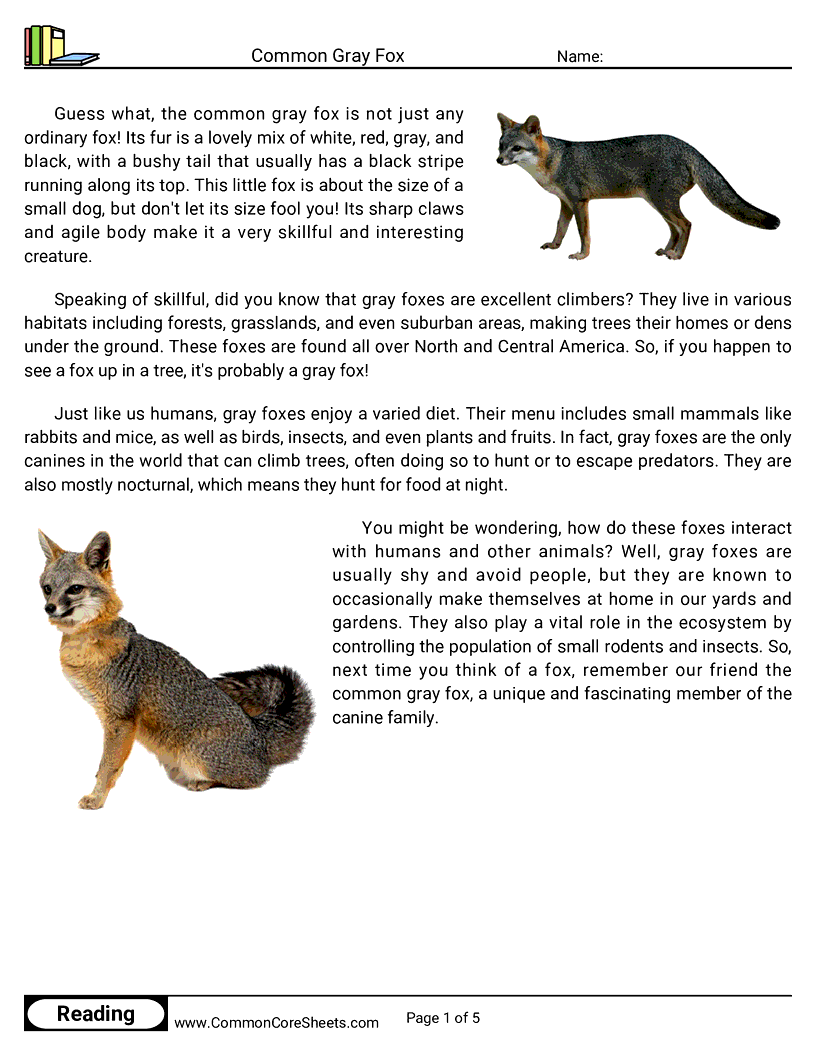
Guess what, the common gray fox is not just any ordinary fox! Its fur is a lovely mix of white, red, gray, and black, with a bushy tail that usually has a black stripe running along its top. This little fox is about the size of a small dog, but don't let its size fool you! Its sharp claws and agile body make it a very skillful and interesting creature.
Speaking of skillful, did you know that gray foxes are excellent climbers? They live in various habitats including forests, grasslands, and even suburban areas, making trees their homes or dens under the ground. These foxes are found all over North and Central America. So, if you happen to see a fox up in a tree, it's probably a gray fox!
Just like us humans, gray foxes enjoy a varied diet. Their menu includes small mammals like rabbits and mice, as well as birds, insects, and even plants and fruits. In fact, gray foxes are the only canines in the world that can climb trees, often doing so to hunt or to escape predators. They are also mostly nocturnal, which means they hunt for food at night.
You might be wondering, how do these foxes interact with humans and other animals? Well, gray foxes are usually shy and avoid people, but they are known to occasionally make themselves at home in our yards and gardens. They also play a vital role in the ecosystem by controlling the population of small rodents and insects. So, next time you think of a fox, remember our friend the common gray fox, a unique and fascinating member of the canine family.
Let\'s learn about the common gray fox, a fascinating creature found in North America. These foxes have a unique appearance with their salt-and-pepper gray fur, reddish-brown legs, and bushy tail with a black stripe. They are medium-sized mammals, measuring about 3 to 4 feet long, including their tail. Gray foxes are known for their incredible agility and ability to climb trees, which sets them apart from other fox species.
The gray fox\'s diet consists of a wide variety of foods, making them omnivorous animals. They primarily eat small mammals like rabbits, rodents, and birds, but also enjoy fruits, insects, and even plants. Their diverse diet helps them adapt to different environments and ensures they have a steady food supply. In fact, they are skilled hunters, using their keen senses of smell, hearing, and sight to locate their prey.
When it comes to where the gray fox lives, they can be found in a range of habitats, from forests to grasslands. They prefer areas with dense vegetation, which provides cover and helps them avoid predators. Gray foxes establish dens in hollow trees, logs, or burrows, where they can raise their young and hide from danger. Their territories can range from 1 to 2 square miles, which they mark with scent to communicate with other foxes.
The life cycle of the gray fox is quite interesting, starting with their breeding season, which occurs in late winter or early spring. The female, or vixen, gives birth to a litter of 3 to 5 kits after a gestation period of around 53 days. The kits are born blind and helpless, relying on their parents for care and protection. After about 9 months, the young foxes become independent and venture off to establish their own territories.
Lastly, let\'s discuss the relationship between gray foxes, humans, and other animals. Although they are generally shy and avoid human contact, gray foxes can sometimes be seen in suburban areas, searching for food. They play an important role in controlling rodent populations, which can be beneficial to humans. Gray foxes also interact with other animals in their ecosystem, such as competing with other predators for food or coexisting with smaller animals that share their habitat.
Now that you\'ve learned all about the common gray fox, you can see just how unique and interesting these creatures are. From their appearance and diet to their life cycle and relationship with humans and other animals, the gray fox is truly a fascinating animal.
Let\'s learn about the common gray fox, a fascinating and unique creature! The gray fox has a beautiful coat of fur, which is a mix of gray, white, and red colors. These little mammals are about the size of a small dog, with a bushy tail and pointed ears. You can find gray foxes in many parts of North America, from southern Canada all the way to Venezuela in South America. Their preferred habitats are forests, swamps, and brushy areas where they can easily hide and find food.
Now, let\'s explore the gray fox\'s diet and eating habits! Gray foxes are omnivores, which means they eat both plant and animal-based foods. Their favorite treats include small mammals like mice and rabbits, birds, insects, and even fruit! These clever foxes are also known to be skilled hunters, using their sharp senses to track down prey. They are nocturnal animals, so they do most of their hunting and eating at night.
Curious about the gray fox\'s life cycle? Let\'s dive in! Gray foxes usually mate between January and April, and their babies, called kits, are born after a gestation period of about two months. The parents work together to raise the kits, which are born blind and helpless. After about a month, the kits begin to explore the world outside their den, learning to hunt and survive in the wild. Gray foxes have a lifespan of around 6 to 8 years in the wild.
What kind of relationships do gray foxes have with humans and other animals? While gray foxes are generally shy and avoid humans, they sometimes live near human settlements and may be spotted in backyards or parks. They play a helpful role in controlling the population of small pests like mice and insects. As for other animals, gray foxes are often preyed upon by larger predators like coyotes, bobcats, and even birds of prey. Their main defense mechanism is their ability to climb trees, which sets them apart from other fox species.
Lastly, let\'s discuss some interesting facts and differences between gray foxes and other fox species! Unlike the more common red fox, gray foxes have a unique ability to climb trees to escape predators or find food. They are not as adaptable as red foxes and are more dependent on their natural habitats. Gray foxes are also known to be monogamous, meaning they mate for life with a single partner. These amazing creatures are an important part of our ecosystem and a fascinating species to learn about.
About this worksheet
Students read an informational passage about the common gray fox and answer comprehension questions about its habitat, diet, and behavior.
This worksheet is designed to enhance children's reading comprehension with engaging content about the Common Gray Fox. Covering diverse topics - its size, habitat, diet, interactions, and ecological role, students explore through 20 problem sets. Flexible and customizable, it can be transformed into flashcards, making it an exciting aid for distance learning. This interactive resource combines education and fun, promoting better understanding about this fascinating creature.
Student objectives
- Read a nonfiction passage about the gray fox and understand the main ideas
- Find specific facts about the fox's habitat, diet, and behavior in the text
- Answer questions using details from what was read
- Build vocabulary by learning words used to describe animals and their environment
Everyday practice
- Read a sign at a zoo or nature center about an animal and understand the facts
- Look up information about a wild animal you spotted outside
- Explain to a friend what a gray fox eats and where it lives
- Read an animal article in a kids' magazine and pull out the key facts