Chameleons Worksheet Download
Free reading worksheets on Chameleons. Each worksheet has 20 problems with an answer key and are ideal for teachers and homeschooling. You can download the PDF, create a set of flash cards or set it up for online learning.
Select a Different Activity
>


Sheet Information >
Available at 2nd grade, 3rd grade, 4th grade, 5th grade and 6th grade reading levels.
Read the passage
Chameleons are fascinating creatures that are well-known for their ability to change color. These amazing animals can be found in a variety of habitats, such as forests, deserts, and grasslands, mostly in Africa and Madagascar. Chameleons come in many shapes and sizes, but they all have a few things in common, like their bulging eyes that can move independently and their long, sticky tongues to catch their prey.
Like most reptiles, chameleons lay eggs, and their life cycle begins when a baby chameleon hatches from its egg. As they grow up, they shed their skin and can live anywhere from 2 to 10 years, depending on the species. Chameleons mostly eat insects, but some larger species also eat small birds and lizards.
Chameleons have some interesting ways of interacting with the world around them. Their color-changing ability helps them communicate with other chameleons and also acts as a defense mechanism against predators. While chameleons are not typically kept as pets, humans can appreciate their unique beauty and abilities from a distance, and it\'s important for us to protect their natural habitats.
Chameleons are fascinating creatures with some amazing features. These colorful reptiles can change their skin color to blend into their surroundings, making them great at hide-and-seek! Chameleons mostly live in warm places like Madagascar, Africa, and southern Europe. They have a unique way of moving; their swaying motion helps them blend in with leaves and branches.
Chameleons have a very diverse diet, which mainly consists of insects. They catch their prey using their long, sticky tongue that can shoot out in a split second. Sometimes, they might also eat plants and small birds. Chameleons lay eggs, and after a few months, tiny chameleons hatch from these eggs and start their own life cycle.
Chameleons have a unique relationship with humans and other animals. In the wild, they might be eaten by birds or snakes, but they use their color-changing ability as a defense mechanism to stay safe. As pets, chameleons can be a bit shy and are better for observing rather than handling. One interesting fact is that chameleons have eyes that can move independently, allowing them to look in two different directions at once!
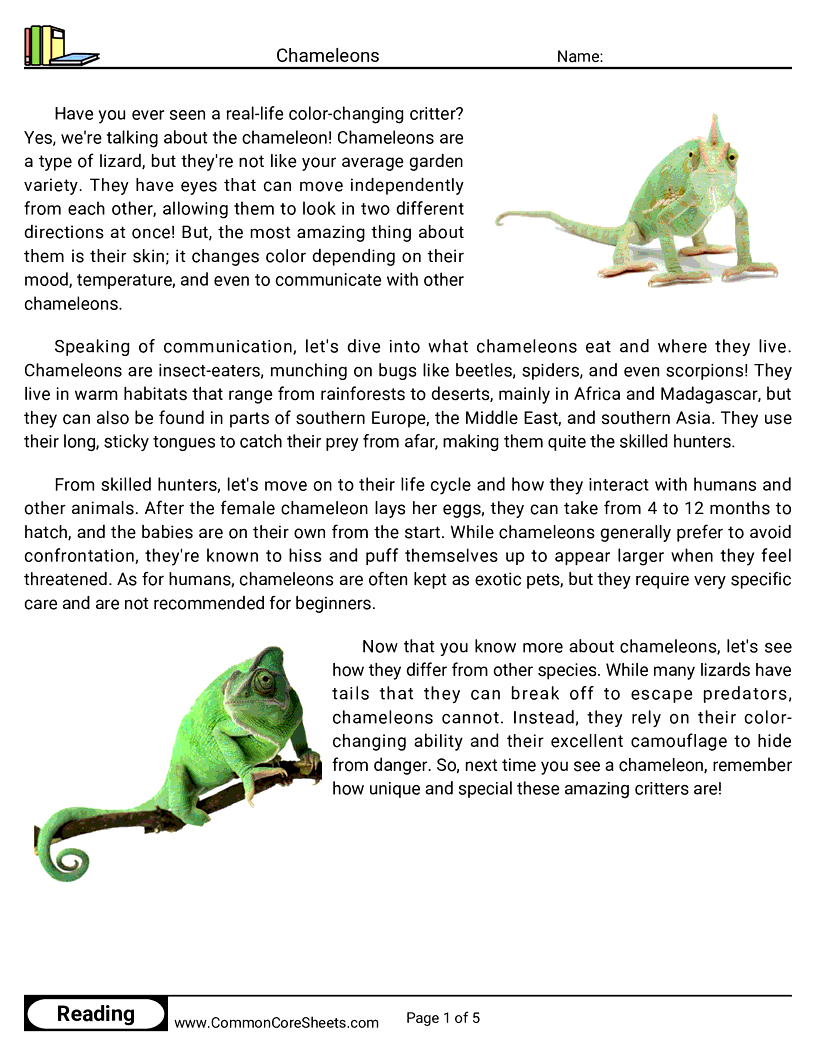
Have you ever seen a real-life color-changing critter? Yes, we're talking about the chameleon! Chameleons are a type of lizard, but they're not like your average garden variety. They have eyes that can move independently from each other, allowing them to look in two different directions at once! But, the most amazing thing about them is their skin; it changes color depending on their mood, temperature, and even to communicate with other chameleons.
Speaking of communication, let's dive into what chameleons eat and where they live. Chameleons are insect-eaters, munching on bugs like beetles, spiders, and even scorpions! They live in warm habitats that range from rainforests to deserts, mainly in Africa and Madagascar, but they can also be found in parts of southern Europe, the Middle East, and southern Asia. They use their long, sticky tongues to catch their prey from afar, making them quite the skilled hunters.
From skilled hunters, let's move on to their life cycle and how they interact with humans and other animals. After the female chameleon lays her eggs, they can take from 4 to 12 months to hatch, and the babies are on their own from the start. While chameleons generally prefer to avoid confrontation, they're known to hiss and puff themselves up to appear larger when they feel threatened. As for humans, chameleons are often kept as exotic pets, but they require very specific care and are not recommended for beginners.
Now that you know more about chameleons, let's see how they differ from other species. While many lizards have tails that they can break off to escape predators, chameleons cannot. Instead, they rely on their color-changing ability and their excellent camouflage to hide from danger. So, next time you see a chameleon, remember how unique and special these amazing critters are!
Chameleons are fascinating creatures that you\'re about to learn all about! They come in various colors and sizes, with some being as small as your finger and others as large as your arm. These incredible reptiles are known for their ability to change colors and their long, sticky tongues. Let\'s dive into the world of chameleons and discover what makes them so unique.
First, let\'s talk about where chameleons live and what they eat. Chameleons are mostly found in Africa, Madagascar, and parts of southern Europe and Asia. They usually live in forests, savannas, and sometimes even deserts. When it comes to food, chameleons love to eat insects like crickets, grasshoppers, and flies, and they use their long, sticky tongues to catch them.
Chameleons have a unique life cycle, just like other animals. They start as eggs, which the female chameleon usually lays in a hole she digs in the ground. After a few months, the eggs hatch and tiny baby chameleons emerge, ready to start their lives. Chameleons grow fast and can become adults in just one year, living for around five to eight years.
Now, let\'s explore how chameleons interact with humans and other animals. Chameleons are generally shy and prefer to avoid humans as much as possible. They can be kept as pets, but they require a lot of care and attention to keep them healthy and happy. When it comes to other animals, chameleons are often preyed upon by birds and snakes, so they have developed some amazing defenses to protect themselves.
Finally, here are some interesting facts and differences between chameleons and other species. Did you know that chameleons don\'t change color just for camouflage? They also change color to communicate with other chameleons and to regulate their body temperature. Unlike most reptiles, chameleons have zygodactyl feet, which means they have two toes facing forward and two facing backward, allowing them to grip branches better. Chameleons also have amazing eyes that can move independently, allowing them to look in different directions at the same time!
As you can see, chameleons are truly fascinating creatures with unique features that set them apart from other animals. Keep exploring and learning about the amazing world of chameleons and other incredible species on our planet!
Chameleons are truly fascinating creatures that have amazing abilities. These colorful reptiles are famous for their incredible ability to change their skin color to blend in with their surroundings. They have unique features, like their swiveling eyes, which allow them to look in different directions at the same time. Chameleons come in various sizes and colors, with the smallest species being just an inch long, while the largest can grow up to 27 inches. There are over 180 different species of chameleons, with most of them living in Madagascar and Africa.
These fascinating creatures live in a variety of environments, such as rainforests, grasslands, and deserts. Chameleons mainly stay up in trees and bushes, using their long, sticky tongue to catch insects and other small creatures for food. Their diet consists mainly of insects like crickets, grasshoppers, and flies, but some larger species also eat small birds and lizards. It is important for chameleons to stay hydrated, so they drink water from the dew and raindrops that collect on leaves. They are well adapted to their environments, using their zygodactyl feet to easily grasp branches and their prehensile tails for extra support.
The life cycle of a chameleon is quite interesting, as they go through various stages of development. Most chameleons lay eggs, which are then buried in the soil or hidden in leaf litter. After a few months, the eggs will hatch and baby chameleons will emerge, already able to change color and catch insects. Chameleons grow rapidly and reach adulthood within one to two years, depending on the species. Their lifespan varies, with some species living only a couple of years, while others can live up to a decade in the wild.
Chameleons have interesting relationships with both humans and other animals. They are often admired for their unique appearance and abilities, making them popular pets in some countries. However, the chameleon trade can be harmful to wild populations, as many are taken from their natural habitats. In their native environments, chameleons serve an important role as both predators and prey. They help control insect populations by eating them, while also being a source of food for larger animals like birds and snakes.
These incredible reptiles have many defenses and adaptations that make them stand out from other species. Their ability to change color is not only used for camouflage but also for communication with other chameleons. Males will display bright colors to show dominance or attract a mate, while females may turn darker colors when they are not interested in mating. Chameleons have a unique method of escape called the 'leaf walk,' where they sway back and forth like a leaf in the wind to avoid detection. All of these amazing features make chameleons truly remarkable creatures that are perfectly adapted to their environments.
About this worksheet
Students read a short passage about chameleons and answer questions to show their understanding of the text.
This worksheet is designed to enhance kids' reading skills with engaging content about chameleons. Covering 20 questions, topics range from the animal's unique hunting methods to their habitat and dietary preferences. The structure facilitates customization, easy transformation into flashcards, and application in distance learning experiences. Overall, it provides flexible, educational fun aimed at improving reading comprehension and instilling an understanding of this fascinating creature.
Student objectives
- Read an informational passage about chameleons
- Find and recall key facts stated in the text
- Answer questions using details from the reading
- Understand new vocabulary about chameleons and their traits
Everyday practice
- Read a fact card at the zoo about chameleons and understand it
- Look up how a pet lizard changes color and explain it to a friend
- Read a nature article and pull out the main facts
- Answer questions after reading a page in an animal book