Camel Spiders Worksheet Download
Free reading worksheets on Camel Spiders. Each worksheet has 20 problems with an answer key and are ideal for teachers and homeschooling. You can download the PDF, create a set of flash cards or set it up for online learning.
Select a Different Activity
>
Sheet Information >
Available at 2nd grade, 3rd grade, 4th grade, 5th grade and 6th grade reading levels.
Read the passage
Meet the camel spider, a fascinating creature that\'s not actually a spider at all! These creatures are part of a group called Solifugae, which means they\'re related to spiders, but they\'re a bit different. Camel spiders can be found in warm deserts around the world, like the deserts in the Middle East, Africa, and the southwestern United States.
Now let\'s talk about what camel spiders eat and how they live. These little critters mostly eat insects and other small animals, and they\'re even known to eat other camel spiders! Camel spiders have a unique way of hunting, using their strong jaws and fast speed to catch their prey, making them very good hunters.
Now that we know about their diet, let\'s learn about their life cycle and relationship with humans and other insects. Camel spiders don\'t have a long life cycle, living only for about a year, during which they grow, mate, and lay eggs. While they might look a bit scary, camel spiders aren\'t dangerous to humans and can even help control the population of other pests.
Hey there, have you ever heard about camel spiders? Well, they are fascinating creatures that live in deserts and other dry places, like in the Middle East, Africa, and Southwest Asia. Camel spiders are not actually spiders, but they are related to them and scorpions. These cool critters have long legs, a pair of big jaws, and can grow up to 6 inches in length.
You might be wondering what camel spiders like to eat. They are carnivorous, which means they love to munch on other insects, small rodents, and even small birds if they can catch them. Camel spiders are great hunters, using their speed and stealth to sneak up on their prey. One interesting fact is that they don\'t have venom, but their powerful jaws help them to catch and eat their food.
Now, let\'s talk about their relationship with humans and other insects. Camel spiders are not dangerous to humans, but they might give you a little scare if you come across one in the desert! Their main defense is their incredible speed, as they can run up to 10 miles per hour to escape from other predators. Camel spiders are different from other species because they are not true spiders, but they are fascinating creatures with unique features and abilities. So, next time you hear about camel spiders, remember that they are amazing creatures that play an important role in the ecosystem, and they are not something to be afraid of.
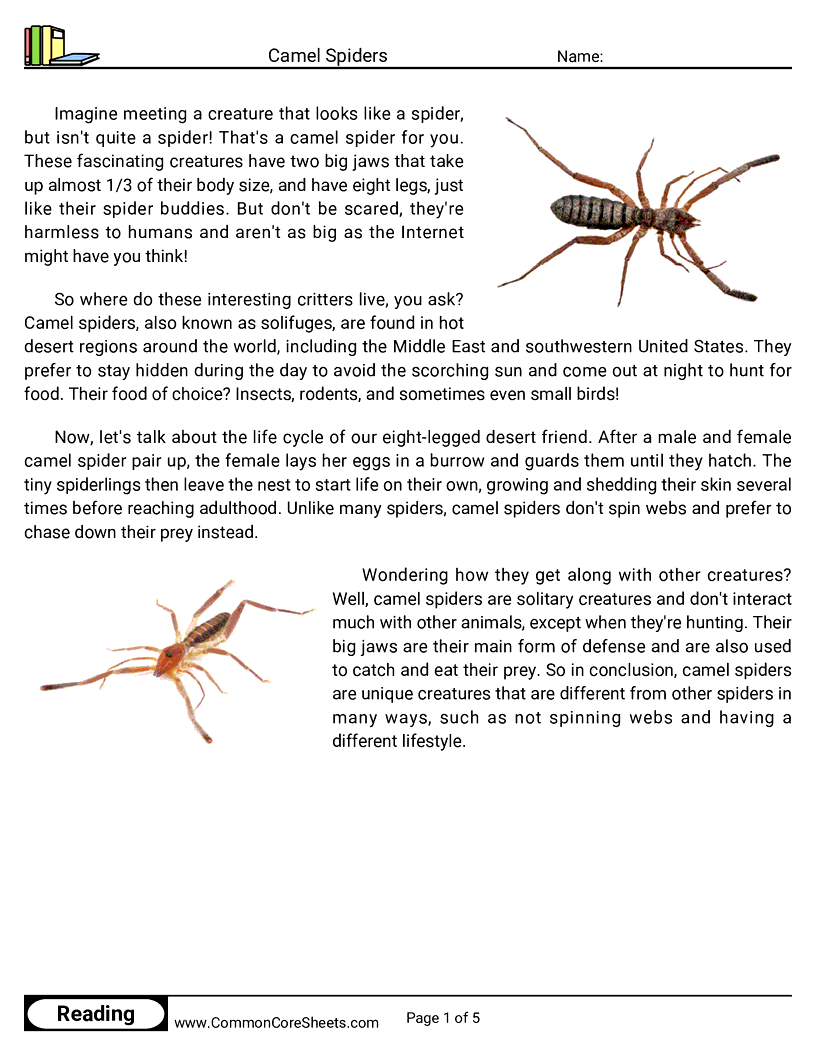
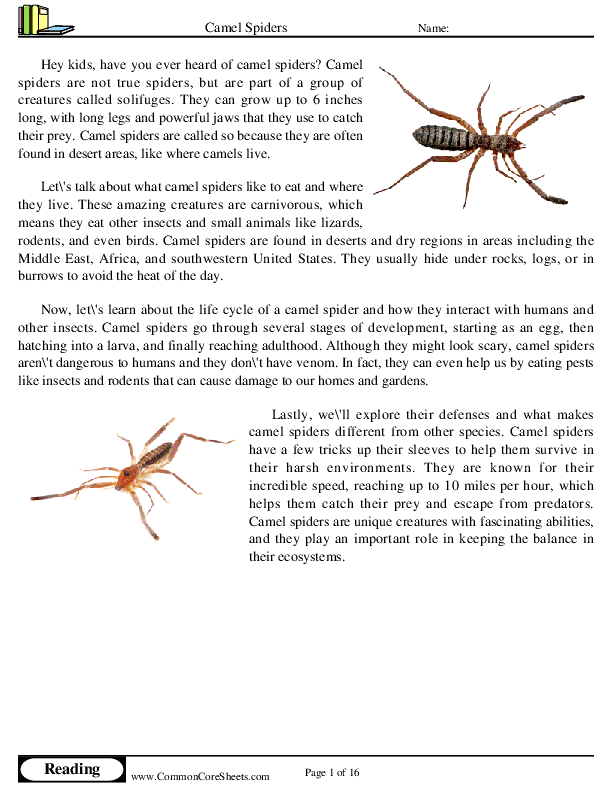
Imagine meeting a creature that looks like a spider, but isn't quite a spider! That's a camel spider for you. These fascinating creatures have two big jaws that take up almost 1/3 of their body size, and have eight legs, just like their spider buddies. But don't be scared, they're harmless to humans and aren't as big as the Internet might have you think!
So where do these interesting critters live, you ask? Camel spiders, also known as solifuges, are found in hot desert regions around the world, including the Middle East and southwestern United States. They prefer to stay hidden during the day to avoid the scorching sun and come out at night to hunt for food. Their food of choice? Insects, rodents, and sometimes even small birds!
Now, let's talk about the life cycle of our eight-legged desert friend. After a male and female camel spider pair up, the female lays her eggs in a burrow and guards them until they hatch. The tiny spiderlings then leave the nest to start life on their own, growing and shedding their skin several times before reaching adulthood. Unlike many spiders, camel spiders don't spin webs and prefer to chase down their prey instead.
Wondering how they get along with other creatures? Well, camel spiders are solitary creatures and don't interact much with other animals, except when they're hunting. Their big jaws are their main form of defense and are also used to catch and eat their prey. So in conclusion, camel spiders are unique creatures that are different from other spiders in many ways, such as not spinning webs and having a different lifestyle.
Camel spiders are fascinating creatures that will amaze you with their unique characteristics. Although they might look a bit scary, these arachnids are not harmful to humans. They have eight legs, two large mouthparts called chelicerae, and can grow up to six inches in length. Keep reading to learn more about these incredible animals and their way of life.
These critters can be found in a variety of habitats, such as deserts, grasslands, and scrublands. Camel spiders are usually found in the Middle East, Africa, and the southwestern United States. They prefer warm, dry climates and are most active during the day when they hunt for food. At night, they hide in burrows or under rocks to stay safe from predators.
Camel spiders are carnivorous, which means they eat other animals. Their diet mainly consists of insects, small rodents, and other arachnids like spiders and scorpions. Using their strong chelicerae, they can crush their prey and even eat it while it\'s still alive. This might sound scary, but it\'s just part of their natural eating habits.
The life cycle of camel spiders is quite interesting. Females lay their eggs in a burrow and guard them until they hatch. Once the baby spiders emerge, they go through several molting stages before becoming adults. The average lifespan of a camel spider is about one year, which might not seem very long, but it\'s enough time for them to grow and reproduce.
Lastly, let\'s explore the relationship between camel spiders, humans, and other insects. As mentioned earlier, camel spiders are not harmful to humans and prefer to keep their distance. They help control the population of insects and other pests, making them beneficial to our environment. Although they might look intimidating, camel spiders are truly captivating creatures that play an important role in nature.
Camel spiders are fascinating creatures that have captured the attention of many curious minds. Despite their name, camel spiders are not actually spiders, but rather, they belong to the Solifugae order in the arachnid class. These intriguing creatures have eight legs, two large, powerful jaws called chelicerae, and a pair of sensory organs called pedipalps. Camel spiders can grow up to 6 inches in length and are usually found in desert regions. Let\'s dive deeper into the lives of these incredible arachnids and learn more about their habitat, diet, and relationship with other creatures.
Camel spiders can be found in various environments, but they particularly love warm, arid places. They inhabit deserts, scrublands, and grasslands in Africa, Asia, and the Middle East. In the United States, camel spiders can be found in the southwestern states, such as Arizona and Texas. These creatures are nocturnal, meaning they are most active during the night when the temperatures are cooler. During the day, camel spiders hide under rocks, logs, or in small burrows to avoid the scorching heat.
Camel spiders are voracious predators and have a diverse diet. They primarily eat insects, spiders, and other small animals like lizards and rodents. Using their strong jaws, they can quickly crush their prey and inject digestive enzymes to liquefy their meal. Camel spiders are also known to scavenge for dead animals, which helps keep their environment clean. These arachnids play a crucial role in controlling insect populations and maintaining a balanced ecosystem.
The life cycle of a camel spider is quite interesting. The female camel spider lays her eggs in a burrow and covers them with a silk-like substance to protect them from predators. After a few weeks, the eggs hatch into tiny, immature camel spiders called nymphs. These nymphs go through several stages of development, shedding their exoskeleton to grow larger. It takes about a year for a camel spider to reach adulthood, and their lifespan typically ranges from one to two years.
Camel spiders have a unique relationship with humans and other insects. While they may appear frightening, they are generally harmless to humans and are not venomous. However, their bite can be painful due to their strong jaws, so it is best to observe them from a safe distance. In their natural habitat, camel spiders help control insect populations, making them beneficial to the environment. These incredible creatures showcase the amazing diversity of the arachnid world and continue to fascinate people all around the globe.
About this worksheet
Students read a passage about camel spiders and answer questions to show understanding of the key facts and details.
This worksheet is designed to educate children about the fascinating world of camel spiders through 20 reading problems. Engaging questions prompt learning about their physical characteristics, habitat, behavior, and relationship to humans. The worksheet is adaptable for distance learning, can be tailored to individual needs, and can easily be converted into flash cards to enhance interactive learning.
Student objectives
- Read an informational passage and understand the main points
- Find specific facts and details in what you read
- Answer questions using evidence from the text
- Learn new facts about camel spiders and how they live
Everyday practice
- Read a fact sheet at a zoo or museum and remember the key details
- Look up information about an animal you're curious about and explain it to someone
- Answer questions about a nature article you read
- Share interesting facts you learned from a book with family or friends