Black Widow Spider Worksheet Download
Free reading worksheets on Black Widow Spider. Each worksheet has 20 problems with an answer key and are ideal for teachers and homeschooling. You can download the PDF, create a set of flash cards or set it up for online learning.
Select a Different Activity
>


Sheet Information >
Available at 2nd grade, 3rd grade, 4th grade, 5th grade and 6th grade reading levels.
Read the passage
Hey kids, let\'s learn about the fascinating black widow spider! These spiders are known for their shiny black bodies with a red hourglass shape on their bellies. Black widow spiders are found in warm regions all around the world, and they like to live in dark, hidden spots such as under rocks, in woodpiles, or even in your backyard.
Now, let\'s talk about what these cool spiders eat and how they live. Black widow spiders love to munch on insects like flies, mosquitoes, and even other spiders. Their life cycle begins as an egg, then they hatch into tiny spiderlings, and eventually grow into the amazing adult spiders we see.
Lastly, let\'s learn about how black widow spiders interact with humans and other insects. While black widow spiders have venom to protect themselves and catch their prey, they usually don\'t bother humans unless they feel threatened. Compared to other species of spiders, black widows are unique because of their appearance and their silky, strong webs.
In conclusion, black widow spiders are fascinating creatures with interesting eating habits, beautiful appearances, and a special place in the world of insects.
Let\'s learn about the amazing black widow spider! These spiders are famous for their shiny black bodies and red hourglass shape on their belly. Black widows are found in warm places, like the United States, Australia, and South Africa. They like to live in dark, hidden spots, like inside woodpiles or under rocks.
Now, let\'s talk about what black widow spiders eat and their life cycle. These spiders are carnivores, which means they eat other animals, usually insects like flies and mosquitoes. Black widows catch their food by spinning strong, sticky webs to trap their prey. Their life cycle starts as an egg, then they grow into spiderlings, and finally into adult spiders.
It\'s important to know about the relationship between black widow spiders, humans, and other insects. These spiders don\'t usually bother humans, but their bite can be harmful, so it\'s best to keep a safe distance. Black widows are helpful to us because they eat insects that can be harmful to humans, like mosquitoes. Their main defense is their venom, which they use to protect themselves and catch their prey.
In conclusion, black widow spiders are fascinating creatures that help keep insect populations in check. Remember to always be careful and respect their space, as they play an important role in our ecosystem.
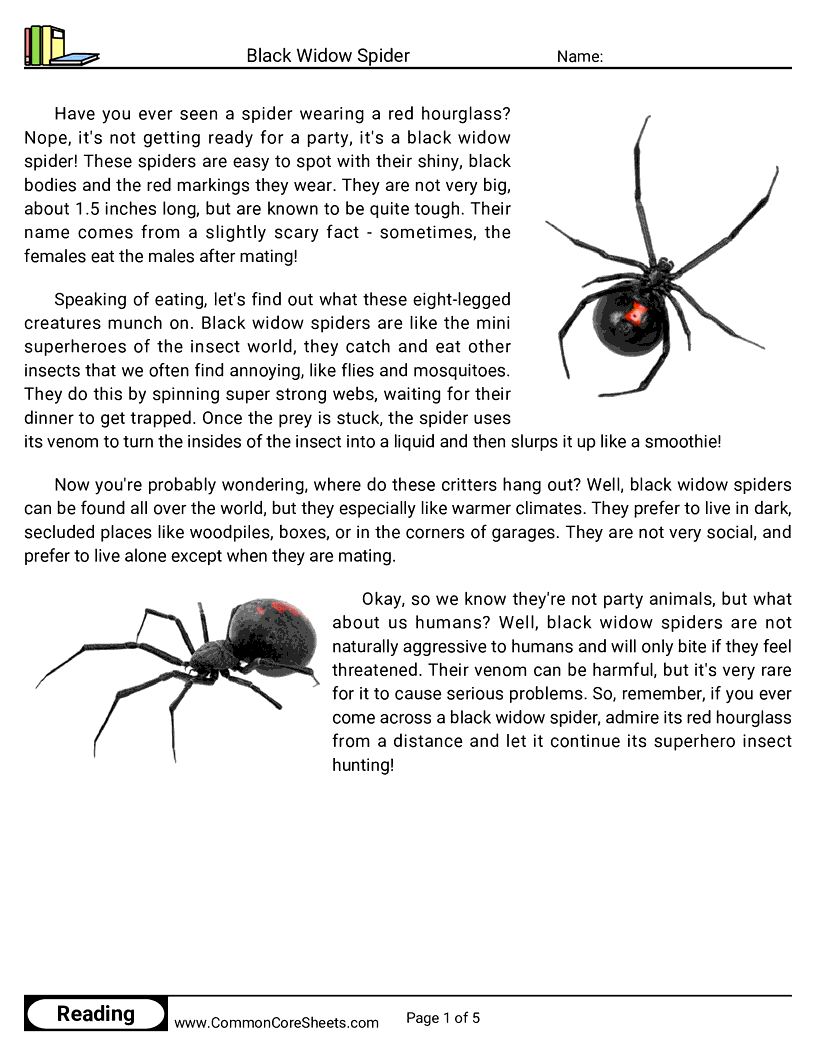
Have you ever seen a spider wearing a red hourglass? Nope, it's not getting ready for a party, it's a black widow spider! These spiders are easy to spot with their shiny, black bodies and the red markings they wear. They are not very big, about 1.5 inches long, but are known to be quite tough. Their name comes from a slightly scary fact - sometimes, the females eat the males after mating!
Speaking of eating, let's find out what these eight-legged creatures munch on. Black widow spiders are like the mini superheroes of the insect world, they catch and eat other insects that we often find annoying, like flies and mosquitoes. They do this by spinning super strong webs, waiting for their dinner to get trapped. Once the prey is stuck, the spider uses its venom to turn the insides of the insect into a liquid and then slurps it up like a smoothie!
Now you're probably wondering, where do these critters hang out? Well, black widow spiders can be found all over the world, but they especially like warmer climates. They prefer to live in dark, secluded places like woodpiles, boxes, or in the corners of garages. They are not very social, and prefer to live alone except when they are mating.
Okay, so we know they're not party animals, but what about us humans? Well, black widow spiders are not naturally aggressive to humans and will only bite if they feel threatened. Their venom can be harmful, but it's very rare for it to cause serious problems. So, remember, if you ever come across a black widow spider, admire its red hourglass from a distance and let it continue its superhero insect hunting!
Black widow spiders are fascinating creatures that many people find both mysterious and intimidating. These spiders are known for their shiny black bodies and red hourglass-shaped markings. One interesting fact about black widows is that they are not always aggressive, and they usually only bite humans if they feel threatened or scared. In this article, we will explore the world of black widow spiders, learning about their habitat, diet, and more.
These spiders can be found across the United States, as well as in parts of Canada and Mexico. They prefer warm environments and can often be found in dark, hidden areas, such as woodpiles, basements, or outdoor sheds. Black widows create irregular, messy webs to catch their prey. It\'s important to be careful and aware of your surroundings when exploring areas where these spiders might live.
Black widow spiders primarily eat insects, such as flies, mosquitoes, and beetles. They use their venom to paralyze their prey, which makes it easier for them to consume. The venom is powerful enough to kill insects, but it is usually not fatal to humans. However, a bite from a black widow can still be painful and cause serious symptoms, so it is essential to seek medical help if bitten.
The life cycle of a black widow spider begins when the female lays her eggs. She creates a small, silk sac to protect her eggs, which can contain up to 400 baby spiders. After about a month, the eggs hatch, and the spiderlings emerge, ready to begin their lives. As they grow, they shed their exoskeletons multiple times before reaching adulthood.
Black widow spiders play an essential role in controlling insect populations. While their venomous bites can be dangerous to humans, they generally prefer to keep their distance. It\'s important to remember that these spiders are a part of our ecosystem and should be treated with respect. So, the next time you hear about a black widow spider, you\'ll know that they are not just scary creatures, but also important members of our world.
Hey there, curious minds! Today, let\'s learn about the fascinating black widow spider. These spiders are known for their shiny black bodies and the red hourglass-shaped mark on their underside. But don\'t worry, they usually aren\'t as scary as they sound! Adult female black widows are the most venomous, while males and juveniles are generally harmless. Did you know there are actually 31 different species of black widow spiders?
So, where do these mysterious creatures live? Black widows can be found across the globe, from the United States to South Africa, and even in parts of Asia. They prefer warm and dry locations, like garages, basements, and outdoor spaces with lots of hiding spots. Their messy and strong webs are usually built close to the ground, making it easier for them to catch their prey. You might even find them hiding under rocks or logs!
Now, let\'s dive into the black widow\'s diet and hunting strategies. These carnivorous critters love to eat insects, like ants, caterpillars, and even other spiders! They catch their prey by wrapping it in their sturdy web, then injecting it with venom to paralyze it. Once their prey is immobilized, the black widow will then start to digest and consume it. Despite their small size, black widows are actually quite the skilled predators.
Black widows have a fascinating life cycle, as well. After mating, the female lays her eggs in a silk egg sac, which can hold up to 900 eggs! The eggs hatch after about a month, and the spiderlings emerge, ready to grow and explore their world. As they grow, these tiny spiders will molt, shedding their exoskeleton to make room for their growing bodies. Black widows usually live for about 1-3 years in the wild.
Finally, let\'s talk about the black widow\'s relationship with humans and other insects. While their venom is potent, black widows are generally shy and will only bite humans in self-defense. Most bites are not life-threatening, but it\'s still important to seek medical attention if bitten. As for other insects, black widows help control insect populations by eating pests that can be harmful to humans and plants. So, in a way, they\'re actually quite helpful!
As you can see, black widow spiders are fascinating creatures with unique characteristics and habits. They play an important role in the ecosystem and, despite their fearsome reputation, are generally shy and non-aggressive. Next time you come across a black widow, remember all the cool facts you learned today and appreciate them from a safe distance!
About this worksheet
Students read a nonfiction passage about the black widow spider and answer comprehension questions about its features, habitat, and behavior.
This worksheet is designed to enhance children's reading and comprehension skills with focused information on the Black Widow Spider. The 20 questions prompt exploration into the spider's characteristics, diet, behavior, and habitat. The topics covered are useful for distance learning and customizable to various educational tools, including flashcards. This makes a flexible yet indepth source material for learning about this remarkable creature.
Student objectives
- Read a nonfiction passage and understand the main ideas
- Find specific facts about black widow spiders in the text
- Answer questions using details from what you read
- Learn new vocabulary related to spiders and insects
- Understand how black widow spiders live and behave
Everyday practice
- Read a nature article and pull out key facts about an animal
- Look up information about a spider you spotted outside
- Answer questions about something you just read for a class report
- Explain to a friend what makes a black widow dangerous
- Compare facts you read with a nature show or documentary