Bailey's Pocket Mouse Worksheet Download
Free reading worksheets on Bailey's Pocket Mouse. Each worksheet has 20 problems with an answer key and are ideal for teachers and homeschooling. You can download the PDF, create a set of flash cards or set it up for online learning.
Select a Different Activity
>


Sheet Information >
Available at 2nd grade, 3rd grade, 4th grade, 5th grade and 6th grade reading levels.
Read the passage
Let\'s learn about Bailey\'s pocket mouse, a small and fascinating creature! These tiny mice have soft, fluffy fur that can be gray or brown in color, and they usually grow to be about 3 to 4 inches long. Bailey\'s pocket mouse is called a 'pocket' mouse because it has special pouches in its cheeks that it uses to store and carry food.
Bailey\'s pocket mice are mostly found in dry, sandy areas like deserts in the southwestern United States and Mexico. They eat seeds, nuts, and insects, and they have a special ability to survive without water by getting all the moisture they need from their food. These mice are nocturnal, which means they are active at night, and during the day, they stay in their burrows to avoid the heat.
Bailey\'s pocket mice have interesting relationships with other animals and humans. Their burrows provide shelter for other small animals, and they can be a source of food for predators like snakes, owls, and foxes. While they don\'t have a direct relationship with humans, they play an important role in the ecosystem by dispersing seeds, which helps plants grow in their environment.
Now that you know about Bailey\'s pocket mouse, you can share these fun facts with your friends and family!
Have you ever heard of Bailey\'s pocket mouse? It is a tiny, furry rodent that lives in the deserts of North America. They have big eyes, soft fur, and special cheek pouches to help them carry food. These little creatures are nocturnal, which means they are active at night and sleep during the day.
Bailey\'s pocket mice are herbivores, eating mostly seeds, plants, and some fruits. They have a unique way of finding their food by using their long whiskers to help them navigate in the dark. Their relationship with humans is a peaceful one, as they do not cause any harm to people or their property. In fact, they are even helpful to humans by eating pesky insects and helping to spread plant seeds.
One interesting fact about Bailey\'s pocket mouse is their life cycle. They usually live for about 2 to 3 years, and during this time, they have several litters of babies called pups. These little mice are very fast runners, which helps them escape from predators like owls and snakes. So, next time you think about desert creatures, remember the fascinating and friendly Bailey\'s pocket mouse.
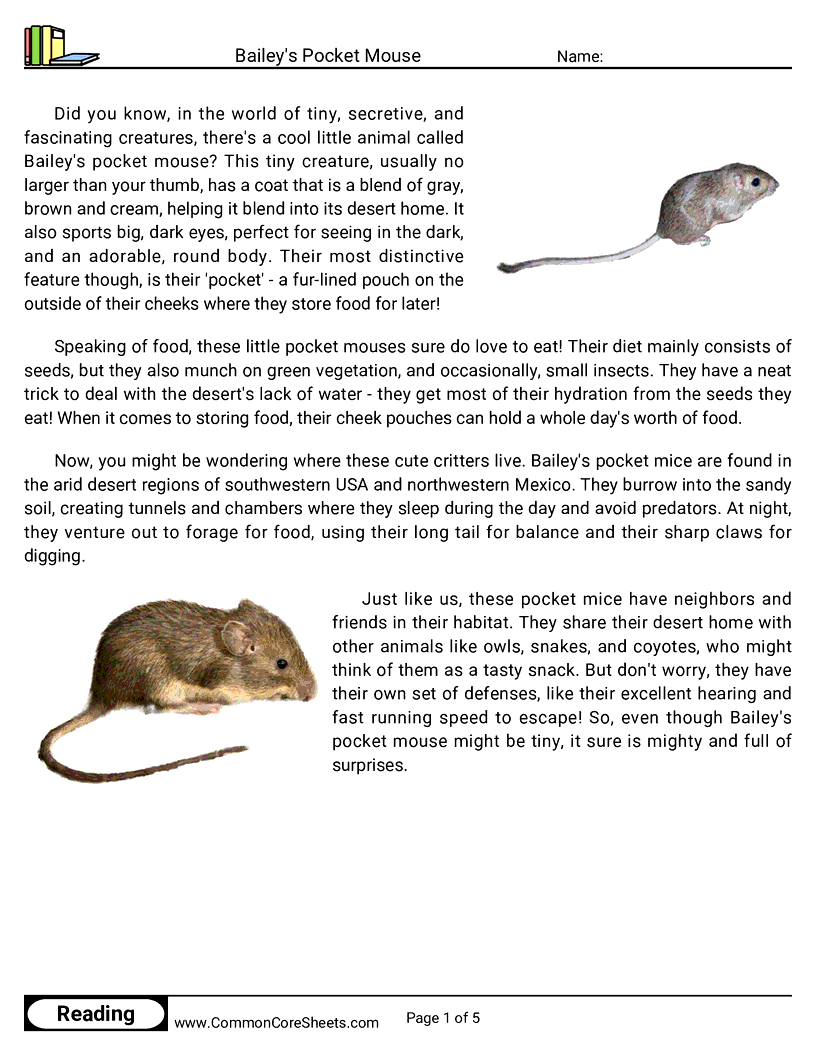
Did you know, in the world of tiny, secretive, and fascinating creatures, there's a cool little animal called Bailey's pocket mouse? This tiny creature, usually no larger than your thumb, has a coat that is a blend of gray, brown and cream, helping it blend into its desert home. It also sports big, dark eyes, perfect for seeing in the dark, and an adorable, round body. Their most distinctive feature though, is their 'pocket' - a fur-lined pouch on the outside of their cheeks where they store food for later!
Speaking of food, these little pocket mouses sure do love to eat! Their diet mainly consists of seeds, but they also munch on green vegetation, and occasionally, small insects. They have a neat trick to deal with the desert's lack of water - they get most of their hydration from the seeds they eat! When it comes to storing food, their cheek pouches can hold a whole day's worth of food.
Now, you might be wondering where these cute critters live. Bailey's pocket mice are found in the arid desert regions of southwestern USA and northwestern Mexico. They burrow into the sandy soil, creating tunnels and chambers where they sleep during the day and avoid predators. At night, they venture out to forage for food, using their long tail for balance and their sharp claws for digging.
Just like us, these pocket mice have neighbors and friends in their habitat. They share their desert home with other animals like owls, snakes, and coyotes, who might think of them as a tasty snack. But don't worry, they have their own set of defenses, like their excellent hearing and fast running speed to escape! So, even though Bailey's pocket mouse might be tiny, it sure is mighty and full of surprises.
Meet the fascinating Bailey\'s Pocket Mouse, a tiny creature with a big personality! This little mouse is unique in many ways, and it\'s sure to capture your imagination. Let\'s explore the wonderful world of this tiny mammal and learn about their interesting life. Are you ready to dive into the remarkable life of Bailey\'s Pocket Mouse?
First, let\'s talk about what Bailey\'s Pocket Mouse looks like and where they live. These tiny creatures are usually between 2.7 and 3.5 inches long, with a tail that\'s even longer than their body! They have soft fur that\'s usually brownish-gray on top and lighter underneath, and they live in the deserts of the southwestern United States and Mexico. Bailey\'s Pocket Mouse makes its home in burrows, which provide shelter from the harsh desert conditions.
Now, let\'s learn about what these little mice eat and their life cycle. Bailey\'s Pocket Mouse is a herbivore, which means it eats plants, primarily seeds. Their life cycle starts when they\'re born as tiny, hairless babies, and they grow up to become adults in just a few months. These mice usually live for about 2 to 3 years in the wild.
Bailey\'s Pocket Mouse has some interesting relationships with humans and other animals. While they don\'t have any direct relationship with humans, they do play a crucial role in the desert ecosystem by helping to spread plant seeds. Their main predators are owls, snakes, and other desert-dwelling creatures. To protect themselves, these mice are nocturnal, which means they are active at night when it\'s harder for predators to spot them.
Lastly, let\'s discuss some differences between Bailey\'s Pocket Mouse and other species, as well as some fun facts. Unlike other mice, they have special pockets in their cheeks to store food and carry it to their burrows. These mice are also known for their amazing ability to survive without drinking water, as they get all the moisture they need from the seeds they eat. Isn\'t it amazing how such a small creature can have so many unique characteristics and adaptations?
Meet the Bailey\'s pocket mouse, a fascinating little critter that might just become your next favorite animal. These tiny mammals are known for their soft fur, large eyes, and long whiskers. Bailey\'s pocket mice are nocturnal, which means they sleep during the day and come out at night to explore and search for food. Their large eyes help them see better in the dark, and their long whiskers help them navigate their surroundings. Now, let\'s dive into some interesting facts about these cute creatures.
First, let\'s talk about the diet of Bailey\'s pocket mouse. They are omnivorous, which means they eat both plants and animals. Their diet mainly consists of seeds, fruits, insects, and sometimes even small reptiles. These mice have special cheek pouches, which they use to store food and carry it back to their burrows. This way, they can enjoy their meal in the safety of their underground homes.
Bailey\'s pocket mice can be found in the southwestern United States and northern Mexico. Their preferred habitats are deserts, grasslands, and rocky areas. These clever mice build complex burrow systems to live in, with separate chambers for sleeping, storing food, and raising their young. They are known to be quite resourceful and can survive in harsh environments with little water. In fact, they get most of their water from the food they eat.
As for their relationship with humans and other animals, Bailey\'s pocket mice are quite shy and tend to avoid contact with people. They are not considered pests and do not cause any significant damage to human property. In the animal kingdom, they have a variety of predators, including snakes, owls, and larger mammals. To escape from these predators, Bailey\'s pocket mice rely on their agility and excellent burrowing skills. They can quickly dig a hole to hide in or dart into their burrows when they sense danger.
Finally, let\'s explore some differences between Bailey\'s pocket mice and other species. One unique feature is their cheek pouches, which not all mice have. These pouches allow them to carry more food than other species and help them survive in their desert habitats. Another difference is their size – Bailey\'s pocket mice are smaller than many other mouse species, usually about 2.5 to 3.5 inches long, excluding the tail. Now you know all about the fascinating world of Bailey\'s pocket mouse and what makes them stand out among their rodent relatives.
About this worksheet
Students read a passage about Bailey's pocket mouse and answer comprehension questions about the details and main ideas.
This worksheet is designed to enhance children's reading skills through engaging content about Bailey's Pocket Mouse. Tackling 20 problems, it probes into the mouse's characteristics, food habits, habitat, and survival techniques. Not only educational, the content can easily be customized, converted into flash cards, or incorporated into distance learning settings.
Student objectives
- Read a nonfiction passage and understand what it says
- Find specific details and facts in the text
- Figure out the main idea of the passage
- Answer questions using evidence from what you read
Everyday practice
- Read a fact sheet at a pet store to learn about an animal
- Look up information about an animal before choosing a pet
- Read a zoo exhibit sign and tell someone what you learned
- Share interesting facts from an animal article with family