Army Ants Worksheet Download
Free reading worksheets on Army Ants. Each worksheet has 20 problems with an answer key and are ideal for teachers and homeschooling. You can download the PDF, create a set of flash cards or set it up for online learning.
Select a Different Activity
>


Sheet Information >
Available at 2nd grade, 3rd grade, 4th grade, 5th grade and 6th grade reading levels.
Read the passage
Army ants are fascinating insects that live in large groups called colonies. These ants can be found in Central and South America, as well as parts of Africa and Asia. Unlike other ants, army ants don\'t have a permanent nest and are always on the move.
These little creatures have a big appetite and eat a variety of foods. Their diet includes insects like spiders, wasps, and other ants, as well as small animals like lizards and frogs. In fact, their powerful jaws and teamwork allow them to take down prey much larger than themselves.
Army ants have a very interesting life cycle and relationship with other insects and humans. Their queen can lay up to 30,000 eggs per day, and once hatched, the young ants work together with adults to protect the colony and find food. While they can be a nuisance to humans when they enter homes in search of food, they are also helpful by eating pests that can harm crops and spread diseases.
Hey there, have you ever heard about army ants? They are fascinating insects that live in tropical rainforests, primarily in Africa, South and Central America. These ants have unique features that make them stand out from other ant species, like their powerful jaws and a great sense of teamwork. Army ants are always on the move, creating temporary nests called bivouacs, which are made up of thousands of ants linking their bodies together.
Now let\'s talk about what these amazing ants eat and their life cycle. Army ants are carnivorous, which means they eat other insects and small animals, even other ants. Their life cycle consists of four stages: egg, larva, pupa, and adult. During the larval stage, the ants are fed by worker ants, and once they become adults, they join the rest of the colony in their never-ending search for food.
Lastly, let\'s explore their relationship with humans and other insects, as well as their defenses. While army ants can be helpful by controlling insect populations, they can also be a nuisance if they enter human homes in search of food. Their main defense against predators is their sheer numbers and aggressive nature when they feel threatened. So, while army ants may look a bit scary, they are truly fascinating creatures that play an important role in their ecosystems.
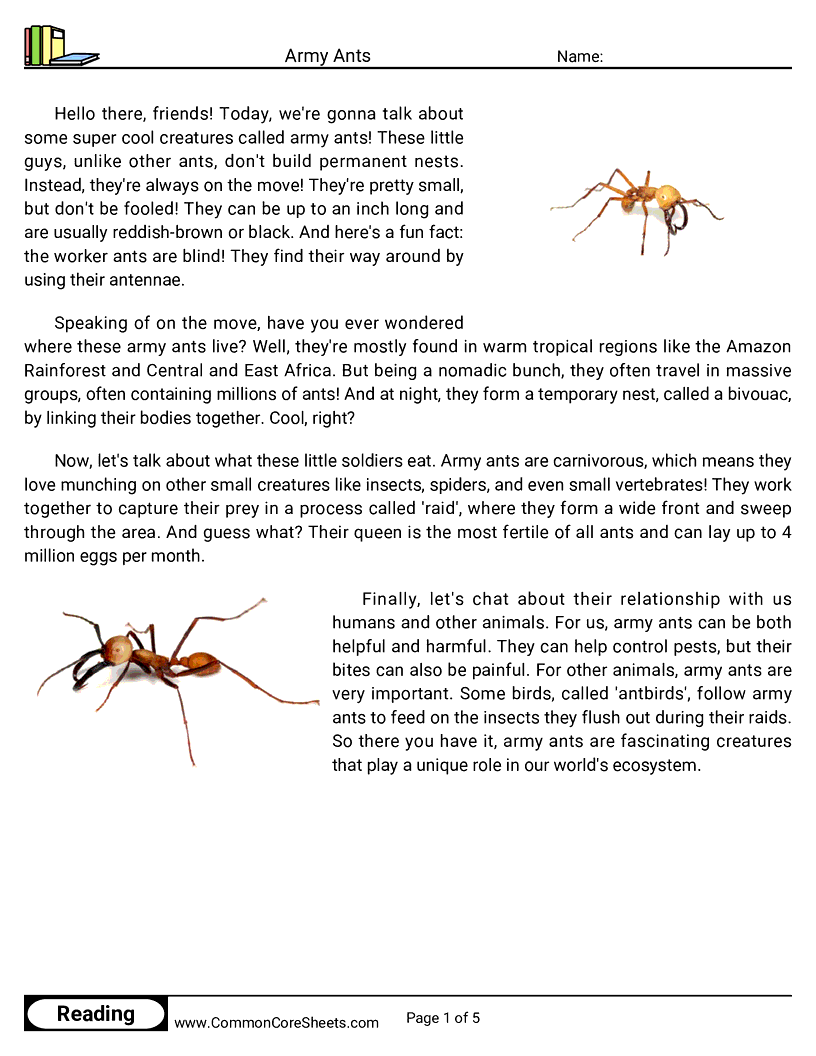
Hello there, friends! Today, we're gonna talk about some super cool creatures called army ants! These little guys, unlike other ants, don't build permanent nests. Instead, they're always on the move! They're pretty small, but don't be fooled! They can be up to an inch long and are usually reddish-brown or black. And here's a fun fact: the worker ants are blind! They find their way around by using their antennae.
Speaking of on the move, have you ever wondered where these army ants live? Well, they're mostly found in warm tropical regions like the Amazon Rainforest and Central and East Africa. But being a nomadic bunch, they often travel in massive groups, often containing millions of ants! And at night, they form a temporary nest, called a bivouac, by linking their bodies together. Cool, right?
Now, let's talk about what these little soldiers eat. Army ants are carnivorous, which means they love munching on other small creatures like insects, spiders, and even small vertebrates! They work together to capture their prey in a process called 'raid', where they form a wide front and sweep through the area. And guess what? Their queen is the most fertile of all ants and can lay up to 4 million eggs per month.
Finally, let's chat about their relationship with us humans and other animals. For us, army ants can be both helpful and harmful. They can help control pests, but their bites can also be painful. For other animals, army ants are very important. Some birds, called 'antbirds', follow army ants to feed on the insects they flush out during their raids. So there you have it, army ants are fascinating creatures that play a unique role in our world's ecosystem.
Army ants are fascinating creatures that live in large colonies. These ants can be found in tropical rainforests and subtropical areas in Africa, South America, and Asia. They are known for their highly organized and aggressive behavior, working together as a team to achieve their goals. Let\'s explore more about these amazing ants and how they live their lives.
One of the most interesting things about army ants is what they eat. These ants are carnivorous, which means they eat other insects and small animals. They hunt their prey by forming a large group called a swarm and overwhelm them with their numbers. This hunting technique is very effective and allows them to capture a wide variety of food sources.
The life cycle of an army ant is unique and intriguing. It begins when the queen lays her eggs, which then hatch into larvae after a few weeks. The larvae grow and eventually pupate, forming cocoons where they will transform into adult ants. Once they emerge, they join the rest of the colony and begin their life as a worker, soldier, or future queen.
When it comes to their relationship with humans and other insects, army ants have both positive and negative aspects. On one hand, they can be helpful by controlling pest populations, such as termites and other harmful insects. However, they can also be seen as a nuisance when they invade homes or farms, causing damage and distress. It\'s important to remember that these ants play an essential role in their ecosystems and should be respected for their contributions.
There are many interesting facts and differences between army ants and other ant species. For example, unlike other ants, army ants do not build permanent nests, but instead create temporary shelters called bivouacs by linking their bodies together. Another unique feature is their defensive strategy, which involves using their strong mandibles and stingers to protect the colony from threats. These amazing insects show us that teamwork and communication are essential for survival in the natural world.
Army ants are fascinating insects that live in large colonies, and they\'re known for their incredible teamwork. These ants can be found in various parts of the world, such as Central and South America, as well as Africa. There are about 200 different species of army ants, and they come in different sizes and colors. Unlike other ants, army ants don\'t build permanent nests, but instead, they create temporary nests called bivouacs by linking their bodies together. This unique lifestyle is called nomadism, and it allows the ants to constantly move and search for food.
Army ants play a critical role in their ecosystems by consuming a wide range of food sources. Their diet mainly consists of other insects like spiders, scorpions, and even small animals like lizards and birds. The ants use their strong mandibles to capture and disassemble their prey, making it easier to carry back to the colony. Also, they are very efficient hunters, using chemical signals called pheromones to communicate and coordinate their attacks. This cooperative hunting strategy is called swarm raiding, and it helps the ants to locate and overpower their prey quickly.
The life cycle of army ants is quite interesting and different from other ant species. The queen ant can lay thousands of eggs per day, which hatch into larvae in about two weeks. After another two weeks, the larvae spin a cocoon and transform into pupae, eventually emerging as adult ants. Army ants have a unique reproductive process called the 'reproductive cycle,' where the queen alternates between laying eggs and moving with the colony. This cycle ensures that the colony always has enough ants to maintain its size and strength, even when some ants die.
While army ants might seem scary or dangerous, they generally don\'t pose a significant threat to humans. However, they can be a nuisance if they invade homes or buildings in search of food. In some parts of the world, people actually appreciate the presence of army ants because they help to control pests like cockroaches or termites. Additionally, these ants have been known to inspire teamwork and cooperation among humans, as their ability to work together is often seen as a lesson in unity and collaboration. Despite their fearsome reputation, army ants are a prime example of how insects can have a positive impact on our lives.
Army ants are truly unique creatures, with several characteristics that set them apart from other insects. Their nomadic lifestyle, cooperative hunting strategies, and impressive teamwork make them stand out among the thousands of other ant species. Moreover, their significant role in the ecosystem highlights the importance of these tiny creatures in maintaining balance and biodiversity. By studying and understanding the behavior of army ants, we can gain valuable insights into the natural world and even learn lessons that can be applied to our own lives. So next time you come across these incredible insects, take a moment to appreciate their fascinating characteristics and the important role they play in our world.
About this worksheet
Students read a short passage about army ants and answer questions to show they understand the details and main ideas.
This worksheet is designed to enhance children's reading skills with intriguing educational content about army ants. It contains 20 questions regarding the biology, behaviors, and ecology of these fascinating insects, encouraging interactive learning. This customizable tool can be converted into flash cards or integrated into distance learning, making it a versatile educational resource that adapts to unique learning styles and preferences.
Student objectives
- Read a nonfiction passage about army ants carefully
- Find specific facts and details in the text to answer questions
- Understand the main idea of what you read
- Use context in the passage to figure out unfamiliar words
- Explain how army ants live and behave based on the reading
Everyday practice
- Read a fact sheet at a zoo or museum and answer questions about the animal
- Look up information about a bug you found outside and share what you learned
- Read a nature article and tell a family member the main points
- Answer questions about a book you just read for fun