American Crocodile Worksheet Download
Free reading worksheets on American Crocodile. Each worksheet has 20 problems with an answer key and are ideal for teachers and homeschooling. You can download the PDF, create a set of flash cards or set it up for online learning.
Select a Different Activity
>
Sheet Information >
Available at 2nd grade, 3rd grade, 4th grade, 5th grade and 6th grade reading levels.
Read the passage
Let\'s learn about the American crocodile! These amazing reptiles can be found in the swamps, rivers, and coastal areas of the southeastern United States, Central America, and the Caribbean islands. They have long, powerful tails, strong jaws, and sharp teeth to catch their favorite meals like fish, birds, and small mammals.
Now, let\'s explore the life cycle of the American crocodile. After laying their eggs in a nest, mom crocodiles will guard them until they hatch in about three months. Once the baby crocodiles are born, they will stay with their mom for a short time before venturing off on their own and growing into big, strong adults.
Finally, let\'s talk about their relationships with humans and other animals. Though American crocodiles might look scary, they usually try to avoid people and are not considered dangerous unless they feel threatened. In the wild, they share their habitat with other animals like birds, fish, and turtles, and they play an important role in keeping the ecosystem balanced.
In conclusion, the American crocodile is a fascinating creature with a unique life cycle and an important role in its environment. Next time you see one, remember to admire it from a safe distance and appreciate the amazing world of reptiles!
Hey kids, let\'s learn about the amazing American crocodile! These cool reptiles have long, narrow snouts and can grow up to 20 feet long. They live in the southernmost parts of Florida, as well as countries like Mexico, Cuba, and Costa Rica. Their habitat usually consists of freshwater areas like swamps and rivers, but they can also be found in saltwater environments.
Now, let\'s dive into the American crocodile\'s fascinating life cycle and relationships with other animals. Crocodiles start their life as eggs, which are laid in nests by their mothers and hatch after around 90 days. They have a balanced diet, feasting on fish, crabs, turtles, and even small mammals. Some animals, like fish and birds, help keep crocodiles clean by removing parasites from their skin, which is a great example of teamwork in nature!
Lastly, let\'s explore how American crocodiles are different from other species and their relationship with humans. Compared to the more aggressive American alligator, American crocodiles tend to be more shy and avoid humans. Their main defense mechanism is their powerful jaw, which can snap shut with incredible force to protect them from threats. It\'s important for us to respect these amazing creatures and their habitats, so we can coexist peacefully.
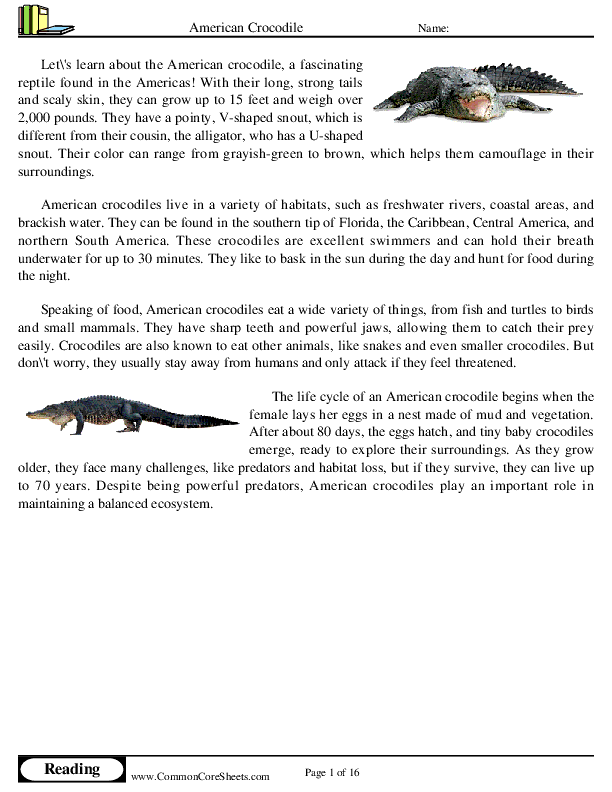
Splashing into the scene is our friend, the American crocodile, one of the many fascinating creatures living in our world! With its long, v-shaped snout and a body covered in a suit of armor-like skin, it's a sight to behold. This cool reptile can grow up to 15 feet long, that's longer than most cars! Their skin is usually a grey-green or olive color, perfect for blending into their swampy homes.
Speaking of homes, American crocodiles have a pretty interesting choice of residence. They can be found in the sunny parts of Florida, the Caribbean, Mexico, and South America, usually near water such as rivers, coastal lagoons, and marshes. Their homes aren't just for lounging though, that's where they find their food! They prefer to dine on fish, birds, and small mammals, but aren't too picky when they're hungry.
Now, let's dive into the life cycle of these amazing reptiles. Mama crocodiles lay between 20-60 eggs in a nest and guard them for about 85 days until they hatch. When the baby crocs are born, they're only about 8 inches long but grow 1 foot per year until they're fully grown. American crocodiles can live up to 70 years, which is a pretty long time in the animal kingdom!
Now, you might be wondering how American crocodiles get along with other animals and humans. Well, they're generally not a danger to humans unless they feel threatened. They do play a big part in the ecosystem, though, by controlling the population of their prey. So, as you can see, American crocodiles are not just interesting, they're important, too. Let's keep learning and protecting these incredible creatures!
Get ready to learn about the amazing American crocodile! These reptiles can be found in North, Central, and South America. They live mostly in freshwater environments like rivers, lakes, and swamps, but can also be found in saltwater habitats such as coastal lagoons and mangroves. American crocodiles are known for their long, narrow snouts and olive green color.
American crocodiles have a pretty interesting diet. They are carnivores, which means they eat other animals such as fish, birds, small mammals, and even other reptiles. These powerful predators use their sharp teeth to catch and hold onto their prey. They even have a special valve in their throats that lets them eat underwater!
The life cycle of an American crocodile starts with an egg. Females lay between 30 and 70 eggs in a nest made of vegetation and sand. After about 80 days, the eggs hatch into tiny crocodiles that are only about 8 inches long. These little crocs grow up to be big adults, reaching lengths of up to 15 feet and living around 70 years.
American crocodiles share their habitats with many other creatures, including humans. While most crocodiles try to avoid people, some may come into contact with humans while searching for food. It\'s important for us to be aware of these animals and give them the space they need to live peacefully. Crocodiles can also help other animals by keeping the populations of some smaller creatures in check.
There are some key differences between American crocodiles and other crocodile species. One major difference is the shape of their snouts, which are more narrow and V-shaped compared to other crocs. The color of the American crocodile is also unique, as it has a lighter, more olive green color than its relatives. These fascinating reptiles are truly one-of-a-kind members of the crocodile family.
Hey kids, let\'s talk about the fascinating American crocodile! These incredible reptiles can grow up to 15 feet long and weigh up to 2,000 pounds. They have a distinctive V-shaped snout and powerful jaws, which make them look pretty cool. You can find them in the southern tip of Florida, Mexico, Central America, and the Caribbean. Did you know that they are one of the few crocodile species found in the United States?
So, what do these big guys eat? American crocodiles are carnivores, which means they eat meat. Their diet mainly consists of fish, birds, and small mammals. At times, they might even eat smaller reptiles like turtles. They are excellent hunters and use their strong jaws to catch their prey.
Now let\'s take a look at their life cycle. Female American crocodiles lay between 30 to 70 eggs in a nest made of sand and vegetation. The eggs take about 3 months to hatch, and the temperature of the nest determines the gender of the baby crocodiles. Once they hatch, the mother carries them to the water in her mouth, and they stay with her for a few months. These crocodiles can live up to 70 years in the wild!
How do American crocodiles interact with humans and other animals? Although they are known to be shy and avoid humans, they can be dangerous if they feel threatened. In their natural habitat, they share space with other animals like alligators and turtles. They play an important role in their ecosystem by keeping the population of their prey in check. Fun fact: American crocodiles and alligators might look similar, but they have different snouts and live in different habitats!
Lastly, let\'s learn about their defenses and what makes them unique compared to other species. American crocodiles have a strong, armored body covered with tough scales that protect them from predators. Their powerful tail helps them swim fast and escape from danger. Unlike other crocodile species, they can tolerate saltwater, which allows them to live in different habitats. We hope you enjoyed learning about these amazing creatures and their role in our world!
About this worksheet
Students read an informational passage about the American crocodile and answer comprehension questions about its habitat, diet, and behavior.
This worksheet is designed to educate children about American Crocodiles in an engaging way. Covering key concepts from their lifespan, diet, habitat, role in the ecosystem to characteristics of baby crocs, it features 20 customizable reading comprehension problems. Suitable for use in distance learning or as flashcards, it effectively combines learning and fun for young learners.
Student objectives
- Read a nonfiction passage and understand the main ideas
- Find facts about the American crocodile in the text
- Learn new vocabulary related to reptiles and their habitats
- Answer questions using details from what you read
- Summarize key information about the animal
Everyday practice
- Read a sign or brochure about animals at a zoo or aquarium
- Look up facts about an animal you saw in a nature documentary
- Explain to a friend what makes crocodiles different from alligators
- Read an article and pick out the important facts for a school report