American Alligator Worksheet Download
Free reading worksheets on American Alligator. Each worksheet has 20 problems with an answer key and are ideal for teachers and homeschooling. You can download the PDF, create a set of flash cards or set it up for online learning.
Select a Different Activity
>
Sheet Information >
Available at 2nd grade, 3rd grade, 4th grade, 5th grade and 6th grade reading levels.
Read the passage
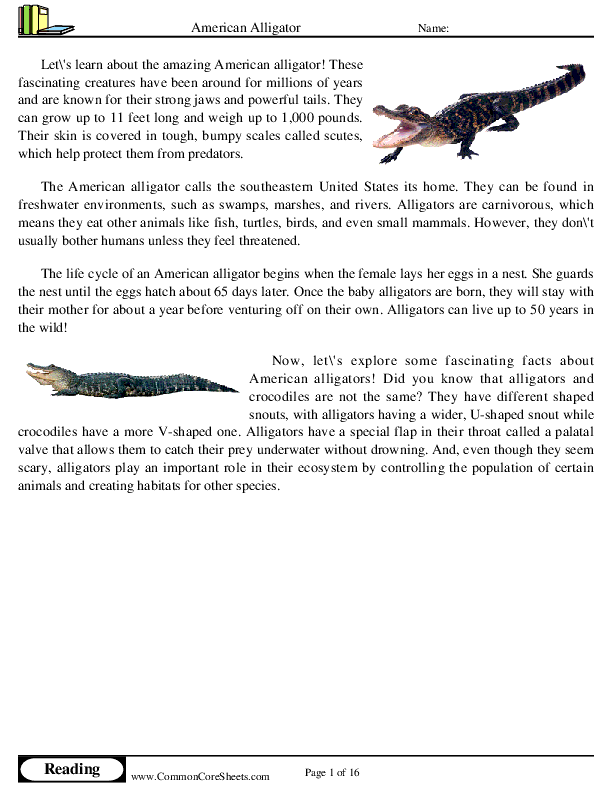
Let\'s learn about the amazing American alligator! American alligators are large reptiles that can grow up to 15 feet long and weigh over 1,000 pounds. They have a powerful tail, strong jaws, and sharp teeth which help them catch their prey like fish, turtles, birds, and even small mammals.
These fascinating creatures can be found in the southeastern United States, mostly in freshwater environments like swamps, marshes, and rivers. Their life cycle begins with the female alligator building a nest made of vegetation and laying her eggs inside it. Once the baby alligators hatch, they stay with their mother for about a year before venturing off on their own.
American alligators have a unique relationship with both humans and other animals. While they usually avoid people, it\'s important for us to respect their space and never feed them. These incredible reptiles also help maintain a balanced ecosystem by controlling the population of certain animals, like raccoons and turtles.
Did you know that American alligators are considered a keystone species? This means they play a crucial role in maintaining a healthy environment for many other animals. So, not only are they fascinating creatures, but they\'re also important members of our world\'s ecosystem!
Hey there, have you ever seen an American alligator? These amazing reptiles can be found throughout the southeastern United States, living in freshwater environments like swamps, marshes, and rivers. With their long, powerful tails and sharp teeth, they are excellent swimmers and hunters. American alligators eat a variety of animals, including fish, turtles, snakes, birds, and even small mammals like raccoons!
Now let\'s explore their life cycle and relationships with other animals. Female alligators build nests and lay around 20-50 eggs, which hatch after about 65 days. Baby alligators, called hatchlings, are born with natural defenses like sharp teeth and a strong instinct to hide from predators. As they grow, alligators learn to live with other animals in their habitat, sometimes even sharing their homes with turtles and birds.
Lastly, let\'s talk about how American alligators are different from other species and some cool facts about them. Compared to crocodiles, American alligators have a wider, rounder snout and are usually darker in color. They can also live for around 30-50 years in the wild! While alligators might seem scary to some people, they usually prefer to avoid humans and only become aggressive when they feel threatened or cornered.
Just like superheroes have unique costumes, the American Alligator has a special suit of its own - a tough, scaly skin which is usually black! This amazing creature can grow up to 15 feet long, that's longer than most cars! These alligators have a broad snout and their upper jaw is wider than the lower one, causing the teeth in the lower jaw to fit into the sockets of the upper jaw. Their eyes are placed high on their heads, so they can see while submerged in water.
Speaking of water, did you know that American Alligators are like the ultimate swimmers? They live in freshwater environments, such as ponds, marshes, wetlands, rivers, and swamps, primarily in the Southeastern United States. These areas provide all the things an alligator needs, like food, fresh water and plenty of sunbathing spots. Also, their nests, which are made of vegetation, sticks, leaves, and mud, can be found in these habitats.
Now, let's talk about the alligator's daily menu. Young alligators love to munch on small fish, insects, snails, crustaceans, and worms. As they grow larger, they expand their diet to larger fish, turtles, various mammals, birds, and other reptiles. They are known as opportunistic feeders because they can eat anything that comes near the water's edge.
While alligators may seem scary, they usually prefer to avoid humans unless their nests are threatened. However, they play an important role in their ecosystem by controlling the population of certain prey species. Alligators and humans have a complex relationship, they are often seen as dangerous, but they also fascinate us and are protected by conservation laws in many areas. So, the next time you think of an alligator, remember they are not just big, scary creatures, but an important part of our natural world.
Let\'s explore the fascinating world of American alligators! These amazing reptiles can be found in the southeastern United States, including Florida and Louisiana. They are often seen near freshwater, such as swamps, marshes, and rivers. American alligators have a distinct appearance with their long, powerful tails, and large, thick bodies covered in dark, scaly skin.
What do American alligators like to eat? They are carnivorous, which means they primarily eat meat. Fish, turtles, birds, and small mammals are some of their favorite meals. However, they have also been known to eat larger animals, such as deer and even other alligators!
The life cycle of an American alligator is quite interesting. Their eggs are laid in nests made by the mother, which are mounds of dirt and plants. The baby alligators, called hatchlings, are born with bright yellow stripes on their bodies. As they grow older, these stripes fade, and they reach full adulthood in about 10-12 years.
American alligators have a unique relationship with humans and other animals. While they can be dangerous to humans if threatened or cornered, they generally prefer to avoid us. In their ecosystem, they play a crucial role by controlling the population of certain prey species. They also create habitats for other animals by digging water-filled depressions called alligator holes.
There are some interesting differences between American alligators and other species. One such difference is their snout shape: American alligators have a wider, U-shaped snout, while other species like crocodiles have a more V-shaped snout. American alligators are also more tolerant of colder temperatures, thanks to special adaptations like the ability to slow down their metabolism. Lastly, unlike some other species, American alligators can change the sex of their offspring depending on the temperature of the nest during incubation.
In conclusion, American alligators are fascinating creatures with unique features, behaviors, and relationships with their environment. Next time you see one, remember how important they are to the ecosystem and how incredible their life cycle is!
Let\'s dive into the world of the American alligator, a fascinating reptile that has been around for millions of years! These alligators can be found in freshwater environments like rivers, swamps, marshes, and lakes across the southeastern United States. Adult alligators have a dark gray or black color on their back, while their belly is lighter, and they have a powerful tail that helps them swim. They are usually around 10 to 15 feet long, but some can grow even bigger! Did you know that the American alligator is also the official state reptile of three states: Florida, Louisiana, and Mississippi?
Now let\'s talk about the diet of these amazing creatures. American alligators are carnivores, which means they eat other animals, such as fish, turtles, birds, and even small mammals. They are known for their strong jaws and sharp teeth, which help them catch and eat their prey. As they grow older, their diet changes, and they start eating larger animals. It\'s interesting to note that they are also known to eat fruit occasionally, making them not entirely meat-eaters!
The life cycle of an American alligator is quite remarkable. Females lay their eggs in a nest made of vegetation, usually in June or July. After about 65 days, the baby alligators hatch and are only about 6-8 inches long. The mother alligator takes care of her babies for a short time, protecting them from predators. These alligators can live up to 50 years in the wild, growing and adapting to their environment.
Alligators have a unique relationship with both humans and other animals. Although they are considered apex predators, they play a crucial role in maintaining the balance of their ecosystem. They help control the population of some animals, like raccoons, which can be harmful to other species if their numbers grow too large. However, it\'s important to remember that they can be dangerous to humans, so it\'s best to observe them from a safe distance. Conservation efforts have helped increase the population of American alligators, which were once endangered due to hunting and habitat loss.
Lastly, let\'s explore the differences between the American alligator and other species. One of the main differences is their snout shape – American alligators have a broad, rounded snout, while other species like the crocodile have a more pointed snout. Another difference is their teeth; when an alligator closes its mouth, you can\'t see its lower teeth, but you can see a crocodile\'s lower teeth. Alligators also prefer freshwater habitats, while crocodiles can be found in both fresh and saltwater environments. These unique features help us identify and appreciate the various species of these amazing reptiles.
So, that\'s a glimpse into the fascinating world of the American alligator. Remember to always respect these incredible creatures and their habitats, and don\'t forget to share your newfound knowledge with others!
About this worksheet
Students read a nonfiction passage about the American alligator and answer questions about its habitat, diet, and behavior.
This worksheet is designed to engage children in learning about the American Alligator. It introduces key aspects like habitat, physical characteristics, diet and interaction with humans using 20 interactive reading problems. Offering versatility for customization and conversion into flash cards, it's perfectly suited to both traditional and distance learning contexts. A great tool for interactive and exploratory education.
Student objectives
- Read a nonfiction passage about the American alligator and understand the main ideas
- Find and recall facts about where alligators live and what they eat
- Learn new vocabulary related to reptiles and their environment
- Answer questions using details from the text
Everyday practice
- Understand facts about alligators when visiting a zoo or wildlife park
- Talk about animals you read about in a book or see in a nature show
- Answer questions about an article you read by finding details in the text
- Share interesting facts about reptiles with family or friends