Home Favorites My Account Menu
login
Playwire Advertisement

Albatross Worksheet Download

Free reading worksheets on Albatross. Each worksheet has 20 problems with an answer key and are ideal for teachers and homeschooling. You can download the PDF, create a set of flash cards or set it up for online learning.

Select a Different Activity >
Sheet Information >
Albatross
Students read a short informational passage about the albatross and answer questions to show what they understood.
Albatross worksheet preview
Albatross worksheet
Open PDF
Customize preview
open in new window
Select Worksheet
pages
Select Problem Type
Customize Problems
×
Problem type
Save
Sheet Layout>
Seed
title
Instructions
Number of Problems
Due Date
Include standard on Sheet
Font
Font Size pt
Minimum Space Below Problems mm
Answer Column
Problem Number
sheet orientation

Available at 2nd grade, 3rd grade, 4th grade, 5th grade and 6th grade reading levels.

Read the passage
Reading level:

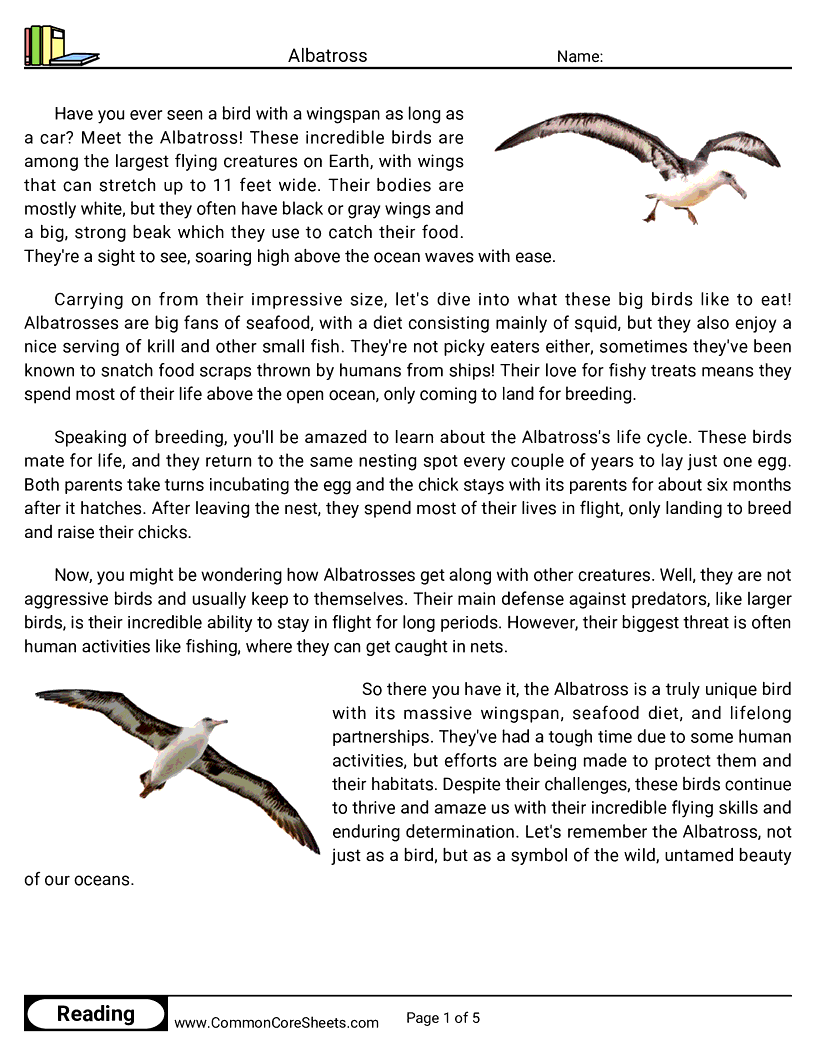
Have you ever seen a bird with a wingspan as long as a car? Meet the Albatross! These incredible birds are among the largest flying creatures on Earth, with wings that can stretch up to 11 feet wide. Their bodies are mostly white, but they often have black or gray wings and a big, strong beak which they use to catch their food. They're a sight to see, soaring high above the ocean waves with ease.

Carrying on from their impressive size, let's dive into what these big birds like to eat! Albatrosses are big fans of seafood, with a diet consisting mainly of squid, but they also enjoy a nice serving of krill and other small fish. They're not picky eaters either, sometimes they've been known to snatch food scraps thrown by humans from ships! Their love for fishy treats means they spend most of their life above the open ocean, only coming to land for breeding.

Speaking of breeding, you'll be amazed to learn about the Albatross's life cycle. These birds mate for life, and they return to the same nesting spot every couple of years to lay just one egg. Both parents take turns incubating the egg and the chick stays with its parents for about six months after it hatches. After leaving the nest, they spend most of their lives in flight, only landing to breed and raise their chicks.

Now, you might be wondering how Albatrosses get along with other creatures. Well, they are not aggressive birds and usually keep to themselves. Their main defense against predators, like larger birds, is their incredible ability to stay in flight for long periods. However, their biggest threat is often human activities like fishing, where they can get caught in nets.

So there you have it, the Albatross is a truly unique bird with its massive wingspan, seafood diet, and lifelong partnerships. They've had a tough time due to some human activities, but efforts are being made to protect them and their habitats. Despite their challenges, these birds continue to thrive and amaze us with their incredible flying skills and enduring determination. Let's remember the Albatross, not just as a bird, but as a symbol of the wild, untamed beauty of our oceans.

About this worksheet

Students read a short informational passage about the albatross and answer questions to show what they understood.

This worksheet is designed to enhance children's reading skills through engaging trivia about Albatrosses. Featuring 20 informative problems, it helps learners grasp facts about these fascinating creatures, including information about their wingspan, defense mechanisms, aggression levels, lifestyle, and diet. Perfect for distance learning, the versatile format allows customization and can be conveniently converted into flash cards for interactive studying.

Student objectives

  • Read a nonfiction passage about the albatross and understand the main points
  • Find specific facts and details stated in the text
  • Answer questions using information from what was read
  • Build vocabulary related to birds and their habits

Everyday practice

  • Read a fact sheet at a zoo or aquarium and tell a friend what you learned
  • Look up information about an animal for a school report
  • Answer questions about a nature article you read online
  • Share interesting facts about seabirds after reading about them
Playwire Advertisement