Finding Angles By Degrees: Determining Angles By Degree Worksheet Download
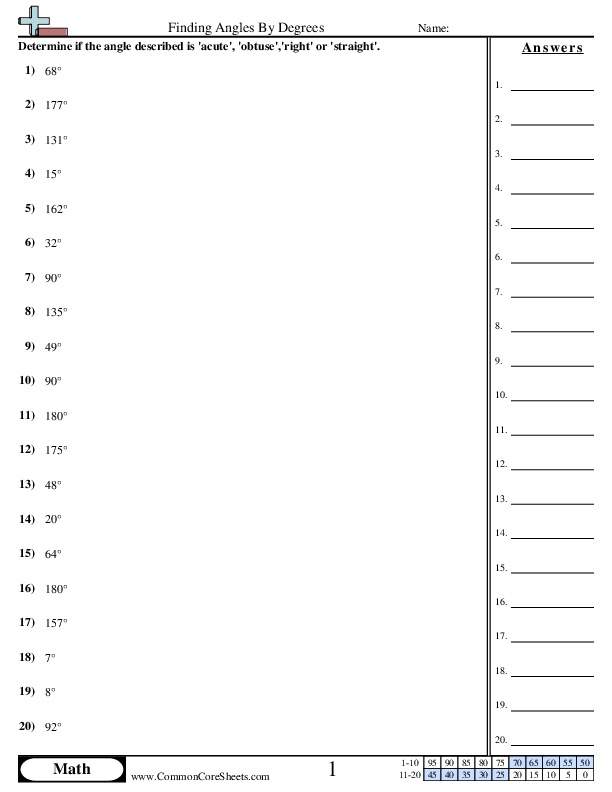
Free 4th Grade (4md5a) math worksheets on Finding Angles By Degrees . Each worksheet has 20 problems with an answer key and are ideal for teachers and homeschooling. You can download the PDF, create a set of flash cards or set it up for online learning.
Select a Different Activity
>


Sheet Information >

About this worksheet
Each Worksheet has 20 problems determining if the angle shown is acute, obtuse, right or straight.
This worksheet is designed to enhance children's knowledge of mathematics, specifically in finding angles by degrees. Comprising 20 problems, it provides practical training in dealing with different degrees of angles, such as 169°, 157°, and 21°. Furthermore, it offers versatility in usage as it can be customized to an individual's needs, converted into interactive flashcards for efficient learning, or utilized in distance learning modules, fostering an adaptable and engaging learning environment.
Student objectives
- Look at an angle and decide if it is acute, right, obtuse, or straight.
- Use the degree measure of an angle to help classify it correctly.
- Recognize benchmark angles like 90° and 180° and compare other angles to them.
Everyday practice
- Deciding if a door is opened a little, halfway, or flat against the wall by thinking about the angle.
- Noticing whether a corner in a room or on a piece of paper makes a right angle.
- Checking if a bike handlebar or scooter handle is turned slightly or turned a lot by comparing the angle.
- Seeing whether the hands on an analog clock make an acute or obtuse angle at different times.