×Description:
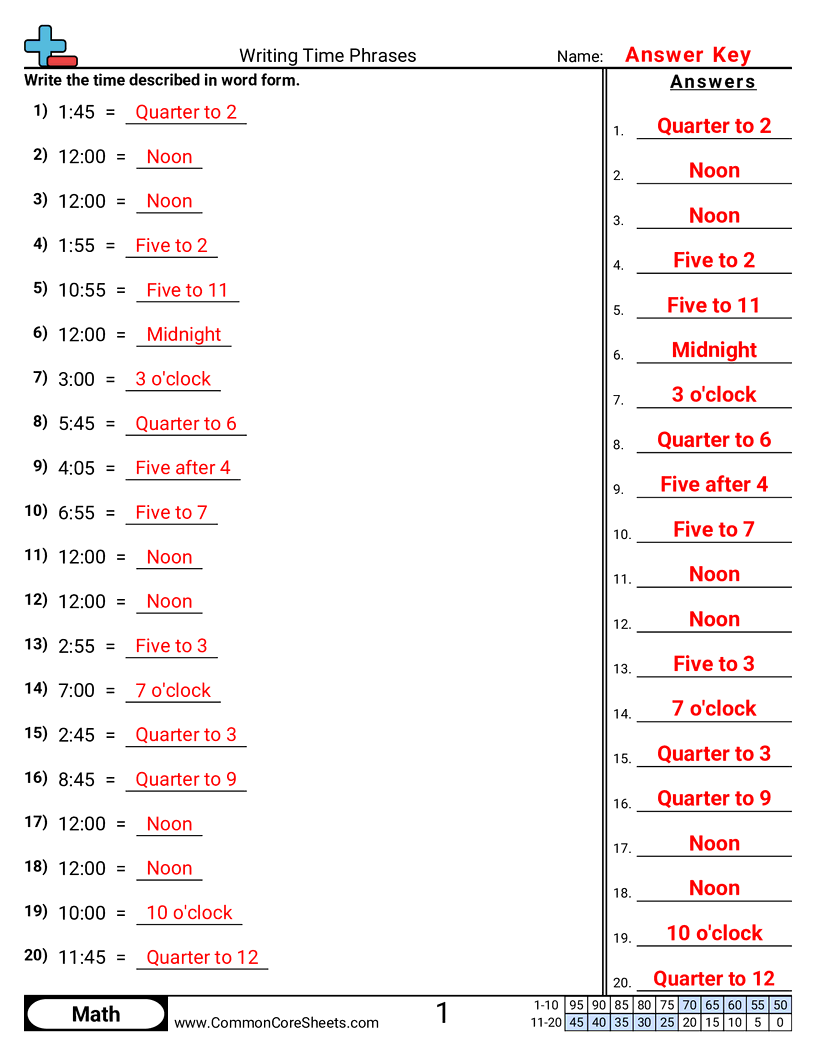
"This worksheet is designed to enhance children's understanding of time in a fun and interactive way. Focusing on math, this 'Writing Time Phrases' worksheet features 20 problems converting clock times to common phrases. The content supports distance learning and can be customized to cater to individual student needs, or converted into flashcards for more dynamic teaching approaches."
×Student Goals: Comprehend Time NotationUpon completion of this worksheet, students will have a comprehensive understanding of how to interpret different time notations. It imparts a fundamental grasp of reading both digital and analog clocks, allowing students to speak and understand the language of time effectively. The student can convert the numeric time into verbal phrases correctly and precisely. They are taught to understand and express time after any given hour which is a critical life skill.Recognition of Basic Arithmetic in timeBy tackling the problems presented in the worksheet, students will gain an elementary introduction to the application of arithmetic in the context of time, such as addition and subtraction. They will be able to identify and understand the significance of minute increments as they relate to the 60-minute structure of an hour, effectively applying concepts of addition and subtraction like 'five after 5' or 'five to 4'.Distinct Understanding of Midday and MidnightStudents will gain clarity about the distinction between midday or noon and midnight. The importance of 12 o'clock as a pivotal point in the day, dividing it into two significant halves: AM (Ante Meridiem, before midday) and PM (Post Meridiem, after midday), becomes clear to them. They will be able to confidently distinguish between noon and midnight and their places in a day's cycle.Confidence in Time CommunicationAs students solve each problem on the worksheet, they will become increasingly comfortable with time-based communication. They will develop the confidence to articulate time with clarity in day-to-day life, from scheduling appointments and activities to telling the current time. Comprehension of quarter hours will no longer be an intimidating concept as they become more familiar with 'quarter past' and 'quarter to' time expressions. This would refine the students' overall communication skills.Application of Time Management SkillsCompleting this worksheet will indirectly instill time-management concepts. As students continue to understand the relationship of time numerically and conceptually, they would become more aware of how time is spent. This awareness can fuel the early development of time managing habits, allowing students to better plan, coordinate, and value their time in future activities and tasks.