×Description:
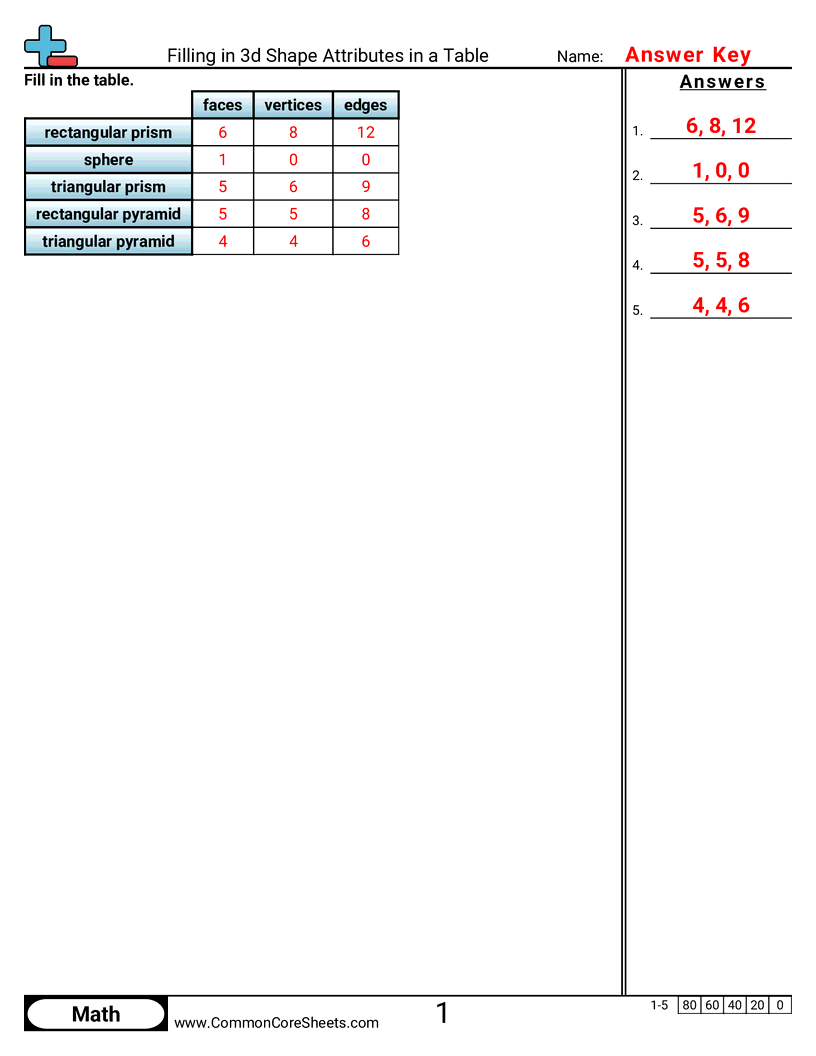
"This worksheet is designed to help children sharpen their math skills by identifying attributes of various 3D shapes, like prisms and pyramids. With five interactive problems, learners explore dimensions such as edges, vertices, and faces. Highly customizable, the worksheet offers flexibility and can be converted into flashcards for memorization. It's an ideal tool for distance learning, fostering independent study while promoting active engagement with geometric concepts."
×Student Goals: Understanding 3D ShapesAfter completing the worksheet, students should be able to identify and describe various 3D shapes including rectangular prisms, rectangular pyramids, triangular prisms, spheres, and triangular pyramids. They should become familiar with the characteristics and attributes of these different 3D shapes. This will instigate the recognition and understanding of geometric concepts in their 3-dimensional forms, which is fundamental to their mathematical learning progress.Numeracy Skills EnhancementSolving the problems in this worksheet will practice the students' numeracy skills. Counting and figuring out the numbers of faces, edges, and corners for each 3D shape will facilitate their number sense and boost arithmetic skills. It will reinforce the idea that mathematics is not just about calculation but also about understanding patterns, relationships, and properties of numbers and shapes.Developing Analytical ThinkingThis worksheet will stimulate analytical thinking among students. They will need to analyze each 3D shape's attributes and correlate them with the properties of the shape. This will not only foster their geometry understanding but also cultivate logical and analytical thinking abilities. Following this pattern, they will learn to draw valid conclusions from presented information, an invaluable skill in their academic and problem-solving pursuits.Spatial Reasoning DevelopmentStudents will develop spatial reasoning after working through this worksheet. Recognizing 3D shapes, as well as their faces, edges, and vertices, requires a certain level of spatial awareness and visualization. This mental exercise will strengthen the students' capabilities of spatial reasoning, which is beneficial for many math problems and everyday life scenarios.Promotion of Independent LearningThe worksheet encourages independent learning among students. As they fill in 3D shape attributes in a table individually, they are actually being guided to self-explore and self-learn. This enables them to become active learners who control their own learning progress. It motivates them to undertake further explorations and facilitates establishing their confidence and capabilities in autonomous learning.