×Description:
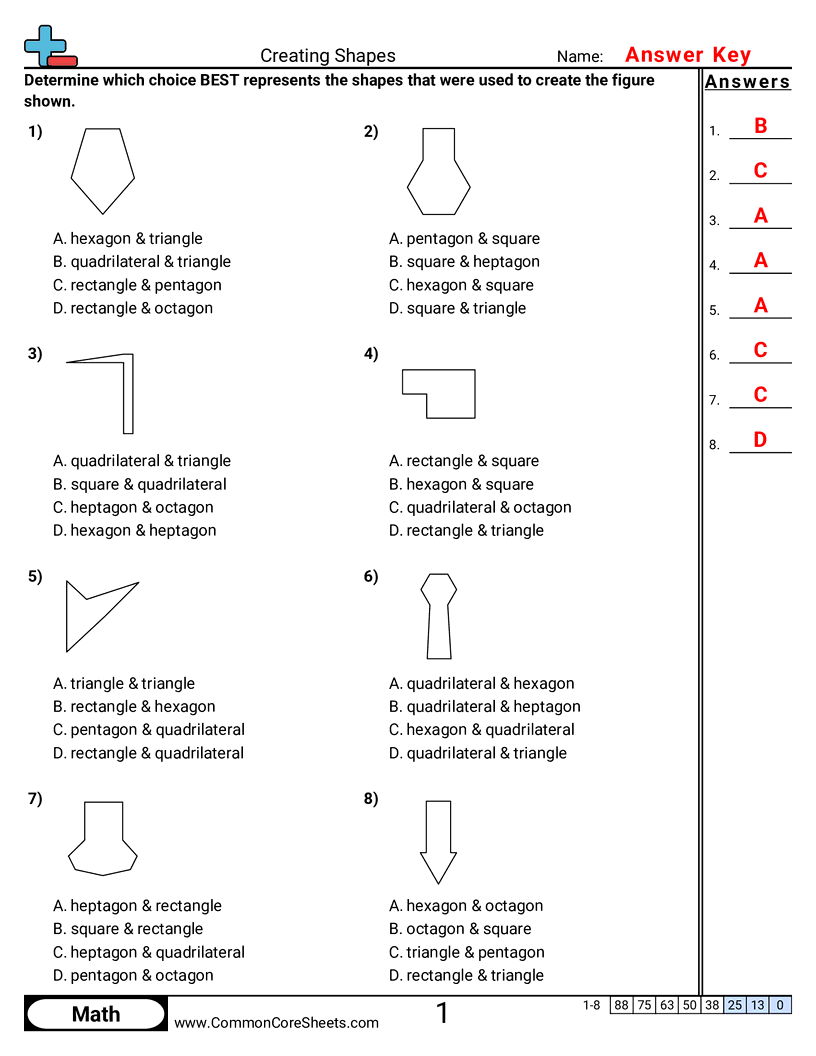
"This worksheet is designed to help children master their understanding of shapes in a fun and interactive way. With 8 math problems, each featuring a mix of different shapes like hexagon, rectangle, pentagon, etc., children are encouraged to identify and create combinations of shapes. The worksheet can be fully customized to suit every child's learning pace. It can also be conveniently converted into flash cards or incorporated into distance learning for a more engaging, kid-friendly experience."
×Student Goals: Master Different Geometric ShapesAfter completing the worksheet, students should have a mastery of various geometric shapes. They should be able to differentiate and name the common shapes such as triangles, rectangles, squares, quadrilaterals, pentagons, hexagons, heptagons, and octagons. These key concepts form the building blocks for higher geometry learning.Understand Shape AttributesStudents should be able to understand and ascertain the attributes of these geometric shapes. This includes recognising the number and types of sides, vertices, and corners each shape has. With this knowledge, students can identify a shape even if its appearance is transformed through flips, turns, or slides.Apply Knowledge to Real-World ScenariosAs students understand and learn about different shapes, they should be able to apply this knowledge to recognise these shapes in their daily life. This enhances their spatial recognition skills, a key aspect of mathematical learning. This ability to apply abstract concepts in real-world context increases their analytical thinking.Advance Mathematical ReasoningBy systematically solving the problems in this worksheet, students should have advanced their mathematical reasoning skills. They will learn how to check for correctness of their answers, a key element of critical thinking. With practice, this leads to improved mathematical intuition and accuracy in problem-solving.Enhance VocabularyCompleting this worksheet will also enhance students' mathematical vocabulary. They'll become more comfortable mentioning and discussing different shapes, aiding their comprehension skills. This is not only crucial in math, but it provides a bridge to language and communication skills too.Boost ConfidenceLastly, through consistent practice and eventual mastery of recognizing and categorizing different geometric shapes, the students' confidence in their mathematical abilities should increase. This is an essential element of math education, as confidence often leads to curiosity and long-term interest in the subject.