3oa9×Description:
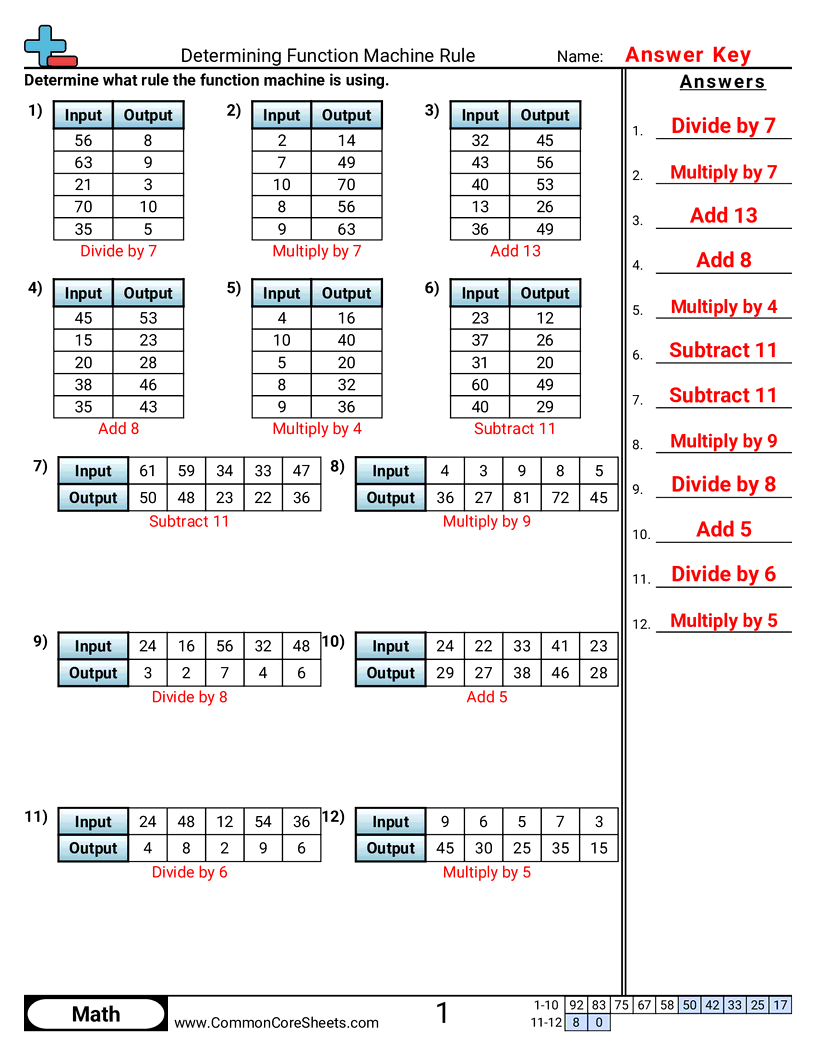
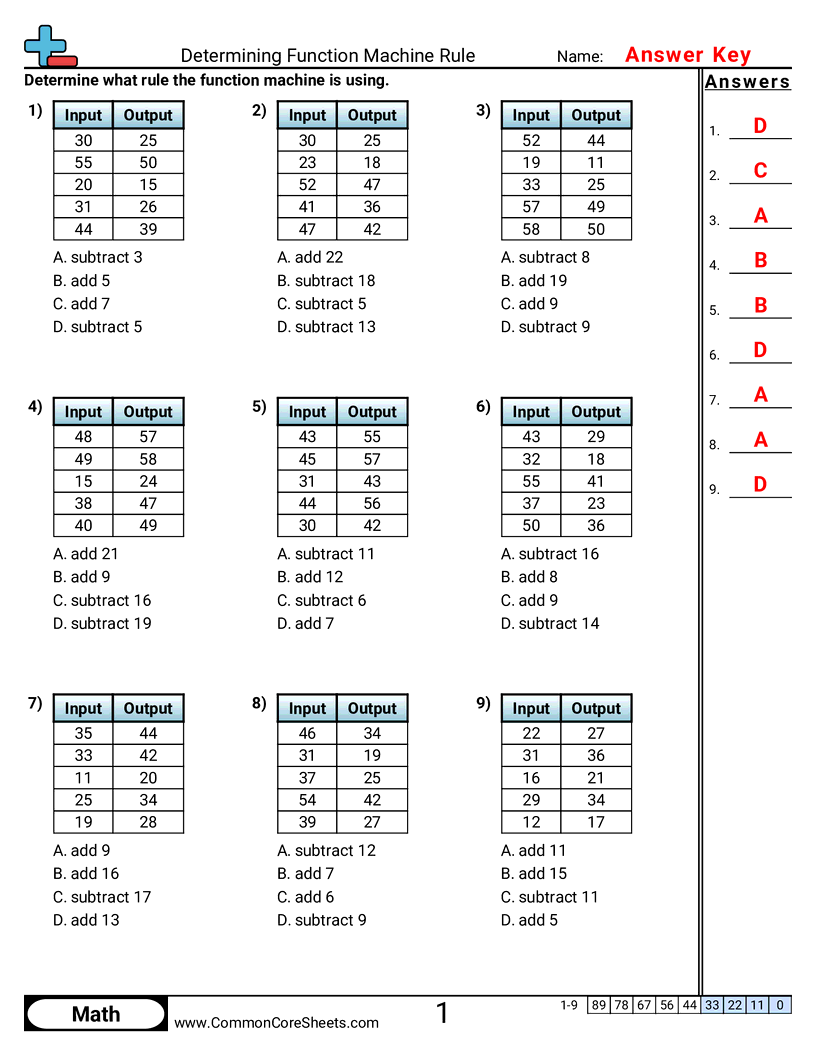
This worksheet is designed to enhance children's understanding of mathematical functions, specifically addition and subtraction rules. It provides a "Function Machine Rule" in which kids decipher the rule by observing input-output patterns. With 12 customizable problems, this educational resource can be re-purposed into flashcards or used in a distance learning setting, making math learning fun, interactive, and flexible for young learners.
×Student Goals: Understanding of basic function machinesStudents will have a clear and practical understanding of basic function machines, learning how to input values and calculate the output using the specific function rule provided such as addition or subtraction.Applying basic arithmetic operationsIn the process of identifying function rules, students would have applied basic arithmetic operations, namely addition and subtraction, thus sharpening their skills in these fundamental areas of math.Problem-solving and critical thinking skillsThis worksheet challenges students to figure out the rule in the function machines. This infers a development in their problem-solving capacities and critical thinking skills, as they observe patterns, infer rules and apply the acquired knowledge to new problems.Mathematical fluencySince the worksheet demands them to process multiple numbers and perform calculations, students would achieve higher fluency and efficiency in their arithmetic abilities pertaining to addition and subtraction. This constant feature throughout the worksheet enables students to improve speed, accuracy, and comprehension in the fundamental arithmetic operations.Understanding of mathematical functionsStudents will be able to achieve a practical knowledge of mathematical functions. They will learn the import of an independent variable (input) and how it gives rise to a dependent variable (output), fostering their understanding of interdependence in function machine problems.Preparation for advanced algebraThis worksheet serves as an ideal preliminary exposure to algebraic concepts. The knowledge and skills acquired will facilitate their learning of more advanced algebraic concepts later, such as symbolic expressions, equations, and function graphs.