6ee8×Description:
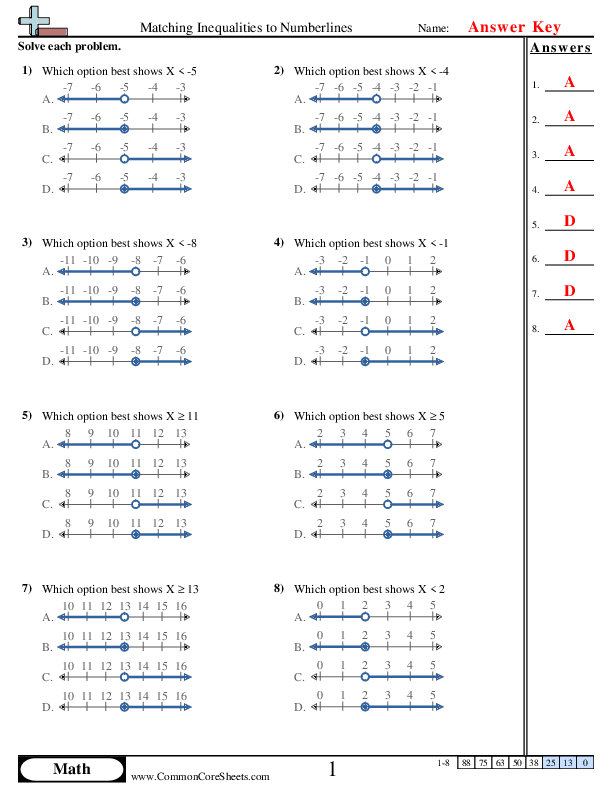
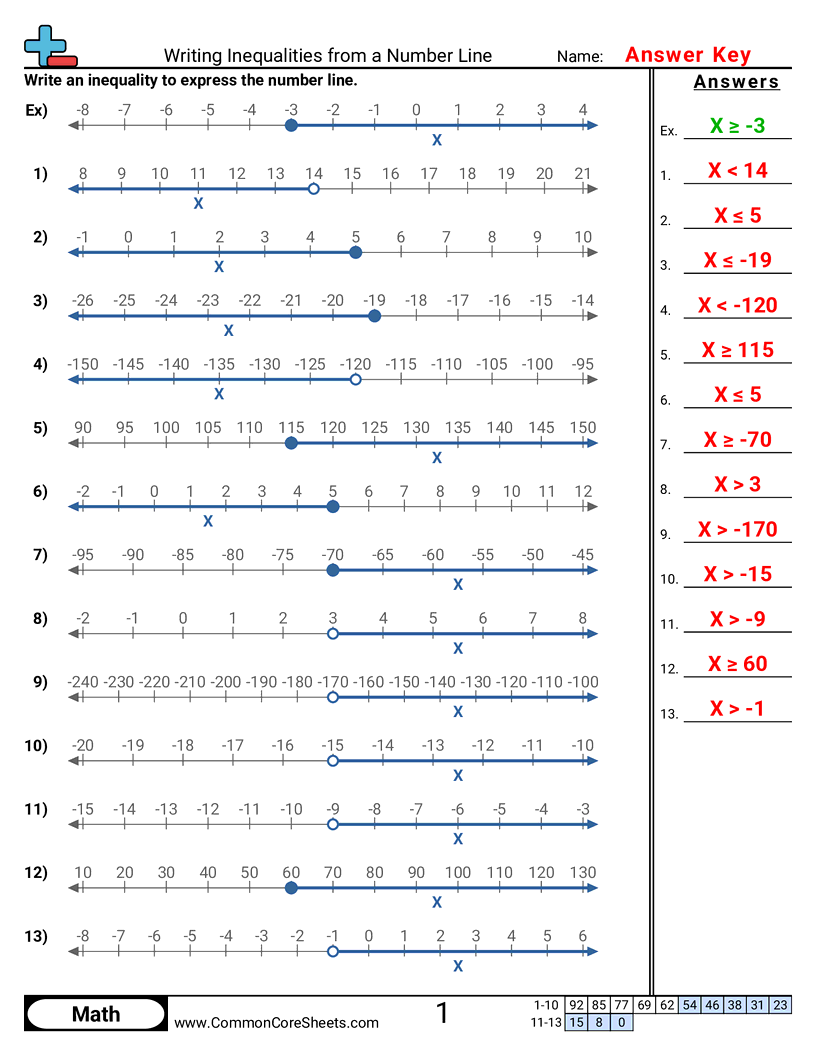
"This worksheet is designed to aid children in grasping the concept of expressing inequalities on a number line. It contains 13 problems that offer interactive visualizations, improving mathematic comprehension in a fun and engaging way. The material is adaptable, can be converted into flashcards, and is suitable for distance learning. This interactive tool serves as an effective resource to reinforce numerical understanding and mathematical logic."
×Student Goals: Understanding of InequalitiesUpon completing this worksheet, students should gain a strong grasp of inequalities. They’ll have learned how to interpret and express mathematical inequalities, which enable comparisons between distinct numbers or variables.Visualization SkillsThis task should enhance the students' ability to employ number lines for visual representation and understanding of inequalities. A number line is an effective tool to visualize and solve problems, as it spatially illustrates how inequalities function and which values correspond to the query.Problem Solving AbilitiesCompletion of these problems should reinforce their problem-solving abilities. Over time, they are likely to find these exercises more straightforward, as they increasingly understand how inequality symbols work and the corresponding solutions.Proficiency in Working with Different Number SetsThrough this worksheet, students should become more proficient in working with different number sets. They will get the experience of dealing with positive numbers, negative numbers, and zero, enhancing their versatility and adaptability in tackling various number types.Building Blocks for Advanced TopicsMastering inequalities and their representation on a number line is a foundational concept in math. It shall act as a building block for more advanced topics students will encounter later, such as graph theory, complex numbers, and functional analysis.Understanding Real World ApplicationsWhile solving the worksheet, learners will unconsciously apply real-world situations that require understanding of inequalities such as time planning, budgeting, and resource allocation. These can be beneficial in cultivating their practical decision-making skills, enhancing their grasp of the subject beyond the academic context.Confidence BoostEach completed problem would add to their confidence as they conquer each inequality. Success with mathematical problems significantly contributes to the confidence of the students. This, in turn, motivates them to face new challenges, in mathematics as well as in other fields of study.Critical ThinkingStudents will engage their critical thinking skills to solve problems. The exercise encourages learners to think logically, analyse the given condition correctly, and decide on the inequality symbol that should be used.