8ee5×Description:
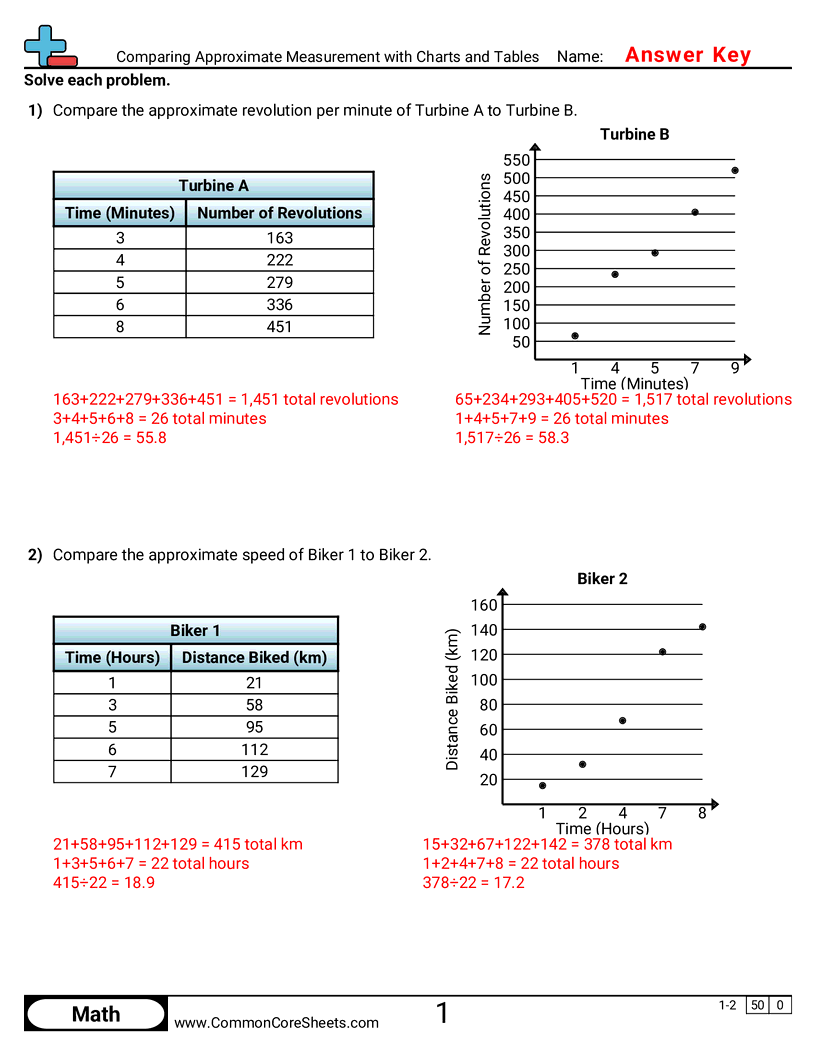
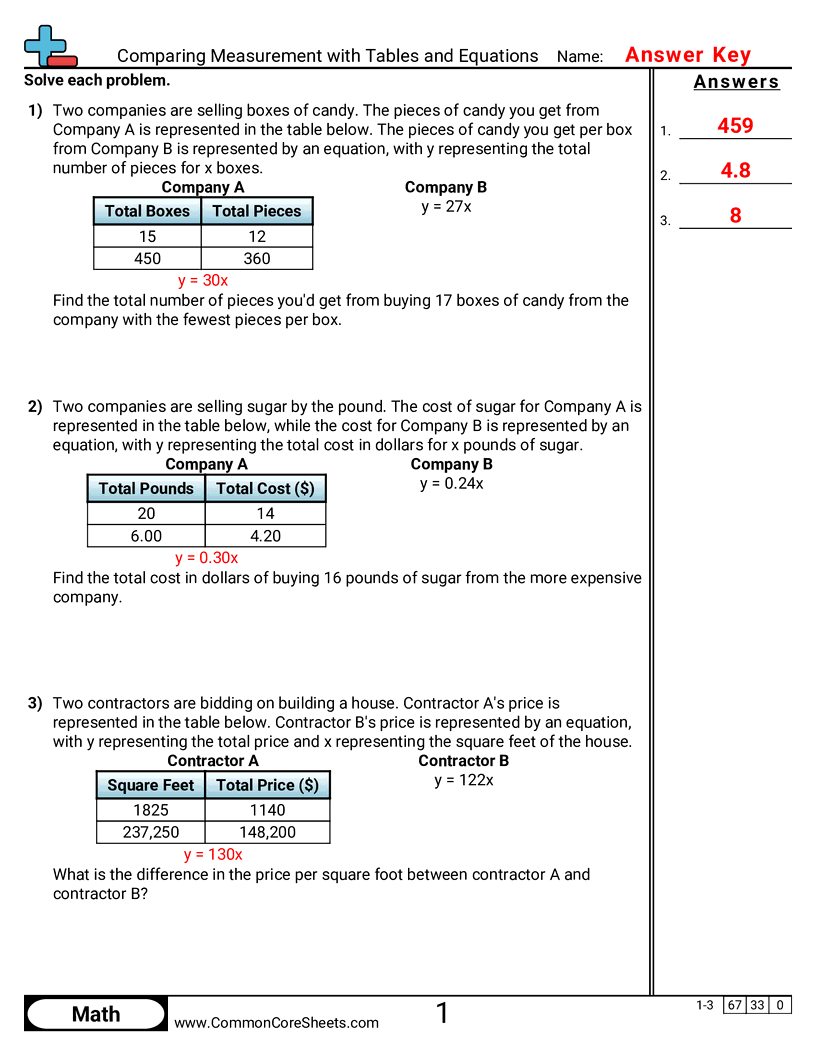
"This worksheet is designed to enhance children's math skills, specifically in comparing approximate measurements using charts and tables. It presents problems related to real-world situations such as comparing paper usage in schools and boat speeds. The interactive worksheet can be customized according to individual learning needs, converted into flash cards, or utilized as an effective tool for distance learning. It's a perfect tool for promoting the practical application of mathematical concepts."
×Student Goals: Understanding of Approximate MeasurementsStudents should have a clear grasp of how to interpret and compare approximate measurements. They should be confident in using charts and tables to understand data before making comparisons. They should also be able to comprehend what approximate measurements are and how they are used in various real-world scenarios, such as calculating the revolutions per minute of turbines or the liters of juice that can be produced from a certain number of orange crates. This will foster their quantitative reasoning skills as well as their ability to apply such reasoning in diverse contexts.Mathematical Computation SkillsUpon completing the worksheet, students should demonstrate improved skills in the realm of mathematical computations, particularly with respect to operations involving addition and division. They should be adept at summing series of numbers and calculating averages which are fundamental aspects of the problems in the worksheet. These vital arithmetic skills are applicable in a plethora of academic and real-world situations, bolstering their overall mathematical competency.Problem Solving and Analytical SkillsStudents should have honed their problem-solving and analytical skills after working through the problems on this worksheet. They should show the ability to decipher the problem, assimilate the information given, perform necessary calculations, and draw accurate comparisons. This would not only improve their adeptness at tackling complex mathematical problems but also enhance their analytical thinking and decision-making skills in broader contexts.Data Interpretation and Comparison SkillsAfter completion of the worksheet, students should be proficient at interpreting and comparing data from charts and tables. They should be able to extract important information from such sources of data, manipulate it to make meaningful computations and ultimately, draw valid conclusions or comparisons from their findings. This would lead to better comprehension of data and its uses in various aspects of life and studies.Conceptual Understanding and ApplicationLastly, students should gain a depth of conceptual understanding that goes beyond simply performing computations. They should understand why they are performing certain operations and how these operations relate to the real-world scenarios being explored in the problems. Furthermore, they should be able to take these concepts and apply them to new, unfamiliar problems, demonstrating a firm and flexible grasp of the subject matter.