4nf4b×Description:
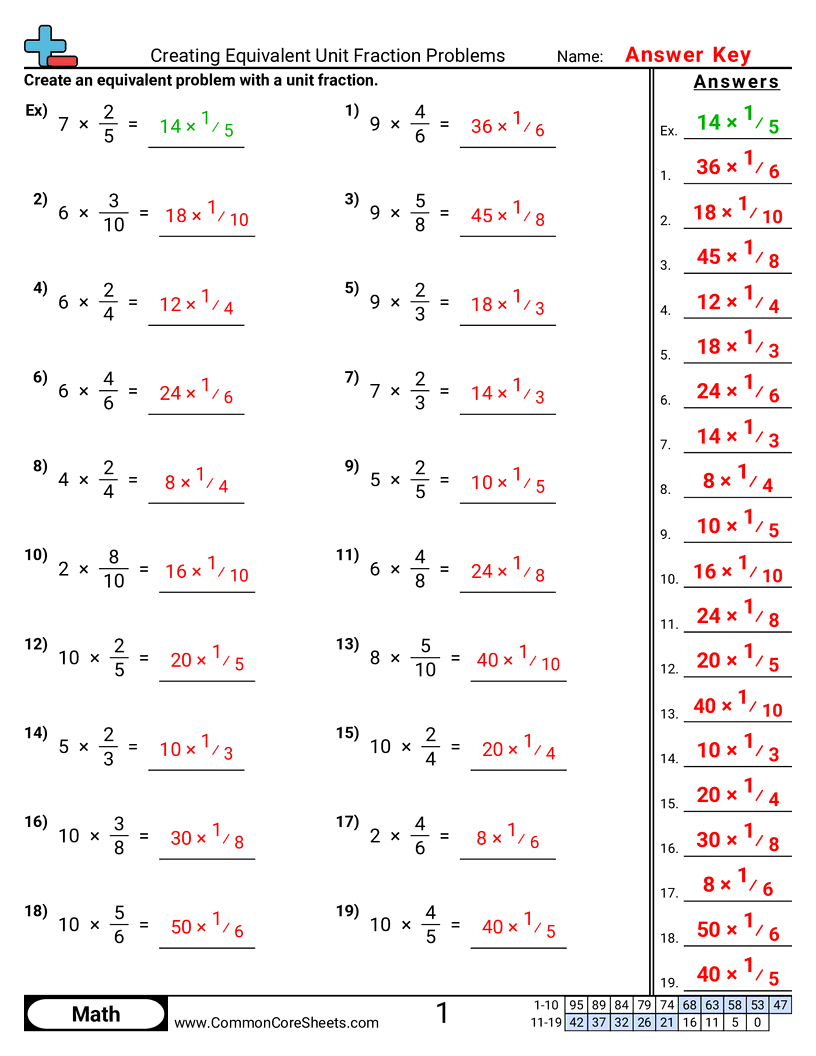
"This worksheet is designed to enhance children's understanding of equivalent unit fractions in mathematics. It includes 20 problems, providing examples of multiplication with fractions to produce equivalent unit fractions. The dynamic and adaptable format allows it to be customized according to individual learning needs: it can be transformed into flashcards for easy revision or seamlessly integrated into distance learning modules. A practical and versatile tool for reinforcing key mathematical concepts."
×Student Goals: Understanding of Unit FractionsStudents will gain a solid understanding of unit fractions. They will be able to define what a unit fraction is and identify it when it is presented in a mathematical problem.Mathematical Operations with Unit FractionsAfter completing the worksheet, students would have practiced various mathematical operations involving unit fractions. They will be adept at multiplying whole numbers with unit fractions and simplify the results. They will also be proficient in expressing product of whole numbers and fractions as a product of a whole number and a unit fraction using properties of operations.Problem Solving SkillsThe worksheet will improve students' problem-solving skills, making them confident to tackle similar problems on their own. By applying their knowledge of unit fractions to a set of unique mathematical problems, they will develop the ability to implement appropriate solving strategies.Accuracy and PrecisionBy engaging with 20 unique unit fraction problems, students will improve their accuracy and precision in their mathematical work. The repetitive practice will enhance their ability to calculate correctly, minimizing any mistakes.Readiness for Advanced Math ConceptsUpon completion of the worksheet, students will be ready to take on more advanced mathematical concepts. The foundation built through understanding and applying unit fractions will be helpful in understanding more complex ideas such as higher-level fractions, decimals, ratios and percentages.Increased Mathematical ConfidenceOnce students have successfully solved all 20 problems, their confidence in their own mathematical abilities would have significantly improved. This confidence can encourage a positive attitude towards math, reducing any related anxiety and enhancing overall academic performance.