7g5×Description:
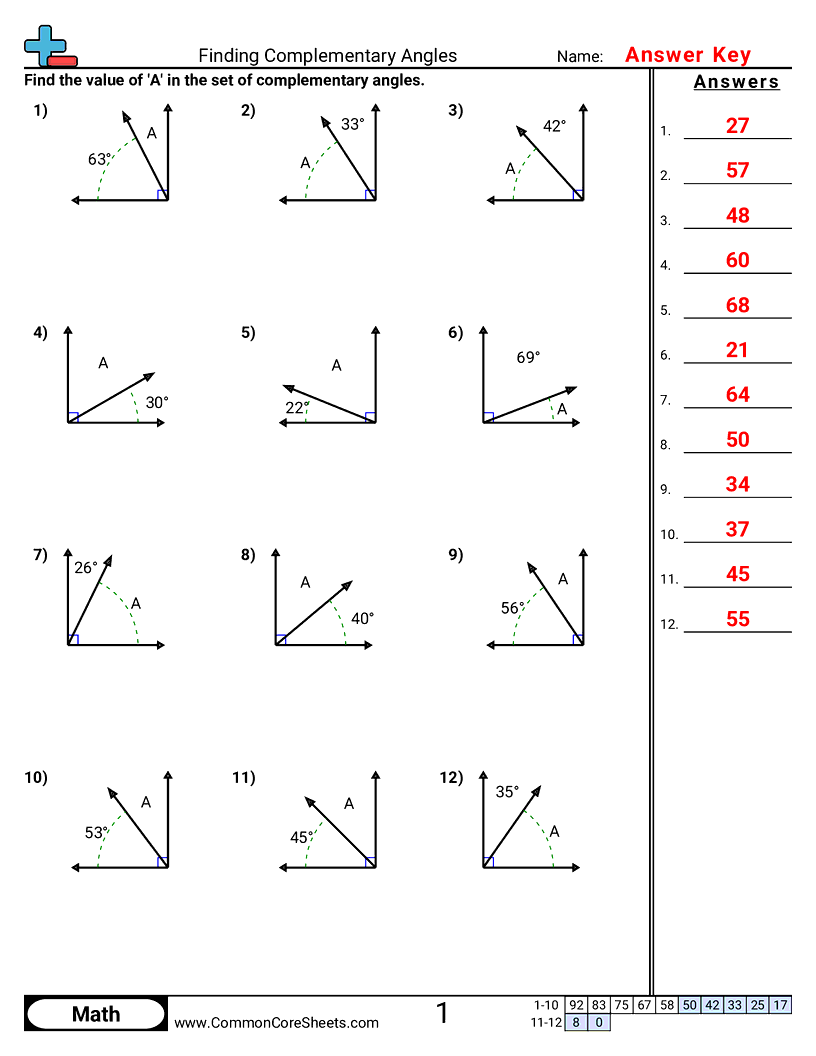
"This worksheet is designed to aid children's understanding of complementary angles in math. Using interactive, visual problems, it provides 12 examples of various angles and require learners to find the complementary pairs. This dynamic learning tool can readily be customized to the learner's needs, converted into flashcards for facilitated memorization, or incorporated into distance learning programs. A worthwhile investment in foundational mathematics education."
×Student Goals: Mastery of Complementary Angles ConceptUpon completing the worksheet, students should have perfected their understanding of complementary angles. They will have reinforced the mathematical theory that complementary angles total to 90 degrees. This foundational concept in geometry will support their understanding of more complex geometric theories in future lessons.Problem-Solving SkillsThrough twelve diverse problems, learners will have honed their problem-solving skills. Rather than simply memorizing facts or formulas, they will have actively applied their knowledge, which increases both understanding and retention. Problem-solving is a necessary life skill that supports success in academics and beyond, making this an extremely valuable outcome of the worksheet.Accuracy and PrecisionLearners who successfully complete the worksheet will ameliorate their numerical accuracy and precision. Since many problems involve determining the precise degree measurement of the complementary angle, students have to deliver exact answers, promoting meticulousness, precision, and a focus on detail.Growth in ConfidenceWith every problem solved on the worksheet, the student's confidence in handling angles will surge. Confidence in one's abilities not only promotes increased enjoyment of a subject but also opens the door to effective self-guided learning, as students feel bolstered to challenge themselves with increasingly complex problems.Autonomous LearningAfter mastering the concept of complementary angles through this worksheet, students will be better prepared for independent or autonomous learning. With a solid understanding of complementary angles, they will have the base necessary to explore related concepts such as supplementary angles or transversals independently.Improved Mathematical VocabularyStudents will also expand their mathematical vocabulary upon completing the worksheet. They will grow comfortable using terms like 'angle', 'degree', and 'complementary', helping them communicate mathematical concepts more effectively.Increased Mathematical IntellectThe completion of this worksheet aids in the overall growth of the student's mathematical intellect. Complementary angles are a foundational concept in geometry, and understanding them can facilitate the learning of other advanced mathematical concepts and ideas in the future.