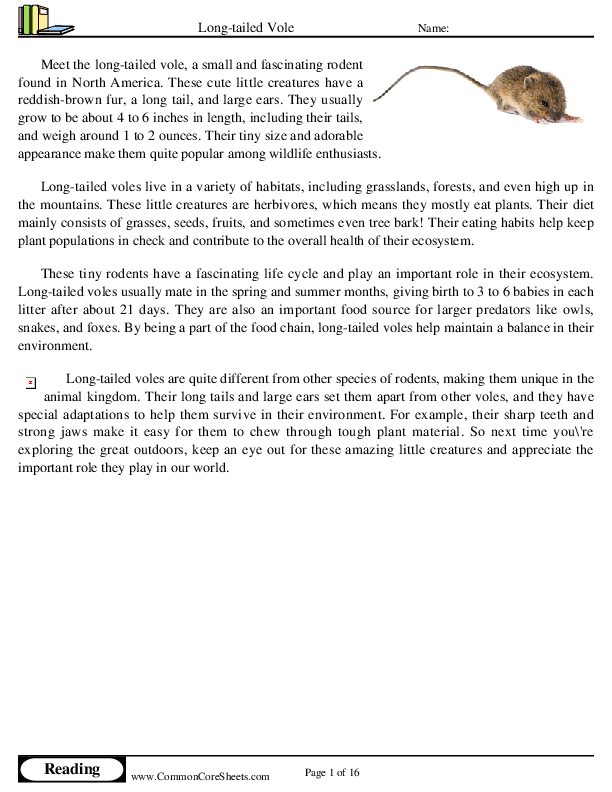
Long-tailed Vole Worksheet Download
Free reading worksheets on Long-tailed Vole. Each worksheet has 20 problems with an answer key and are ideal for teachers and homeschooling. You can download the PDF, create a set of flash cards or set it up for online learning.
Select a Different Activity
>
Sheet Information >
Available at 2nd grade, 3rd grade, 4th grade, 5th grade and 6th grade reading levels.
Read the passage
Meet the long-tailed vole, a small and furry creature that is just as interesting as it is adorable. These little animals are part of the rodent family and can be found in the forests and grasslands of North America. With their long tails, small round ears, and dark brown fur, they are quite different from their mouse and rat cousins.
One really cool thing about long-tailed voles is their diet, as they love to munch on all kinds of plants. They are known to eat grass, seeds, and even tree bark, which makes them important for keeping the plant populations in check. Their role in the ecosystem also benefits other animals, as they are a delicious meal for predators like hawks, owls, and snakes.
Long-tailed voles have a special way of living and growing up. They usually have two to four litters of babies each year, with each litter having about four to six cute little baby voles. Although they don\'t have a close relationship with humans, they can sometimes be found living near our homes and gardens, but don\'t worry, they\'re more interested in plants than anything else.
Let\'s learn about the fascinating long-tailed vole! These cute little creatures are a type of rodent, similar to mice and rats, but with a more elongated body and a longer tail. They are mostly found in North America, living in a variety of habitats like forests, grasslands, and wetlands. They love to munch on grass, seeds, and even insects, making them omnivores.
Now, let\'s dive into the life cycle of the long-tailed vole! These voles usually live for about a year, and during that time, they can have several litters of babies. They build nests in underground burrows or under logs and rocks, where they give birth to their tiny, blind, and hairless babies. As the babies grow, they develop fur, open their eyes, and eventually venture out of the nest to start their own families.
Lastly, let\'s explore the relationships of long-tailed voles with humans and other animals. Although they don\'t directly interact with humans, they can be beneficial by consuming insects and spreading seeds in their habitats. However, they also have natural predators, such as birds of prey, snakes, and larger mammals, who rely on them as a food source. The long-tailed vole is just one of many vole species, but its unique features and behaviors make it stand out from the rest.
And that\'s a wrap on our journey into the world of the long-tailed vole! Remember, these tiny creatures play an important role in their ecosystems and are unique in their own special way.
Get ready to meet a fascinating creature, the long-tailed vole! This little furball is about the size of your hand, with a tail longer than its body, hence the name, long-tailed vole. It's covered in soft, brown fur, with tiny ears peeking out from its head, and bright, watchful eyes. On their little feet, you'll find sharp, tiny claws that help them to dig and climb.
Speaking of digging, did you know that long-tailed voles are also known as little architects of the animal kingdom? They make their homes, called burrows, in the ground of the forests and grasslands of North America. These cozy burrows are not only their homes, but also their safe spots from predators like hawks, owls, and weasels. Wow, it sure sounds like they lead busy lives in their homes, doesn't it?
Well, when they aren't busy building, they're usually out foraging for food. Their diet mainly consists of green vegetation, seeds, and occasionally small insects. They're pretty important to the ecosystem, as they help in the decomposition of organic material and plant dispersal. But don't worry, they're not pests! In fact, they don't have any significant negative impact on human activities.
While we humans may not interact much with these voles, they certainly play a crucial role in the food chain. They're a vital source of food for many of the larger animals and help to control the population of insects and plants by eating them. And guess what? Unlike many other animals, the female voles are the ones who establish and defend the territory! So, remember, every creature, no matter how small, has its own important role in our big, beautiful world.
Meet the long-tailed vole, a small and fascinating furry creature that loves to munch on plants and seeds. These little critters have a long tail, as you might have guessed from their name, which can be up to 40% of their total body length. With their round ears and whiskers, they can be quite adorable at times. Let\'s dive into the world of the long-tailed vole and learn all about their diet, habitat, and more.
The long-tailed vole has a diet that mostly consists of plants, seeds, and occasionally insects. These herbivores love to munch on grasses, leaves, and even tree bark when they get the chance. Their flexible diet allows them to adapt to different environments and find food in various locations. Long-tailed voles have an important role in the ecosystem as they help spread seeds and provide food for predators.
These voles can be found in a variety of habitats in North America, from forests to grasslands. They are more commonly found in areas with plenty of vegetation and moisture, which provide them with ample hiding spots and food sources. These little creatures are excellent burrowers and create complex tunnel systems for protection and to raise their young. Their homes are usually built close to water sources, which they need to survive.
The life cycle of a long-tailed vole is quite interesting. The female voles give birth to several litters each year, with each litter consisting of 3-6 babies, called pups. The pups are born blind, hairless, and completely dependent on their mother for the first few weeks of their lives. As they grow, the pups will learn how to find food, avoid predators, and eventually start families of their own.
Long-tailed voles may be small, but they have a big impact on both humans and other animals. These voles are important prey for many predators, such as owls, hawks, and foxes. They also help control insect populations by eating some of the pesky bugs that bother us. One difference between long-tailed voles and other vole species is their longer tail which, as mentioned earlier, can be up to 40% of their body length.
Now that we\'ve explored the world of the long-tailed vole, you can see just how fascinating these small creatures are. From their diet and habitat to their life cycle and impact on the environment, the long-tailed vole is an important part of our ecosystem.
Let\'s learn about the fascinating long-tailed vole, a small, furry creature that lives in North America. These little mammals have dark brown fur with a white or gray belly, and as you can guess from their name, they have a long tail! Their small size, about 5 to 7 inches, makes them perfect for living in the wild and hiding from predators. Long-tailed voles are part of the rodent family, which means they are related to mice, rats, and squirrels. Their large eyes and small ears make them quite adorable and unique among other rodents.
Now that we know what they look like, let\'s find out where these cute creatures live. Long-tailed voles can be found in North America, particularly in the western region of the United States and Canada. They prefer to make their homes in moist meadows, grassy areas, and forests. These little mammals love to dig burrows and create tunnels in the ground, which provides them with shelter. Their adaptable nature allows them to survive in a variety of environments, from sea level to high up in the mountains.
Like all animals, long-tailed voles have specific things they like to eat. Their diet consists mainly of plants, such as grasses, seeds, and fruits. Occasionally, they will also eat insects and other small animals. Since they are herbivores, their sharp teeth are perfect for chewing through tough plant materials. Long-tailed voles are important for the environment, as they help spread seeds and promote plant growth.
Long-tailed voles have some interesting interactions with humans and other animals. While they may not be kept as pets, they are important for scientific research, especially in the study of population cycles. In the wild, these voles have many predators, including birds of prey, snakes, and larger mammals like foxes and weasels. To protect themselves, long-tailed voles use their agility and speed to escape danger quickly. They also rely on their keen sense of smell and hearing to detect potential threats.
Lastly, let\'s explore some unique facts and differences between long-tailed voles and other species. One key difference is the length of their tail, which is longer than most other vole species. Long-tailed voles are known for their high reproductive rates, giving birth to several litters a year with an average of 5 to 6 pups per litter. Their short life expectancy, around 6 months to a year, means that they must reproduce quickly to maintain their population. These fascinating creatures play an important role in the ecosystem by providing food for predators and helping maintain plant life.
About this worksheet
Students read an informational passage about the long-tailed vole and answer comprehension questions about its habitat, diet, and behavior.
This worksheet is designed to engage children in learning about the Long-tailed Vole through 20 distinct reading problems. It skyrockets their understanding on the vole's physical characteristics, dietary habits, predators, habitat, and ecological role. Customizable for personalized learning, it can be transformed into flashcards or adapted for distance learning, making it versatile for various teaching methods.
Student objectives
- Read a nonfiction passage about an animal and understand the main ideas
- Find specific facts about the vole's habitat and diet in the text
- Answer questions using details from what you read
- Learn new vocabulary words connected to animals and nature
Everyday practice
- Read a sign at a zoo or nature center and explain what an animal eats
- Look up facts about an animal you saw outside and tell someone about it
- Answer questions after reading an article in a kids' nature magazine
- Describe where a wild animal lives after reading about it