1md3×Description:
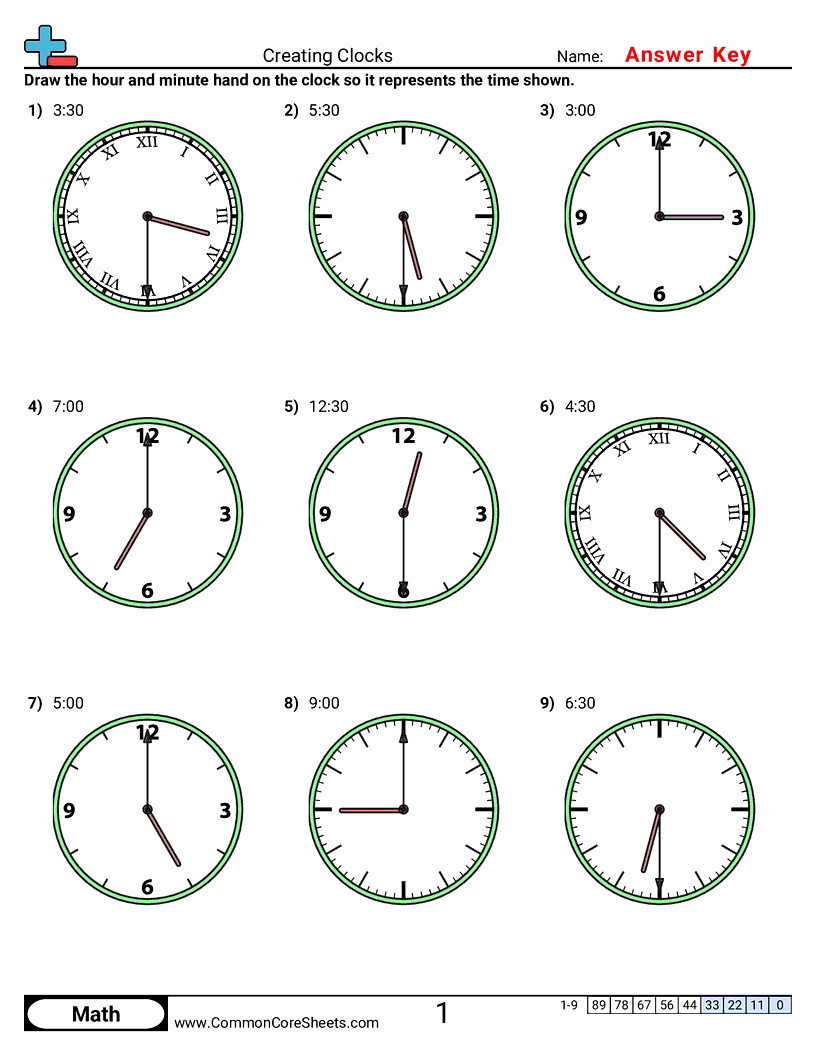
"This worksheet is designed to help children master the concept of time through the engaging activity of creating clocks. It includes 9 math problems that each present a different time of day. The worksheet offers flexibility for all learning styles and environments—it can be customized to meet individual student needs, converted into flash cards for hands-on learning, or used in distance learning scenarios. An excellent resource for developing essential math skills in a fun, intuitive way."
×Student Goals: Understanding Clock FacesAfter completing the worksheet, students should acquire a clear understanding of how traditional clock faces work. Familiarity with the relationship between the short and long arms of the clock and how they denote hours and minutes will allow for error-free interpretation of the time. Through visual recognition of the difference between half-past and o’clock times, they can better understand the concept of time passage.Building Time Telling SkillsAdeptness in telling time on both analog and digital clocks is an essential milestone in children's mathematical learning. By completing the problems provided, they should develop a proficiency in translating time from paper to an actual clock. With improved skill levels, students should not only tell time accurately but also be able to make reasonable estimates about the duration of various events and activities.Enhancing Problem-Solving CapabilitiesUnderstanding the placement and movement of the clock hands enhances children's problem-solving ability. When given a specific time, they should be able to determine the position of each hand on the clock independently. These exercises train children's minds to think logically and solve problems, skills that generalize beyond this specific task.Developing Time Management AwarenessBeing able to tell time accurately is the first step to developing beneficial skills such as time management. As students understand time's passage, they also become aware of life's rhythms and the need for planning and scheduling. Upon completion, students should demonstrate an emerging appreciation for timely task completion.Boosting Math ConfidenceSuccessfully solving time-related problems boost students' confidence in their mathematical abilities. Each correct answer they arrive at, fosters a can-do attitude towards math and instills belief in their quantitative skills. This practice work should help them transition from guided support to independent problem solving in various mathematical contexts, hence encouraging continuous mathematical exploration.