×Description:
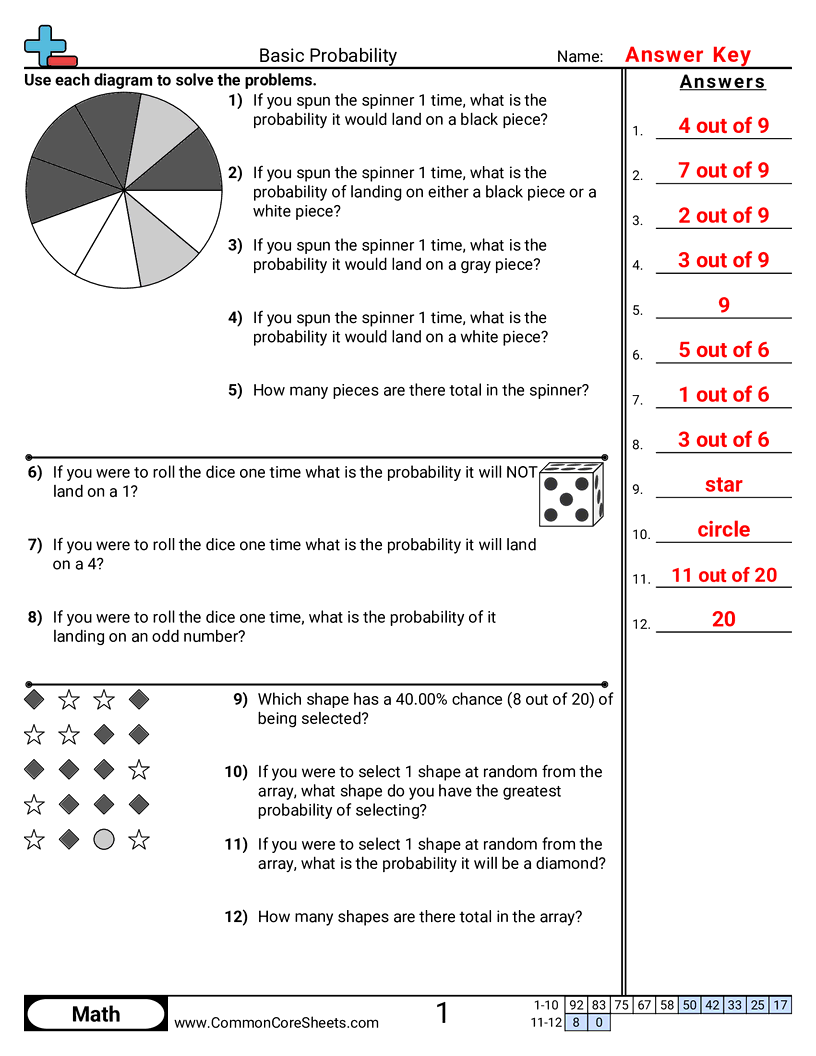
"This worksheet is designed to introduce children to the concept of basic probability through practical examples leveraging dice and spinners. It comprises 12 engaging and thought-provoking math problems, teaching them about odds, event likelihood, and random selection. The worksheet is versatile in its application, allowing for customization, conversion into flashcards, and perfect for distance learning environments, making math interactive and fun."
×Student Goals: Understanding the Concept of ProbabilityAfter completing this worksheet, students should have a fundamental grasp of the basic principles of probability. They'll understand how it's calculated and be introduced to various scenarios of its application. This will aid in honing logical reasoning and critical thinking skills, critical in not just math but also different facets of daily life.Practical Applications of ProbabilityThe students will learn to interpret and make assumptions based on probabilities. They are provided with real-world examples, such as rolling a dice or selecting a random shape, to understand the practical applicability of the concept. This will also boost their decision-making ability as they will understand the odds better.Interpreting Data and Making PredictionsThe students will also gain the ability to interpret data and make predictions based on the understanding of probability. They will understand that math isn't just about numbers but is also about interpreting these numbers and applying them to predict outcomes. This will enhance their data interpretation skills immensely.Enhanced Problem-Solving SkillsWorking through the various problems in the worksheet will improve the students' problem-solving skills. They will learn to address problems systematically, categorize data, implement probability, and solve for the outcome. This practice will enhance their analytical skills, which are important in every field of study.Knowledge Retention and Continual LearningCompleting this worksheet on Basic Probability, students will be setting a strong foot in the field of probability, a topic that spans over various grade levels in Math. The designed problems will ensure the retention of learned concepts while sparking curiosity for continual learning.