4md1×Description:
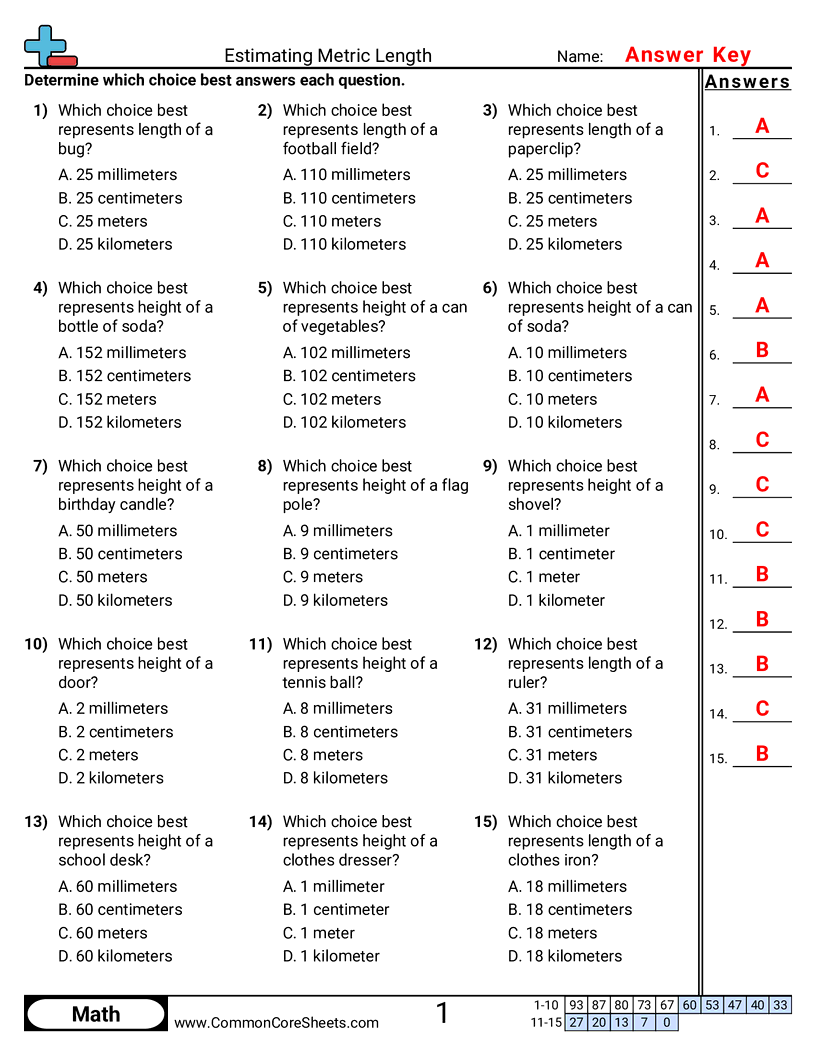
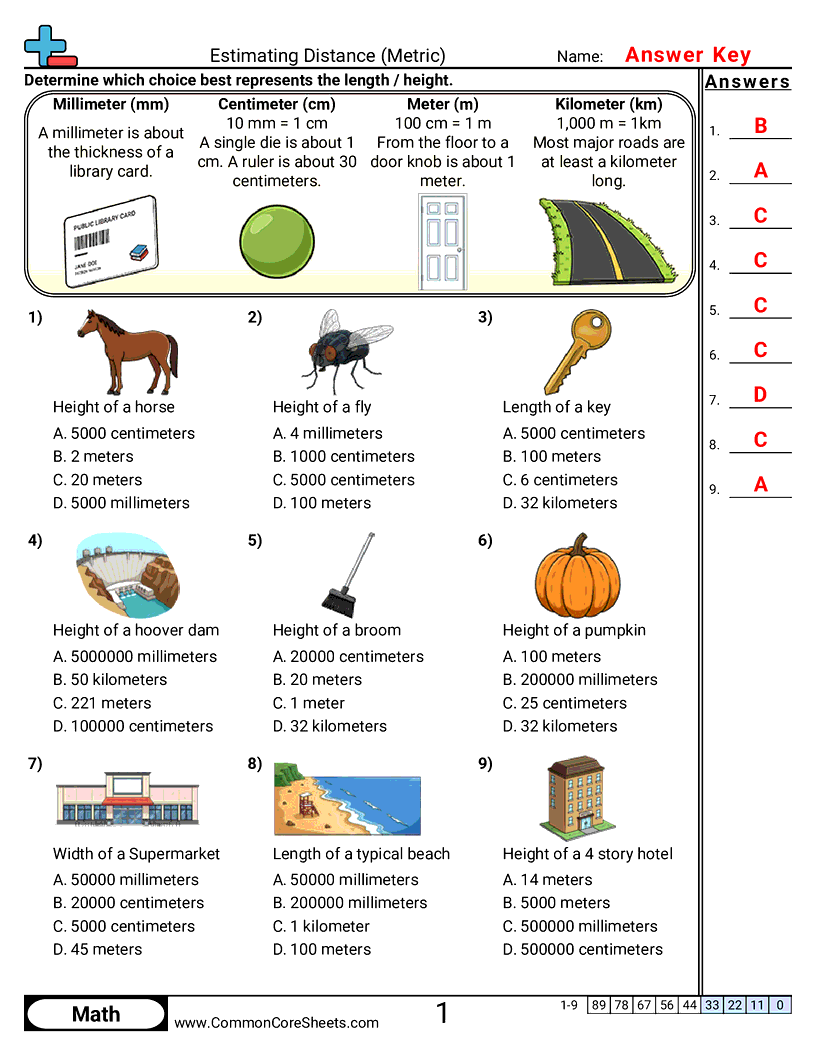
"This worksheet is designed to help children practice estimation of metric lengths. It offers 15 mathematical problems dealing with real-world objects, varying from daily household items to larger landscapes, to improve the grasp of metric units. This versatile aid can be customized based on a learner's level, transformed into flashcards for revision, or incorporated into distance learning curriculums to effectively and engagingly teach metric length estimation."
×Student Goals: Understanding of Metric UnitsAfter completing the worksheet, students should have gained a clear understanding of various metric units of length such as millimeters, centimeters, meters, and kilometers. They will also comprehend how these units relate to real-world objects, enhancing their understanding of metric scales.Problem Solving SkillsThe worksheet aims to enhance critical thinking and problem-solving skills in a student. As they navigate through the problems, they are encouraged to make logical decisions on what metric units best represent the given objects—thus, equipping them with fundamental problem-solving abilities.Practical Application of Math ConceptsPost worksheet completion, students should be able to apply the mathematical concepts learned in practical scenarios. They will be equipped to estimate and measure lengths of various objects around them accurately using the correct metric units.Conceptual KnowledgeStudents will also assimilate conceptual knowledge about the size and scale of everyday items, which will be beneficial not only in their mathematical journey but also in general cognitive development. They will understand the typical length of objects, their comparison, and get a sense of spatial awareness.Improved Estimation SkillsThe worksheet is designed to help students significantly improve their estimation skills. By solving problems that involve estimating the length of various items, students will develop a better sense of judgment. They will learn to make accurate estimates, a skill that is essential in many areas of life beyond math.Strengthens Logical ReasoningUpon completion, students should exhibit improved mental agility and logical reasoning. Probing the metric length of everyday objects and comparing choices demands regular practice for cognitive development, which in turn strengthens their logical reasoning skills.Confidence in Handling MeasurementsStudents will attain familiarity and confidence in dealing with measurements in their day-to-day encounter. By linking realistic objects to measurements, theoretical concepts of metrics and measurements become more approachable and less abstract.